Scott Sine/Park Record
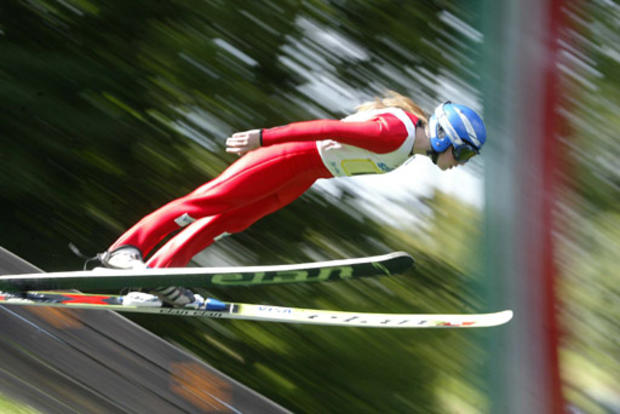
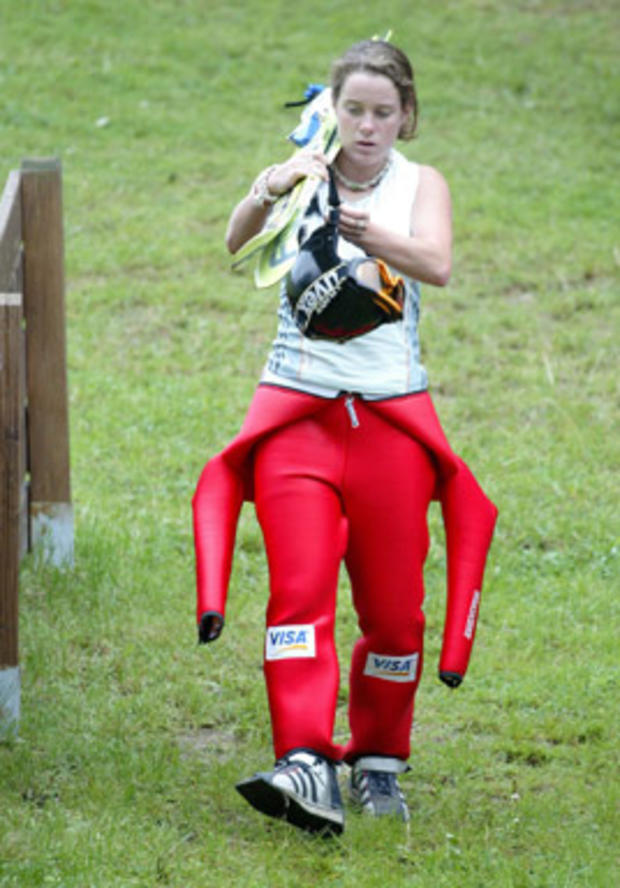
Meet Lindsay Van. Ranked second in the world amongst women ski jumpers, Lindsay also regularly beats the men she is forced to compete against.
However, when the men go to the 2006 Olympics in Torino, the women are not welcome. Van and other U.S. ski jumpers have their sights set on inclusion on the 2010 Olympics. But first they need to prove to the International Ski Federation that they're good enough.
Scott Sine/Park Record
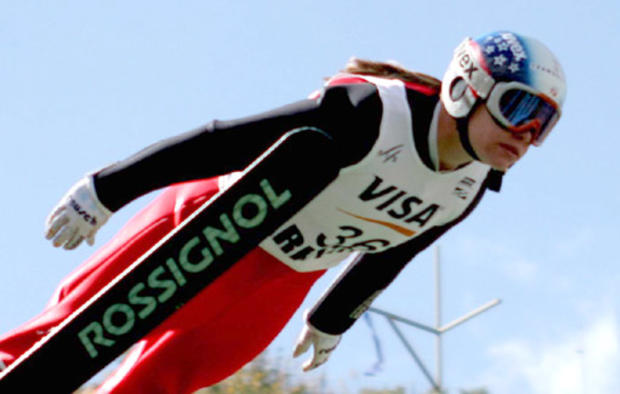
Abby Hughes, 16, is the youngest world-class women's ski jumper in the United States.
Here, she jumps the k-90 hill in Meinerzhagen, Germany, in 2005. She other member of her Park City, Utah, based club team (comprised of both men and women) also practice and compete on 120-meter jumps.
Scott Sine/Park Record
Twenty-one year old Lindsay Van is a University of Utah sophomore. While school is important to Lindsay, jumping sometimes trumps it.
Lindsay is taking this spring semester off from college in order to compete in a long series of international ski jumping competitions. "I'm pretty much on the six-year plan" to finish college, Van said.
Scott Sine/Park Record
Traveling to European competitions is no vacation. The top five U.S. women's ski jumpers operate in a non-profit club, so they spend long hours on busses and in youth hostels throughout Europe. Once they camped on the floor of a barn.
Former Olympic medalist Casey Colby coaches these women out of Park City, Utah. Lindsay Van is pictured in the foreground.
Scott Sine/Park Record
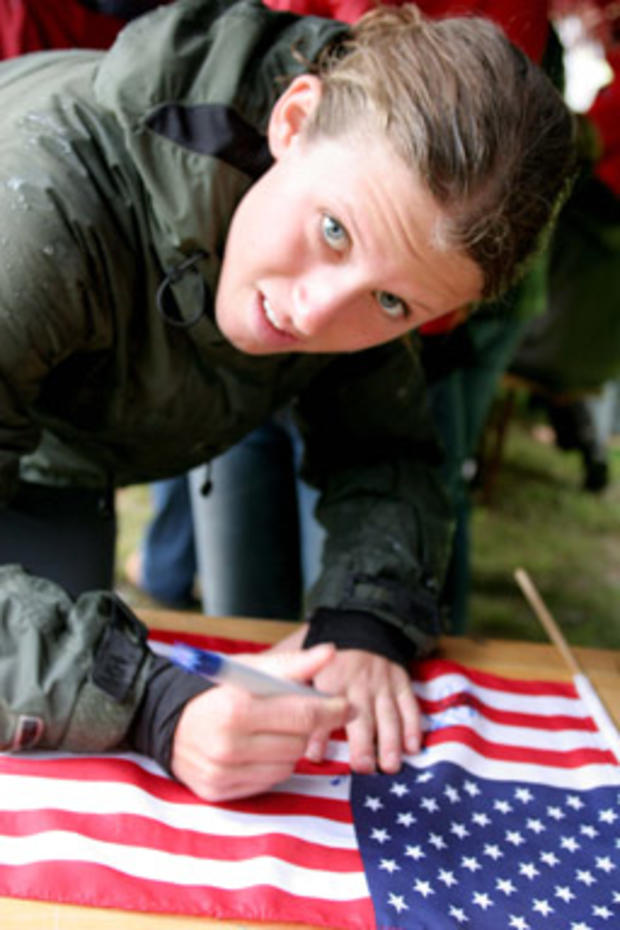
Alissa Johnson comes from a family of ski bunnies, but she and her brother have stepped the hobby up a notch.
Alissa holds seven Junior Olympics medals and won a national ski jumping competition in Park City, Utah, on Saturday, Jan. 7, 2005. Her younger brother, Anders, 16, is on the 2006 U.S. Olympic men's ski jumping team.
Scott Sine/Park Record
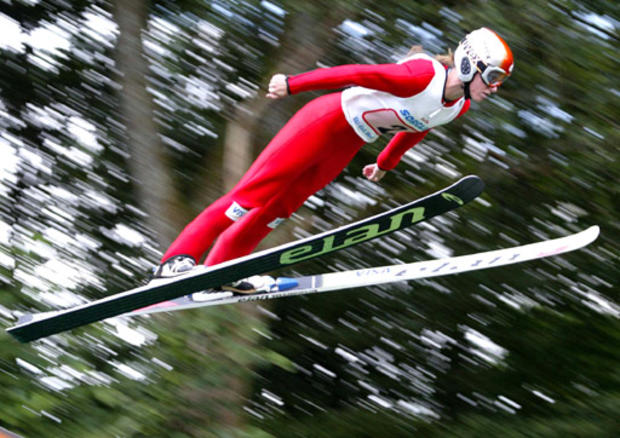
Flying 120 meters in the air -- and landing -- can be hard on the body. Until recently, doctors thought that landing could put extra strain on a woman's body, which made the International Federation of Skiing wary of including women in top competitions. But that school of though has been disproved recently.
Here, Alissa Johnson gears up for a jump in Meinerzhagen, Germany.
Scott Sine/Park Record
It is common for American ski jumpers to practice year-round, snow or no. When the weather's warm, slicked down porcelain comprises the jumps and mats of tightly woven thin plastic straps provide a smooth, slick landing surface.
Coach Casey Colby told CBS News that the women he trains "actually do more jumping in the summertime than the wintertime."
Scott Sine/Park Record
"I've never necessarily wanted to be the best, or wanted to go to the Olympics, but I just wanted it to be on option," 18-year-old Alissa Johnson told CBSNews.com.
This year's Torino games will be bittersweet because the United States' best women cannot compete. Instead, they will be in another European competition that week.
Scott Sine/Park Record
"I've been jumping since I was 6. I'm 17 now. We train six days a week and jump four days per week, so it's a lot of my life," said Brenna Ellis, a student at Park City High School who is also a junior Olympian.
Even though she can't be an adult Olympian, she says her hard work has paid off. At the past two Junior Olympics, Brenna racked up first-place finishes.
Scott Sine/Park Record
Jessica Jerome, who has been a women's national champion in ski jumping for three years, flies though the night sky during a 120-meter jump in Holmankohln, Norway, in 2005.
Scott Sine/Park Record
Who says women can't jump?
Jessica Jerome poses after winning a competition in Meinerzhagen, Germany.