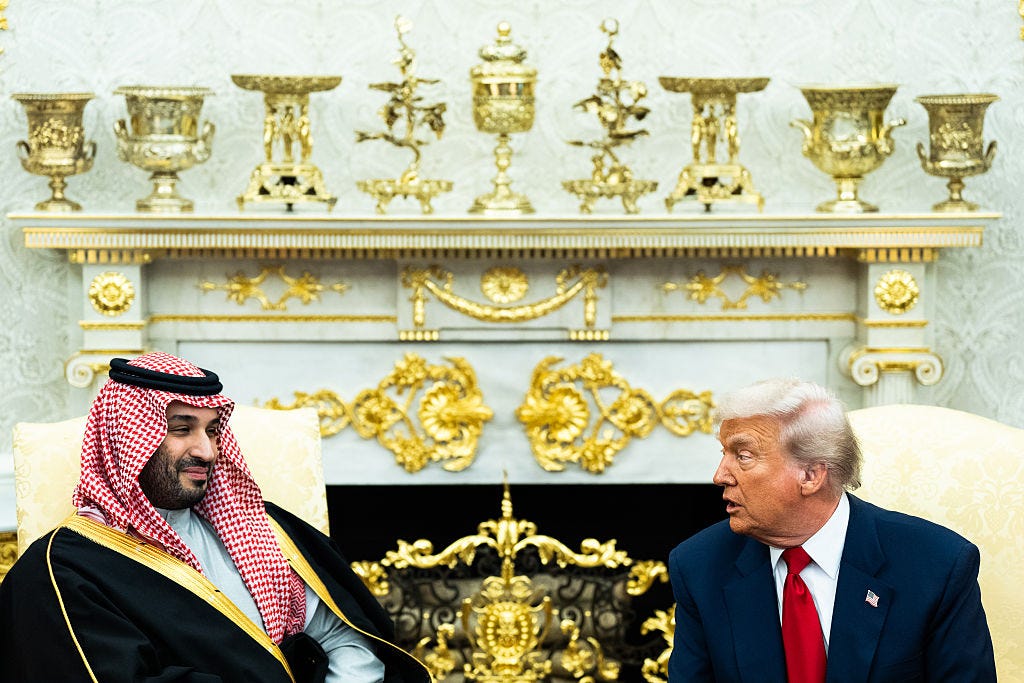
U.S. and Saudi Arabia sign deal that could allow civil nuclear program, contingent on joining Abraham Accords

Washington — The U.S. and Saudi governments have signed a commercial nuclear deal that could allow Saudi Arabia to have a civilian nuclear program on its soil in cooperation with American companies, the U.S. Department of Energy announced Wednesday. But a day later, President Trump said in a Truth Social post that the deal would not allow the Saudis to enrich uranium, and he stipulated the deal "is totally subject" to Saudi Arabia joining the Abraham Accords to normalize relations with Israel.
The text of the agreement, which has not yet been released, will go to Congress for review.
Energy Secretary Chris Wright and Saudi Minister of Energy Prince Abdulaziz bin Salman signed what the Trump administration calls a peaceful nuclear cooperation agreement, along with a safeguard agreement that the Energy Department says will lay the groundwork for a multibillion-dollar partnership to boost Saudi energy capacity. The deal could set the stage for a nuclear program for energy and other civilian purposes, not to build nuclear weapons.
CBS News previously reported the expected signing, which was first reported by The Wall Street Journal.
"These agreements reflect our two nations' shared commitment to strengthening U.S.-Saudi commercial relations, delivering prosperity at home and security to our allies abroad," Wright said in a statement. "Rest assured, these agreements uphold the highest standards of nuclear safety and nonproliferation, while relying on the world's best nuclear technology and scientists, designed right here in the United States."
Mr. Trump on Thursday added that approval of the deal is contingent upon Saudi Arabia signing on to the Abraham Accords, a series of agreements that were reached during the president's first administration to normalize relations between Israel and several Arab nations. It's unclear whether the Saudis were aware of this when signing, but it was not mentioned publicly until Thursday morning.
"The Civil Nuclear Deal (There will be no enrichment of material!) being made between the United States Department of Energy and Saudi Arabia, which pertains only to non-military use such as the ones that Iran and UAE (and others) already have, will be approved, but is totally subject to Saudi Arabia joining the very respected and successful Abraham Accords," Mr. Trump said in a post on Truth Social. "The United States is not opposed to Civil (Non-Enriched) Nuclear Facilities."
Saudi Arabia has not yet responded publicly to the president's social media comments on enrichment and the Abraham Accords.
A reporter asked White House press secretary Karoline Leavitt on Thursday why the Abraham Accords condition wasn't mentioned when Wright announced the deal.
"Well, look, the president is always the final dealmaker, as you know, and this is something he has mentioned on numerous occasions," she responded.
Leavitt confirmed that joining the Abraham Accords is a necessary condition of the nuclear agreement.
Israeli Prime Minister Benjamin Netanyahu's office said in a statement, "Saudi Arabia's joining of the Abraham Accords would be an historic leap forward for peace in the Middle East. Peace through strength."
The deal would create the potential for uranium enrichment on Saudi soil, though that would be controlled by a contracted corporation and only after a lengthy study is completed, CBS News previously reported. A civilian program is for energy supply for things like AI data centers, and not a military program.
The U.S. will want to see protocols and monitoring.
A 1954 law requires congressional review of all nuclear cooperation deals with foreign countries.
Westinghouse Electric Company, which builds nuclear reactors, is one of the U.S. companies planning to help develop Saudi Arabia's nuclear sector.
"The U.S. government's announcement to launch a civil nuclear cooperation agreement with Saudi Arabia is a landmark step that strengthens energy security, expands opportunities for U.S. industry and workers, and drives significant long-term economic growth and investment benefits for both countries," said Westinghouse CEO Dan Sumner.
A Trump administration framework for civil nuclear cooperation had been publicly announced in the fall of 2025. At the time, Wright described it as including bilateral safeguard agreements to bring U.S. nuclear technology to the kingdom. At the time, Wright stipulated that this keeps a "firm commitment to nonproliferation."
The original framework for this agreement was developed under the Biden administration, which a former U.S. official with direct knowledge described as requiring U.S.-only enrichment at a U.S.-controlled facility. It would also have been subject to congressional approval.
Under former President Joe Biden, the deal had been tied to a U.S. push to incentivize Saudi Arabia to follow through on the normalization of relations with the state of Israel. Normalization was also dependent on Israel providing a pathway to a future for self-determination by Palestinians, not necessarily a state of their own, and it offered investments and diplomatic representation. After the deadly terrorist attack by Hamas on Oct. 7, 2023, and the launch of the war in Gaza, that deal was put on hold.
But fuel-rich Saudi Arabia was still interested in the nuclear energy cooperation, particularly given the high degree of energy supply needed for artificial intelligence. The late Sen. Lindsey Graham had continued to work on this effort through both administrations.
The Trump deal does not appear to be overtly linked to a foreign policy objective, though the administration is at pains to reassure regional allies of the U.S. commitment to their security amid the ongoing Iran war. Saudi Arabia and other regional allies have borne the brunt of Iranian attacks since the war began at the end of February.
The landmark deal signifies the strengthening alliance and trust between the U.S. and the Saudis. But the civilian nuclear deal is likely to irritate Iran, Saudi Arabia's chief rival, which has long insisted on its right as a signatory of the Treaty on the Non-Proliferation of Nuclear Weapons to maintain a civilian nuclear program.
Saudi Arabia will not be the first Gulf state with a civilian nuclear program. Back in 2009, the Obama administration signed an agreement with the United Arab Emirates that included a pledge for peaceful nuclear energy under nonproliferation controls.