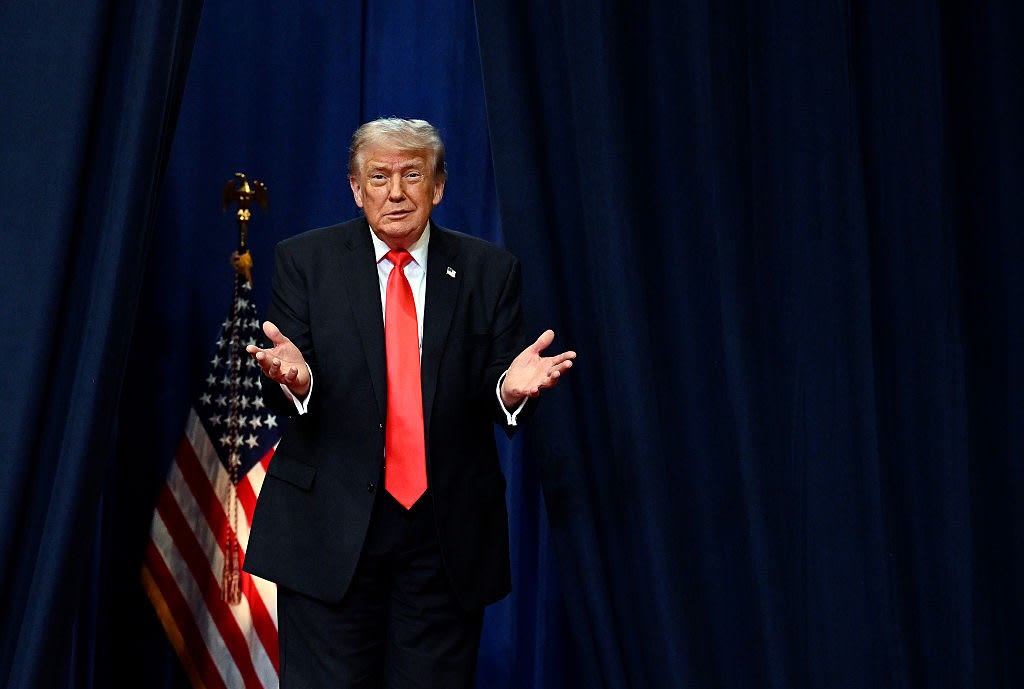
Trump's monumental reimagining of Washington, D.C.

Vietnam veteran Shaun Byrnes had always planned to one day be buried at Arlington National Cemetery. Now, he's not so sure. "I'm entitled to be buried there, and so are my colleagues," he said. "But we're all reconsidering. It's gonna depend on whether this arch goes up."
Why? "It's disrespectful," Byrnes said. "It's wrong."
Byrnes is one of three veterans suing the Trump administration over a triumphal arch President Trump wants to build to celebrate America's 250th birthday. At 250 feet, it would be taller than most buildings in D.C., and would stand just across the Potomac River in a traffic circle, at the base of Arlington National Cemetery.
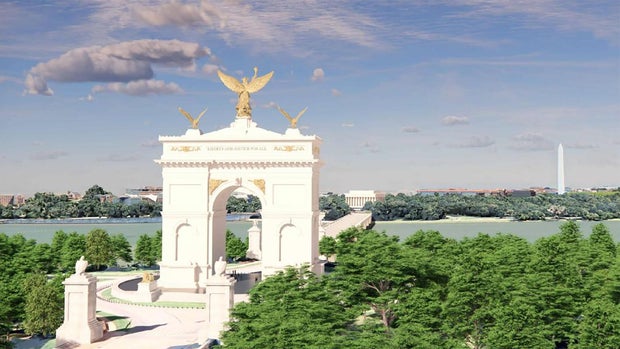
Critics argue the arch would obstruct historic sightlines between the cemetery that was built during the Civil War, and the memorial to Abraham Lincoln, the man who ended that war.
Byrnes says he's never done anything like this lawsuit before: "But I was angered by it. There are 400,000 American veterans buried at Arlington National Cemetery. We thought this was disrespectful, particularly coming from a man who called Americans who'd volunteered and served, wore the uniform in various wars, 'suckers' and 'losers.' So, we took this step."
[President Trump has denied making this comment.]
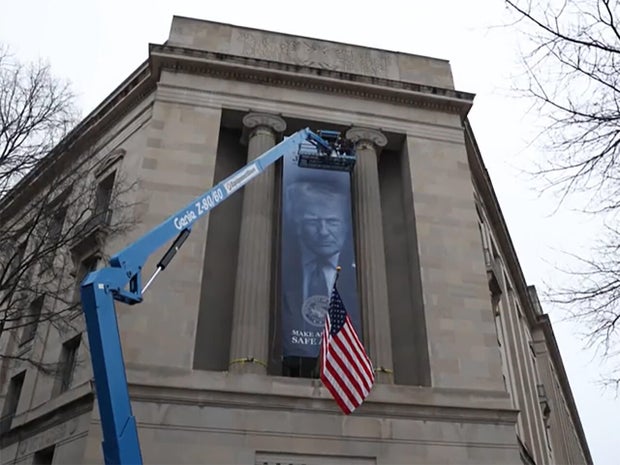
The arch is just one way President Trump is seeking to remake the nation's capital in his vision. His face now adorns multiple government buildings, as he oversees dozens of projects around the city – projects he says will make the city "more beautiful."
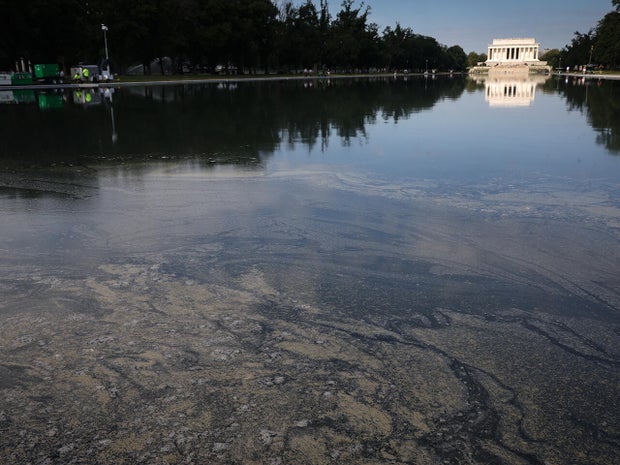
So far, he has resurfaced the National Mall's reflecting pool … made plans to overhaul the public golf course along the Potomac River … and proposed a new "Garden of Heroes" featuring 250 sculptures.
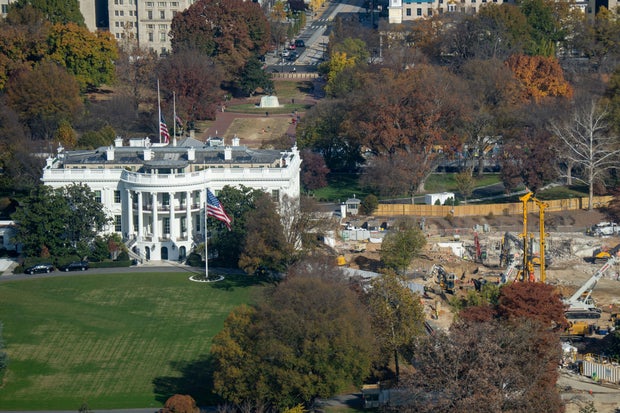
Mr. Trump demolished the East Wing of the White House in a surprise move last year; and his name was added to the Kennedy Center. (A judge has since ordered its removal.)
Charles Birnbaum, CEO and president of the Cultural Landscape Foundation and an expert on Washington, D.C.'s historic core, says the city was designed with purpose, "like a quilt, and for generations the city's design and planning has contributed to that quilt to honor its bone structure, and to understand its place in this mosaic of 250 years."
Birnbaum says every new project is meticulously designed to avoid interfering with the other patches on the quilt. "Whether it's the arch or the ballroom, these are massive objects that are being forced upon spaces that have symbolism, that tell the story of who we are as a people," he said. "And they also symbolize how the viewshed can be uninterrupted; how light and shadow across a lawn at the White House is not open space for construction. … The space is actually there satisfying a purpose."
As the number and scale of President Trump's projects have mounted, so have the lawsuits over the lack of public input or Congressional authorization, and over the use of no-bid contracts to "speed up" construction.
Rebecca Miller, executive director of the D.C. Preservation League, which has filed six lawsuits against the administration, says Mr. Trump may be acting quickly on these projects because he is thinking about his legacy. "But the city isn't his own personal portfolio," she said.
And then there are the consequences of projects moving too quickly: "You have the Reflecting Pool, which already has been compromised, from the sealant coming up and the algae blooms and whatnot," Miller said.
The Trump administration has referred to work on the White House grounds as "deferred maintenance and repairs." Miller responded, "Well, demolishing the entire East Wing isn't 'deferred maintenance.' There's been notes of, 'Oh, it was terribly ridden with all kinds of asbestos and lead paint.' But we've not seen those reports."
In fact, some of that allegedly toxic debris was dumped in a nearby park.
The cost for all this beautification and restoration has topped $100 million so far, and is projected to grow to nearly $1 billion, with the money coming from both public and private sources. At least $80 million has been diverted from our national parks.
In a statement, the Department of the Interior told "Sunday Morning": "Great nations build beautiful structures and works of art that cultivate national pride and love of country." [See below for the full statement from the Interior Department.]
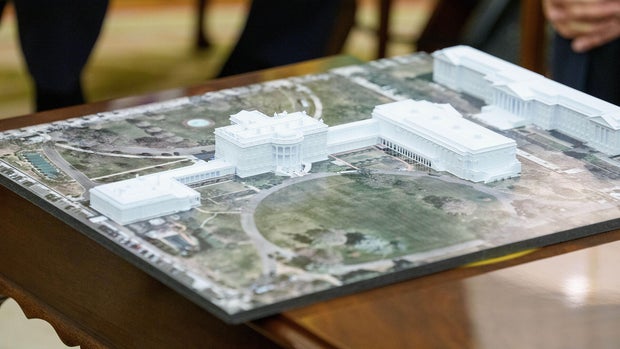
The Commission of Fine Arts, the body responsible for reviewing projects like the proposed White House ballroom, is now made up entirely of Trump appointees. They approved the ballroom in less than two months.
"We are lucky at this point to have a 'builder president' who appreciates the style of Jefferson, to have that city be President Reagan's 'shining city on a hill,'" said Rodney Mims Cook, chair of the commission.
Some planners who have spoken to CBS News argued that the Commission of Fine Arts has become a rubber stamp for President Trump. "They're wrong," Cook responded. "Because the president listens to us, and we've had – my conversations with the president are confidential, but he enjoys this. He is very educated about it."
Asked why the commission approved the ballroom so quickly without the public input typical of a project this important, Cook said, "The White House is an insufficient [building footprint] for the presidency of the United States. It's been complained about since the Harrison [presidency], and now with drones and people who tend to shoot at leaders, it's a security problem of a major note."
Cook has also been one of the driving forces behind an arch in Washington, D.C. In fact, his Atlanta-based office is located on top of an arch similar to the one he'd like to see in the nation's capital. "I proposed it as a private citizen 26 years ago," he said, "because it will ultimately become the de facto gateway into Arlington Cemetery, and the current gateway into it is insufficient."
Asked about putting the arch somewhere else in Washington, away from Arlington, Cook said, "You couldn't have a more open space in the entire District of Columbia than that space for such a properly-scaled arch. It's two feet higher than the Arc de Triomphe. The Arc de Triomphe is 164 feet tall, and it is surrounded by a massive city. This is surrounded by parkland."
His commission signed off on the arch in May. Another key approval could come as early as September for what some opponents, like Shaun Byrnes, have dubbed the "Arc de Trump."
"We have several other iconic monuments to presidents – Washington, Lincoln, Jefferson," said Byrnes. "They were not built at the orders or direction of any of those three men. They were built after they were deceased. This is not the case with this monument."
Asked if he thinks Mr. Trump wants a monument to himself, Byrnes laughed: "You don't?"
For more info:
Story produced by Sara Kugel, Editor: Jason Schmidt.
From a Department of Interior spokesperson:
"Great nations build beautiful structures and works of art that cultivate national pride and love of country. In this tradition, Secretary Burgum is thrilled to champion the United States Triumphal Arch which will be a project that all Americans can be proud of. In America's 250th year, President Trump wants to fulfill this vision and build the Triumphal Arch to celebrate the triumphs of the American people, inspires patriotism and love of country, and beautify our nation's capital. The arch will also enhance the visitor experience at Arlington National Cemetery for veterans, the families of the fallen, and all Americans alike, serving as a visual reminder of the noble sacrifices borne by so many American heroes throughout our 250-year history so we can enjoy our freedoms today.
"Some historical background:
"Dating back over 100 years, Congress and various commissions intended for a monumental work to adorn Columbia Island—the location of the Triumphal Arch. In 1902, the U.S. Senate "McMillan Commission" called for "a concourse suited to memorial treatment be established" on the westerly terminus of the Memorial Bridge.
"In 1924, the congressional Arlington Memorial Bridge Commission said, "[Columbia Island] was always considered as a suitable site for formal park treatment, a fitting end for the Memorial Bridge, as well as an important feature in itself." Specifically, the commission called for "a plaza with fitting architectural adornment in a measure supplemental to the Lincoln Memorial across the river."
"Despite Congress's intent, the site became a barren traffic circle lacking monumental treatment and significant historic value. The route extending from Arlington Memorial Bridge to Arlington National Cemetery was meant to serve as a grand entryway—an Avenue of Heroes— "for the Nation's fallen heroes to their last resting place in the Arlington National Cemetery," according to the 1924 Arlington Memorial Bridge Commission report.
"In 1932, Charles Moore—the longtime chairman of the Commission of Fine Arts and, notably, former clerk for the McMillan Commission—urged that Columbia Island "should not be suffered to fall from [its] intended high estate into a mere thoroughfare. ... [T]he center of the island is to be treated in monumental fashion."
"Similarly, Ulysses S. Grant III—a member of the National Capital Park and Planning Commission and grandson of the former president and victorious Union general—decried the state of Columbia Island after World War II as a "temporary road with an informal circle." He lamented that that "the central plaza on Columbia Island had never been undertaken and seems to be absolutely essential to link together the two parts of the project, namely the main bridge itself and the entrance to Arlington Cemetery." "