SpaceX launches milestone Starship flight to demonstrate full reusability of orbit-class rocket
SpaceX launched its huge Starship rocket on the program's 15th test flight Friday, a 22-hour mission that was meant to feature planned launch pad catches of both the booster and the Starship's upper stage.
However, after the booster sent the Starship on its way to orbit as planned, a problem of some sort prevented a return-to-the-launch-pad capture. Instead, the rocket made a splashdown off the Texas Gulf Coast, exploding in a spectacular fireball moments before hitting the water.
SpaceX managed to catch a Super Heavy booster during three previous test flights, using giant mechanical arms on the launch gantry to snag the rockets as they descended tail first on the power of three of their 33 Raptor engines. But the flight plans always include a splashdown option if an issue crops up preventing a safe capture.
It was not immediately known what triggered the diversion Friday or the explosion before splashdown.
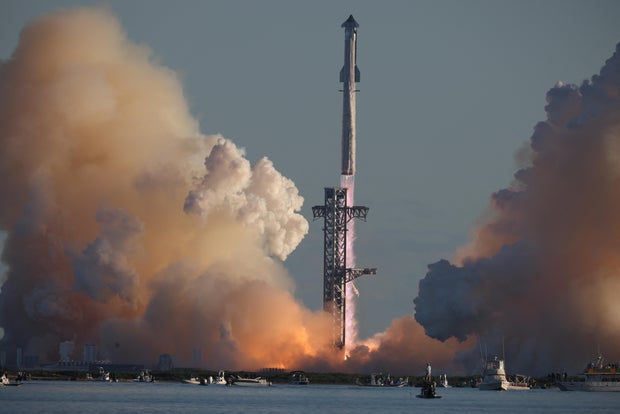
It was a disappointment for SpaceX workers who had hoped the Super Heavy-Starship rocket's 15th test flight would be the first to demonstrate full reusability in an orbit-class rocket. The company still plans to attempt its first-ever launch pad catch of a Starship upper stage Saturday at the conclusion of the mission.
Loaded with 8 million pounds of supercold liquid oxygen and methane fuel, the rocket's 236-foot-tall first stage, powered by 33 methane-burning Raptor engines, roared to life and majestically propelled the booster away from SpaceX's "Starbase" launch site on the Texas Gulf Coast at 5:47 p.m. ET.
Arcing away to the southeast, the Super Heavy booster propelled the rocket out of the thick lower atmosphere before falling away about 2 minutes and 20 seconds after liftoff.
Technical problem forced SpaceX to divert booster to Gulf Coast
While the 171-foot-tall Starship continued the climb to space using six Raptors of its own, the booster flipped around and fired up a set of Raptors to reverse course and head back to the launch site.
But a little more than 6 minutes after liftoff, flight controllers ordered a diversion to a Gulf Coast splashdown because of a technical problem. Long-range cameras captured the big booster slowly descending to the Gulf, shrouded in steam and then a fireball as residual propellants ignited.
The Starship, meanwhile, followed a suborbital trajectory, ensuring a safe ocean splashdown in case of problems, while giving SpaceX flight controllers time to assess its health before committing to a final push to orbit.
But no issues were found and after an 18-minute coast, a single Raptor reignited for a short 10-second burn to push the craft into its planned orbit. Eight and a half minutes after that, the first of 26 upgraded version 3 Starlink internet satellites was expected to be pushed out into space to fly on its own.
For the rest of the flight, controllers planned to closely monitor the Starship, periodically assessing its health to make sure it could be safely de-orbited in case of problems that might prevent a safe return-to-launch-site capture at the same pad where it launched Friday atop the Super Heavy booster. It will be SpaceX's first attempt to get a Starship back to its pad for possible refurbishment and relaunch.
"During this prolonged coast phase, flight control teams have several options to end the mission early and return Starship to pre-cleared areas of the Pacific Ocean if needed," SpaceX said in a blog post. "These locations include early- and late-mission splashdown options around Hawaii and a mid-mission splashdown opportunity several hundred kilometers off the coast of Chile. These precleared areas ... provide a safe place to land Starship if any conditions arise that may preclude the ability to perform a safe reentry."
Starship's upper stage slated to reenter Earth's atmosphere and land at Starbase on Saturday
One hour after a final "return check" Saturday, a single Raptor is expected to fire at 3:21 p.m. Eastern time to lower the far side of the Starship's orbit deep into the atmosphere for a 56-minute belly-first reentry and return to the Texas Gulf Coast.
"During reentry, Starship can alter its flight path by moving its four control flaps," the company said. "This will permit Starship to maintain a safe and known trajectory while guiding itself with high precision control toward Starbase."
As it descends, the Starship will carry out "a series of small turns in its trajectory to intentionally fly over sparsely populated areas of northern Mexico and southern Texas," SpaceX said.
Starship will avoid major cities in the Rio Grande Valley and pass to the north of South Padre Island before heading "out over the Gulf of America as it makes its final turn south towards Starbase."
Nearing the launch pad, the 171-foot-tall Starship will fire three Raptors to flip upright. Once the maneuver is complete, one Raptor will be shut down as the rocket descends between the gantry's mechanical arms. Finally, with just one engine firing to slow the rocket to a near stop, the mechanical arms will move in to snag the spacecraft.
But all of that depends on a problem-free descent. If any problems develop that might lead to an uncontrolled landing, flight controllers can ensure a vehicle breakup before it has any chance to reach a populated area.
"During reentry, flight controllers will have several options to end the reentry early and safely by intentionally tumbling Starship to ensure that it breaks up in the atmosphere before reaching land," SpaceX said. "There is also a late-reentry option to send Starship into the Gulf ... if any of its systems or the tower itself encounter an issue after reentry that would preclude a safe catch at Starbase."
SpaceX calls development of a fully reusable rocket "the holy grail of rocketry," opening the door to airplanelike cadence where a vehicle flies again rapidly.
NASA is counting on a variant of the Starship to carry Artemis astronauts to the lunar surface in 2028. But the rocket's development has taken longer than initially expected and the space agency is now hedging its bets, saying it is also open to using Blue Origin's Blue Moon Mark 2 lander depending on which spacecraft is ready.