Seeking relief from chronic pain

Veterinarian Dr. Troy Hudnall enjoyed an active practice in Missouri. But in 2022, during an intense delivery of a calf, he felt a sharp pain, and heard a strange sound: "A snap or a pop, snap's probably the best way to describe it," he said.
Herniated discs and a pinched nerve in his neck caused numbness and severe muscle loss in Hudnall's right hand: "The first thing that I really remember is, I couldn't click my mouse on my computer. I started having trouble with instruments. Anything that required much agility in the fingers was almost gone."
Hudnall had multiple surgeries to help free up the nerves, but as sensation returned, he began experiencing severe pain … pain so bad, he says, he thought about amputating his own arm. Asked to describe how it felt, Hudnall replied, "For me, it's always been electricity. If you've ever touched an electric fence on a farm, or accidentally touched both prongs while you're plugging something in, it's that, but it's repetitive, it pulses."
That chronic pain has haunted Hudnall for three years now, forcing him to stop working. He treats it with a daily handful of pills, including opioids, and has tried red light therapy, physical therapy, electrical spine stimulation, and lidocaine injections. But despite all that, he says he experiences pain every second of every day. Rating his pain level from zero to ten, Hudnall says his "best days" rank at six to eight.
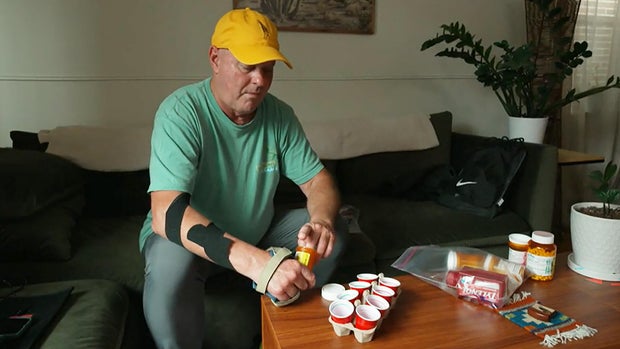
About one in four American adults lives with chronic pain, defined as pain lasting more than three months. Most are still suffering a year later.
"When you have chronic pain day in, day out, you're just inundated with this signal all the time; it's crushing you completely," said pain specialist Dr. Lara Crock.
A global problem
We followed Hudnall's care at one of the nation's top pain centers, the Washington University School of Medicine Pain Center in St. Louis, where, Crock explained, patients often end up trying many different approaches. "We throw medicines at it, we try different injections, we try different procedures," she said. "But really, we don't have a full understanding of why one person with the same injury continues to hurt while the other person heals and no longer hurts."
Treating chronic pain requires understanding the different ways a body can react to a painful stimulus. For example, when a person burns their hand, an electrical signal travels up nerves in the arm to the spine, then on to brain cells that interpret that signal as pain. In most people, once the painful stimulus stops, the sensation of pain stops. But not always.
Crock said, "The tissue that was injured before may be healed, or the injury that you had is recovered, but that signal continues to go and go." Why? "We don't know!" she said. "Your arm is totally normal, every scan, everything about your arm is completely normal, but there's an area of your brain that is affecting your hand that's damaged and causes your arm to hurt all the time."
Chronic pain is a global problem. Over the last 35 years, more than 900 journals in 86 countries have published thousands of articles about chronic pain. Approaches to treatment include using devices that stimulate the vagus nerve in the neck to lower pain in patients with rheumatoid arthritis or migraine headaches. And researchers are testing new non-opioid medications that block tiny gateways in nerve cells (called sodium channels) to keep pain signals from traveling to the brain.
Biofeedback
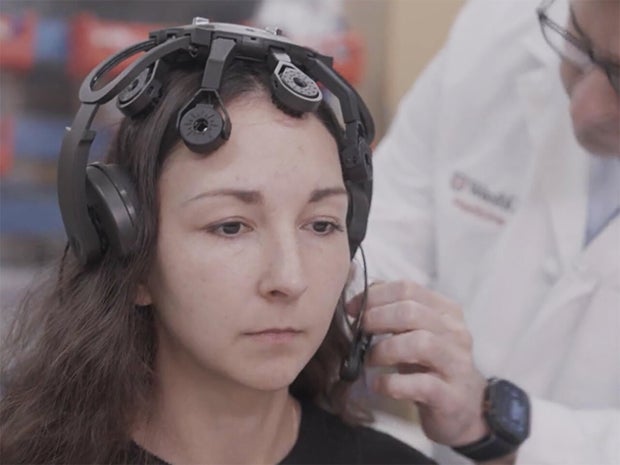
At Washington University, researchers are trying to lower pain by "retraining" the brain. Doctors Eric Leuthardt and Simon Haroutounian have come up with a headset, wearable at home, that uses biofeedback to train patients to increase certain brain waves that ease pain. "We have conducted a pilot in a small group of about six patients with chronic pain that was non-responsive to other treatments, like surgery, medications," said Haroutounian. "And everyone improved to some extent."
The positive assets of the device, Leuthardt said, include, "It's not a drug, it's got no pathologic side effects, it's not addictive, and in many ways, [it] empowers the patient to rehabilitate their own neural circuits for improvement."
Self-hypnosis
Still in early research stages, that headset isn't ready for patients like Troy Hudnall. But since last May, Hudnall has been trying hypnosis, in sessions conducted by pain psychologist Sarah Buday. "Clinical hypnosis is not your Las Vegas stage show; I'm not trying to make anyone cluck like a chicken or be under my control," Buday said. "The way I think of it is, I'm teaching somebody the skill of self-hypnosis. We are having them go into a very deep state of relaxation, at which point, I start to make suggestions about maybe the quality of the pain or the meaning of it, their emotions."
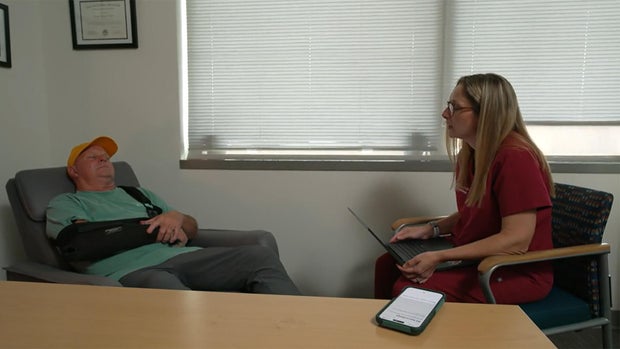
Several weeks ago, with the help of self-hypnosis, Hudnall endured another surgery. As for his future, he says he tries to remain positive.
And Buday is positive about Hudnall's outlook as well: "I think it's good. It's already getting better. And he is somebody that has a lot of optimism and hope."
And Lara Crock says, even if – despite all you throw at it – pain is only partially relieved, "It can be the difference from being able to get up and take your kid to school or eat breakfast or dinner with your family, versus laying in bed all day. So, that can be huge."
Story produced by Amiel Weisfogel. Editor: Remington Korper.
For more info:


