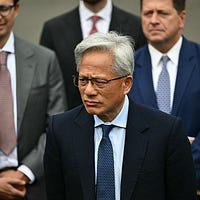
Nvidia's stock slides as questions swirl around Jensen Huang's future as CEO
Nvidia's stock price dropped in early trading on Monday amid questions about CEO Jensen Huang's future at the chipmaker, following the board of directors' investigation into allegations that China targeted him in an intelligence operation.
The investigation is raising concerns about Huang's role at the company, which he co-founded and helped build into the world's second-most valuable company, with a $4.5 trillion valuation. Nvidia is barred from selling its high-end chips, specifically designed to power artificial intelligence models, to China due to competitive concerns.
Nvidia shares sank by $10.40, or 5.7%, to $176.24 shortly after markets opened, shrinking the chipmaker's market valuation by about $247 billion.
The allegations center around reports that Huang had a close relationship with Alice Huang, who U.S. intelligence officials believe was a spy for China's Ministry of State Security, the country's main intelligence agency. On Sunday, Nvidia's board said it is starting an "independent investigation" into the allegations, sparking questions about the CEO's future with the company.
"This is a black eye moment for Jensen and will spark multiple congressional inquiries at a minimum and will create an overhang on the stock for a myriad of reasons," Dan Ives, a tech analyst at Yorkville Ives, said in a research note. "The key question investors will be asking is: Will Jensen remain CEO of Nvidia?"
Ives added, "There is clearly risk that Jensen could be removed as CEO depending on the board investigation, and this will add risk to the stock as he is so important to the Nvidia story and strategy globally."
Nvidia didn't immediately respond to a request for comment.
The company's board said it had no reason to believe that the company's secrets or national security were compromised. John Rizzo, a spokesperson for Nvidia, told CBS News on Sunday, "We trust that if we were the target of a genuine threat, the U.S. government would have notified us."
The Chinese government dismissed allegations that it targeted Nvidia's chief executive, who co-founded the company in 1993, as part of an espionage operation. "The so-called Chinese spy narrative is entirely baseless and constitutes slander and smear," Guo Jiakun, a spokesperson for China's Ministry of Foreign Affairs, said in a statement.
Who is Alice Huang?
Alice Huang, also known as Huang Le, was a former executive at a Singapore-based data center company, Megaspeed International, whose website touts its partnership with Nvidia.
Many offices in Singapore were closed on Monday for a holiday. Megaspeed and the Singapore Ministry of Home Affairs did not immediately reply to requests for comment.
Succession challenges
Replacing Jensen Huang, 63, would prove challenging because he is viewed as integral to the company's success, tech analysts said on Monday. Huang also serves as the public face of Nvidia, appearing at industry events and media interviews in his trademark black leather jacket.
Huang is the company's fifth-largest shareholder, with about 3.4% of its shares, according to financial data provider FactSet.
"There is no known succession plan, and there is no leader in the company who would be the clear next step if he had to step down. In many ways, Jensen is Nvidia's Steve Jobs," said Daniel Newman, CEO of tech consulting firm Futurum, in an email.
He added, "That does not mean they cannot find a Tim Cook in the future, but it would be a massive changing of the guard, and the company has not been set up for that."
Another blow for the AI trade
The scandal puts more pressure on Nvidia shares, which have already been bruised by mounting investor concerns about the valuations of companies driving AI growth. Prior to Monday's early decline, Nvidia's shares had tumbled almost 20% over the last month amid a broader sell-off in AI stocks.
The board investigation into Huang could loom over Nvidia and raise the risk that U.S. regulators could impose additional restrictions on the company's chip exports, according to Adam Crisafulli, an analyst at Vital Knowledge.
"The key questions are whether he was aware of any espionage activities and whether any confidential or strategically sensitive information was compromised," said George Chen, a partner and chair of digital practice at The Asia Group, a Washington-based consultancy.
In recent years, Jensen Huang has lobbied federal authorities to loosen limits on sales of Nvidia chips to China, winning approval from President Trump to sell its H200 chips this year. Those chips are not Nvidia's most advanced models, but they are still considered important products for Nvidia.
Previously, Huang also lobbied Mr. Trump to be allowed to sell Nvidia's less-advanced H20 chips, which were designed to comply with U.S. export restrictions on China.
"The real potential fallout from the Jensen Huang scandal will be the U.S. government imposing dramatically more draconian restrictions on sales of sophisticated chips to China (the issue isn't the H200 but instead the fact that a large amount of higher-end Nvidia products are still making it into the hands of Chinese buyers)," Crisafulli said in a research note.