Nobel Peace Prize 2026 awarded to Navanethem "Navi" Pillay, former International Criminal Court judge
The Nobel Peace Prize for 2026 was awarded Friday to Navanethem "Navi" Pillay, a South African-born former judge with the International Criminal Court who went on to become the United Nations human rights chief and is still serving with the U.N.'s other judicial body, the International Court of Justice.
The Nobel Committee said it was honoring Pillay "for her efforts to promote peace and international law," and that awarding the prize to someone with her body of work on international justice was a message to those seeking to undermine international law institutions.
The South African-born former United Nations human rights chief, who is 85, was recognized for her efforts to promote peace and international law, said Jørgen Watne Frydnes, chair of the Norwegian Nobel Committee.
"This is definitely a message to those who are undermining the international system and institutions," Frydnes said.
"The system of international law is under tremendous pressure and its institutions are under attack," he said, noting what the committee saw as a shift "towards power politics at the expense of legal frameworks and global respect for law and justice."
The International Criminal Court (ICC) has come under fire from the Trump administration over the last year, with the U.S. imposing sanctions against the U.N. court after it issued an arrest warrant in 2024 for Israeli Prime Minister Benjamin Netanyahu. President Trump accused the court of "illegitimate and baseless actions targeting America and our close ally Israel."
The ICC condemned the U.S. sanctions against its staff and said they were intended to "harm (the Court's) independent and impartial judicial work."
Pillay served as an ICC judge from 2003 until 2008, when she resigned to take on the role of United Nations High Commissioner for Human Rights. She was the chair of the U.N. Commission of Inquiry on the Occupied Palestinian Territory that said last year it had concluded Israel's actions in Gaza amounted to genocide. Israel dismissed the report as "scandalous."
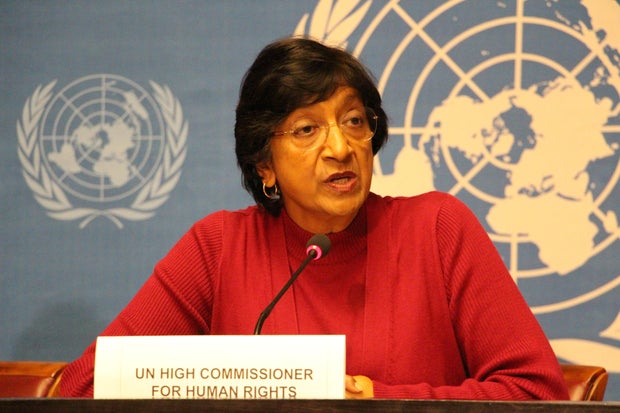
Pillay is currently serving as an ad hoc judge for the International Court of Justice (ICJ), which is separate to the ICC, in the case of Gambia v. Myanmar, in which Myanmar's ruling military junta stands accused of genocide over its treatment of the nation's Rohingya Muslim minority in the western state of Rakhine.
Frydnes said the committee wasn't immediately able to reach Pillay Friday to tell her she had been awarded the prize, adding from the podium that if she was watching and saw a call coming in from a Norwegian phone number, to "please pick up."
Pillay soon appeared in a video posted on social media by the head of Amnesty International, being applauded by well-wishers at the Palace of Justice in Nuremberg, Germany.
"If you clap a little bit louder I may share this prize with Trump," she quipped, drawing laughs from the crowd. She said that when she was informed that she had been awarded the prize, she first thought "it must be a joke," and that as a "lawyer and a judge, I still want to verify this thing."
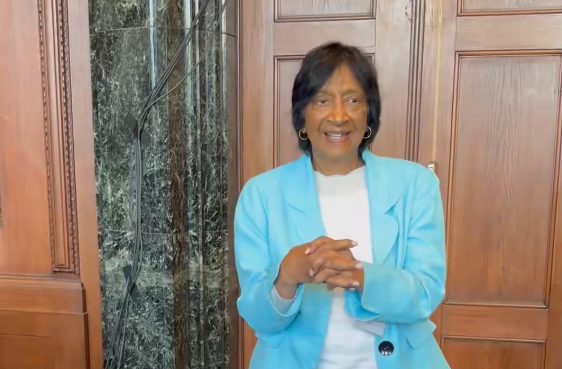
She noted that she was lauded by the Nobel committee for her courage, which she questioned, saying: "You can imagine how surprised I was. Why would you need courage to speak the truth? You interpret the law, you look at all the facts, so it's an impartial decision you make."
Last year, Venezuelan opposition leader María Corina Machado won the Nobel Peace Prize for her struggle to achieve a democratic transition in the South American nation, winning recognition as a woman "who keeps the flame of democracy burning amid a growing darkness."
Machado gave President Trump, who has long said he deserves the prize, her Nobel medal shortly after the United States ousted then-President Nicolás Maduro. But it was largely a symbolic gesture: The Nobel Committee has said the honor itself cannot be transferred.
Nominations can be made by a select group of people and organizations, including heads of state or politicians serving at a national level, university professors, directors of foreign policy institutes, past Nobel Prize recipients and members of the Norwegian Nobel Committee itself.
Four of this year's Nobels were announced earlier this week. The Nobel for medicine went to three scientists whose work led to a tool that uses light to help unravel how the brain works. The physics award recognized a scientist's efforts to demystify a rare group of neutrinos. The chemistry prize recognized two scientists for untangling mysterious mirror images in molecules, a discovery that has been used to develop countless drugs.
Canadian poet, essayist and translator Anne Carson won the literature prize Thursday for "bold and inventive" works that fuse the classical and the modern and blur the boundaries of poetry and prose.
The Nobel Memorial Prize in Economic Sciences will be announced Monday.
The prize money this year is 12 million Swedish kronor (about $1.2 million).
Education activist Malala Yousafzai is the youngest Nobel Peace Prize laureate; she won at 17 in 2014.
The United States is the most-credited country, with 24 awards naming U.S. institutions or individuals, ahead of the United Kingdom (13) and Switzerland (11). No laureate listed as American has won since then-President Barack Obama was awarded in 2009.
The prize has gone unawarded on 19 occasions, most of them during the world wars. In 1948, the year Mahatma Gandhi was assassinated, no prize was awarded; he had been nominated 12 times and never won.
In 1939, a Swedish member of parliament nominated Adolf Hitler, then withdrew the nomination, saying it was never meant seriously.