U.S. charges 10 Mexican officials, including Sinaloa governor, with drug trafficking
The governor of Sinaloa and nine other current and former Mexican officials were charged with drug trafficking and weapons offenses in a U.S. indictment unsealed Wednesday in New York, accused of aiding in the massive importation of illicit narcotics into the United States.
Some officials were members of Mexico's progressive ruling party, Morena, posing a political conundrum for Mexican President Claudia Sheinbaum as she seeks to offset mounting pressures from the Trump administration. Some of those politicians called the indictment a political attack on their party.
U.S. federal officials announced the charges in a news release. None of the defendants were in custody, but Mexico's government said shortly afterward that it had received multiple extradition requests from the U.S. without identifying those requested. It did not say how it would respond.
The 10 people charged in Manhattan federal court are current and former government or law enforcement officials in Sinaloa, including Rubén Rocha Moya, 76, who has been governor of Mexico's Sinaloa state since November 2021.
Charges against Rocha Moya included narcotics importation conspiracy and possession of machine guns and destructive devices, along with another conspiracy count. If convicted, he could face life in prison or a mandatory minimum of 40 years behind bars.
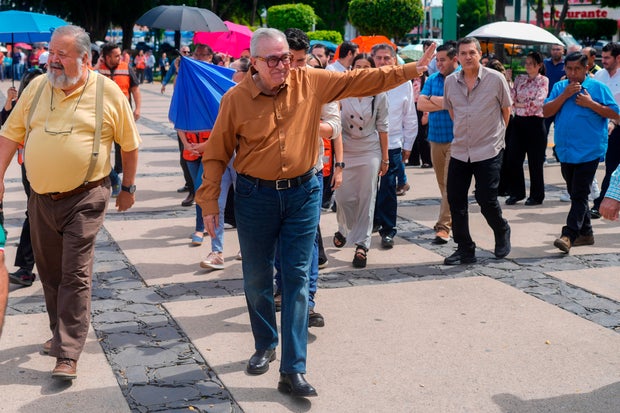
In a statement posted to social media, Rocha Moya, the highest-profile official charged, said he "categorically and absolutely" rejects the charges from U.S. officials, saying the accusations were an "attack."
"It is part of a perverse strategy to violate the constitutional order, specifically on national sovereignty, " he wrote Wednesday in a post on X. "We will show them that this slander doesn't have any sort of foundation."
Rocha Moya was a staunch ally of Sheinbaum's mentor, former President Andrés Manuel López Obrador. The governor enthusiastically backed the ex-president's "Hugs, Not Bullets" policy, which involved avoiding direct confrontation with powerful drug cartels. López Obrador built a political platform by railing against endemic corruption plaguing Mexican politics.
Some of those named, according to the indictment, have themselves participated in the Sinaloa cartel's campaign of violence and retribution.
The indictment alleged that they were closely aligned with the Sinaloa cartel faction known as "Los Chapitos," which is run by the sons of Joaquín "El Chapo" Guzmán, the ex-cartel leader now serving a life sentence in a U.S. prison.
Authorities said the defendants played critical roles in helping the cartel ship fentanyl, heroin, cocaine and methamphetamine from Mexico into the U.S. The Sinaloa cartel is among eight Latin American crime groups designated as terrorist organizations by the U.S. government.
"As the indictment lays bare, the Sinaloa Cartel, and other drug trafficking organizations like it, would not operate as freely or successfully without corrupt politicians and law enforcement officials on their payroll," U.S. Attorney Jay Clayton said in a release.
DEA Administrator Terrance Cole said in a statement that "the defendants allegedly used positions of trust to protect cartel operations, enabling a pipeline of deadly drugs into our country."
The indictment of Rocha Moya, who was born in the same town as "El Chapo," was particularly notable because the governor was embroiled in a scandal in 2023 involving the Sinaloa cartel. His name was published in a letter written by a then-Sinaloa cartel capo who was kidnapped by leaders of a rival faction of the cartel and handed off to law enforcement in the U.S. In the letter, the capo said that when he was kidnapped, he believed he was on his way to meet with Rocha Moya.
In the years since, the cartel's two warring factions have ravaged the northern Mexican state in their struggle for territorial control.
U.S. Ambassador to Mexico Ronald Johnson said in a statement that "while we cannot comment on the individual facts of these indictments, and the legal process will need to play out, one thing is certain: corruption that enables organized crime and harms both our countries will be investigated and prosecuted wherever U.S. jurisdiction applies."
Among those indicted, at least three officials — Rocha Moya the mayor of Sinaloa's capital, and Enrique Cazarez, a senator — were affiliated with Sheinbaum's party, Morena. A number of other officials held positions unaffiliated with Mexican parties.
It's not the first time the U.S. has brought drug trafficking charges against ranking Mexican officials. In 2023, Genaro García Luna — a former Mexican public security secretary under former President Felipe Calderón — was convicted by a U.S. court and sentenced to 38 years in prison after he was accused of taking bribes from the Sinaloa cartel. He denied the allegations and is appealing his conviction.
The indictment unsealed Wednesday comes after Johnson last week said that the U.S. administration would launch an anti-corruption campaign targeting Mexican officials he said were linked to organized crime.
"Corruption not only hinders progress, it distorts it. It increases costs, weakens competition, and erodes the trust upon which markets depend. It is not a problem without victims," Johnson said.
Sheinbaum responded Monday by saying her government has not seen "any evidence" of the charges of corruption.
"Any investigation in the United States against any person in Mexico must have evidence reviewed by the (Mexican) Attorney General's Office," Sheinbaum said.
Sheinbaum's government has already detained several local officials across Mexico in its ongoing crackdown against the cartels, fueled by pressure by the Trump administration.