Watch Live: Lindsay Clancy trial jury hears testimony from medical examiner

Lindsay Clancy's trial was paused briefly Wednesday afternoon as she sobbed during testimony from Dr. Renee Stonebridge, who works for the medical examiner's office in Boston. Stonebridge was testifying about the injuries the three Clancy children suffered the night their mother killed them.
You can watch the trial in Plymouth Superior Court live on CBS News Boston in the embedded video or on YouTube when court is in session.
Clancy, 36, is charged with first-degree murder in the deaths of her three children, 5-year-old Cora, 3-year-old Dawson and 8-month-old Callan, in their Duxbury home on Jan. 24, 2023. She has pleaded not guilty.
Prosecutors Jennifer Sprague and Shanan Buckingham said Clancy planned the murders and faked a suicide attempt.
Clancy's attorney Kevin Reddington said Clancy admits to killing her children but says she should not be held criminally responsible because she was overmedicated and suffering from postpartum psychosis.
Lindsay Clancy sobs during testimony
Following the lunch recess, a Plymouth County Sheriff's Department employee who guarded Clancy's hospital room was on the stand for about five minutes.
Then, Dr. Renee Stonebridge from the Office of the Chief Medical Examiner in Boston took the stand.
She spoke about the injuries she observed on the three Clancy children when the autopsies were performed.
The direct questioning from the prosecution lasted less than 10 minutes, and Reddington did not cross-examine the witness. Clancy could be seen crying during the testimony.
As Sprague began to a call the next witness, Judge William Sullivan called for a brief recess as Clancy was loudly sobbing with her head in her hands. WBZ-TV's Penny Kmitt, who was in the courtroom, said that Clancy's father was crying as well.

Mental health counselor takes witness stand
Latiesha Dukes, a mental health counselor who worked with Clancy, was on the stand for about two hours and stepped down just before 1 p.m.
Dukes, who worked at the time for South Shore Hospital, first met with Clancy in late November 2022 into early December of that year. She met with Clancy four times total during that time period.
Dukes said she worked closest on Clancy's case with Rebecca Jollotta, a psychiatric nurse practitioner who finished her testimony on Tuesday.
"Her presenting concerns were anxiety, lack of sleep, suicidal ideation, thoughts of no longer wanting to live or be here," Dukes said.
Dukes testified that her feeling about Clancy's diagnosis was postpartum anxiety because she did not have anxiety about most things. She recommended outpatient therapy, continued use of medications, and seeing her for weekly therapy.
On Dec. 5, 2022, Clancy reported that she had a difficult weekend and had intrusive thoughts about wanting to die.
Following her meeting with Clancy that day, Dukes said she recommended partial hospitalization.
On Dec. 19, 2022, Dukes said Clancy seemed more engaged during a telehealth visit, was able to smile and laugh and was enjoying time with her family.
Dukes testified that on her last visit with Clancy, she seemed to show an improvement of mood and ability to connect with others. She said that Clancy did not show signs of mania, delusions, paranoia or psychosis.
On cross-examination, Reddington asked about Clancy's reluctance to take medications.
"She was concerned about becoming addicted to medication, yes," Dukes said.
On Tuesday with Jollotta on the stand, Reddington attempted to show that Clancy tried to attend an outpatient postpartum program at Women and Infants Hospital of Rhode Island for two weeks in December 2022, but was turned away on the first day because they wanted to find out if she was overmedicated.
"Would you be surprised if I told you that they said they could not help her because she was overmedicated?" Reddington asked Dukes on Wednesday.
"It would surprise me, yes," Dukes said.
Reddington also questioned Dukes over her testimony that Clancy laughed during her final visit, saying it was not in her notes.
After Dukes stepped down, Cameron Daley, who was working for the Duxbury Police Department and stood watch outside of Clancy's room at Brigham and Women's Hospital after she killed her children, testified for less than five minutes.
Massachusetts State Police investigator testifies
Earlier, Sgt. Dan Lawlor testified. Lawlor has worked for Massachusetts State Police for nine years.
The night of the children's deaths, Lawlor went to South Shore Hospital in Weymouth and saw Clancy, who was unable to speak and suffering from injuries after jumping out a second-floor window.
Lawlor went to Boston Children's Hospital to check on 8-month-old Callan's status, then later went to Brigham and Women's Hospital, where Clancy was transferred, to stand watch outside the room.
Reddington took over cross-examination after about 15 minutes. The defense attorney asked Lawlor about how no one was allowed to get into Clancy's hospital room. Eventually, Reddington got a court order for psychologist Paul Zeizel to enter the room to meet with Clancy.
"Isn't it fair to say that one of the contentions of the district attorneys is that Paul Zeizel, my doctor, that I got a court order to get in and see her, told her to call Pat and tell him that she heard voices?" Reddington asked.
When Reddington referred to Pat, he was speaking about Patrick Clancy. Lindsay and Patrick Clancy were married at the time of their children's deaths, but have since divorced.
Following that question, the judge asked to see attorneys at sidebar due to an objection by the prosecution. After about 20 minutes, the judge sent jurors out of the room to question Lawlor without the jury present.
With the jury out of the room, Reddington asked about Lawlor's recollection that lead investigator Josh McKelligan had told him that at some point when Clancy was hospitalized, she called Patrick to indicate she was hearing voices. Reddington suggested that the theory investigators were trying to use was that Zeizel had suggested Clancy make the phone call.
"I don't know if it's a theory or not, I just recall the conversation," Lawlor said.
The prosecutor then questioned Lawlor without the jury present.
"You never had a conversation with the prosecution about what the theory was, did you?" she asked. Lawlor said he had not, saying it was only with the fellow trooper.
"Is this conversation guiding your testimony?" Buckingham asked. Lawlor said it was not.
The judge took arguments under advisement and the jury returned a short time later.
With the jury back in the room, Reddington asked Lawlor if he and McKelligan talked about the theory that Zeizel "is the reason that she told her husband she heard voices." Lawlor said they did talk about that theory.
"There's no investigator basis for that, that's McKelligan's speculation, correct?" Reddington asked. Lawlor said that was correct.
Buckingham then questioned Lawlor.
"Is it fair to say you oftentimes will have conversations as investigations are unfolding with other investigators that you're working on the case with about the case, potential evidence, theories of the case?" Buckingham asked.
Lawlor said that was true, and added that theories can change over time.
Buckingham asked Lawlor, "You didn't hear anything that occurred in that room that day that you were there when Dr. Zeizel was there, did you?"
"I did not hear anything," Lawlor said, concluding his testimony at around 10:45 a.m.
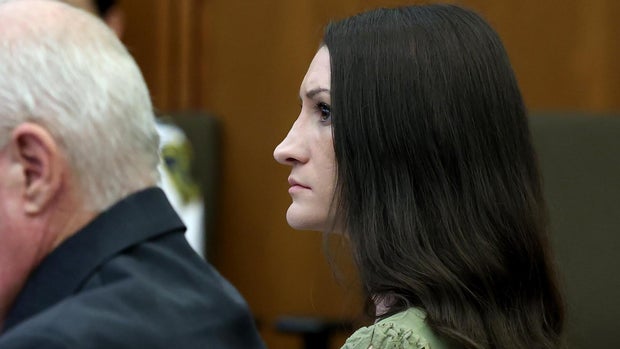
Lindsay Clancy trial
The jury heard from a psychiatric nurse practitioner Tuesday who specializes in postpartum patients. Rebecca Jollotta said she met with Clancy three times late in 2022, a few weeks before the murders. Jollotta was the 62nd witness in the trial.
Judge William Sullivan said the attorneys told him the proceedings are "well on schedule and somewhat ahead of schedule."
If convicted of first-degree murder, Clancy faces life in prison without parole. If the jury finds that she was not criminally responsible for the deaths of her children, she will be sent to a state psychiatric hospital in Massachusetts.
If you or someone you know is in emotional distress or a suicidal crisis, you can reach the 988 Suicide & Crisis Lifeline by calling or texting 988. You can also chat with the 988 Suicide & Crisis Lifeline here.
For more information about mental health care resources and support, The National Alliance on Mental Illness HelpLine can be reached Monday through Friday, 10 a.m. to 10 p.m. ET, at 1-800-950-NAMI (6264) or email info@nami.org.