In tight Kansas Senate race, struggling rural voters are split: "There's a lot of pissed-off farmers right now"
"There's a lot of pissed-off farmers right now at Trump and Marshall," said Kansas farmer Jeff Preisser, "because you see the situation we're in."
In the final stretch of Kansas' unexpectedly competitive Senate race between Republican Sen. Roger Marshall and Democrat Adam Hamilton, the Preisser family laid out their situation for CBS News, handing over a piece of paper detailing their heightened expenses. It cost them $737,375 more to operate their farm in 2026 than last year.
That included $514,625 more for fertilizer and $187,000 more for diesel, costs that have jumped during the Iran war, and $10,000 more for parts, which they linked to steel tariffs. Meanwhile, drought has decreased their crop yields by 20%, commodity prices are low and trade wars have shrunk agriculture exports, causing them to bring in $325,000 less in revenue from 2025 to 2026.
It's been a challenging few years for farmers. Kansas lost 700 farms from 2024 to 2025. Across the Midwest, farm bankruptcies increased 70% over the same period.
"Last year it was pretty damn tough … and it's way worse now. And there's no more collateral out there. There's no more money," said Jeff Preisser.
He said he isn't sure if his 6,500-acre corn, cotton, soybean and wheat farm in Sylvia, Kansas, will survive through next year.
The dire situation is leading his father, Larry Preisser, who started the farm, to vote for a Democrat for the first time. For the Senate, he plans to cast his vote for Hamilton, a pastor who is aiming to be the first Democrat to represent Kansas in the Senate since the 1930s, rather than Marshall.
The father told CBS News he is disillusioned with Republican leadership. He said he was promised that once Republicans gained power under President Trump, Marshall would fight to pass the Farm Bill — a massive piece of legislation that supports crop insurance, prices and rural development. Congress hasn't passed a new bill since 2018, and last month, it officially expired.
"Two years [later], we got no farm bill, nothing," he said.
His son, Jeff Preisser, wasn't sure if he would vote at all. If he does, he said it wouldn't be for the Republican.
"We need someone who's not Roger Marshall," he said.
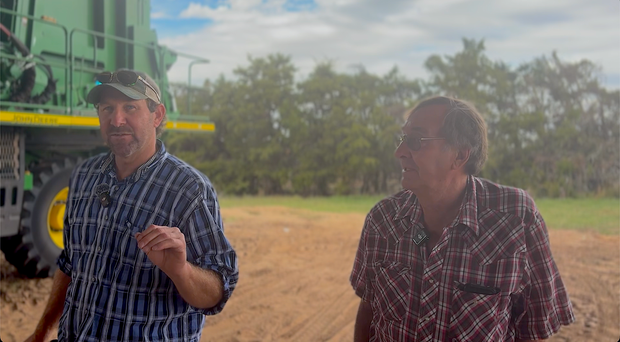
Jeff Preisser's sister, Mandi Sieren, said she doesn't "trust anybody at this point enough to vote for them. I don't care if they're Democrat, Republican … I don't even want to vote for anybody."
But Tracy Chambers, who also owns farmland in the area, emphatically told them: "Your vote is your voice."
She and Larry Preisser said they were drawn to Hamilton after seeing him speak at the Kansas State Fair because he seemed like a moderate Democrat who could bring the parties together.
"He wants to work with the Republicans, too," said Larry Preisser. "He don't want to fight. He wants to work with them, and that's what we need. When I was a kid, they didn't argue like that years ago."
Chambers added: "In fact, he used to be a Republican. … So I think he's not a flaming liberal, and he's somebody who would be good for Kansas."
An hour's drive away, soybean farmer Mick Roush echoed the Preisser family's concerns for his own farm. He said he won't be able to hold on to it much longer if conditions don't change.
But unlike the Preissers, Roush is sticking with Marshall because he thinks Hamilton is "too liberal."
The pressure has split farmers. The Preissers argued Marshall hadn't stuck up for farmers against political decisions at odds with the industry, from the Iran war, to tariffs, to recent Immigration and Customs Enforcement raids in southwest Kansas that left ranchers short-staffed during harvest season.
But many, like Roush, are sticking with Marshall because "he's from farm country." They feel the strain of the Iran war but see it as temporary, and in many cases, say it is justified to keep Iran from building a nuclear weapon. Some are voting for Marshall because they don't want Republicans to lose the Senate, for fear that farmers will fare worse under a Democratic Congress.
An April survey sponsored by Farm Journal found that more farmers and ranchers trust Republicans to handle issues that are key to the industry than Democrats. But it also found that 73% believe their elected officials understand the realities they face "not very well" or "not at all." On every economic issue tested, at least one in five said they didn't trust either party to deliver for them.
Mr. Trump has announced a series of policies aimed at easing diesel prices. At a midterm rally outside Wichita last week, the president announced an $8 billion program to provide temporary fuel relief for farmers.
But the Preisser family called that program a "Band-Aid" for a fundamentally broken system, when what they need is a long-term solution. They lamented that farmers are not able to set their own prices, are paying increasing input costs, are facing more unpredictable growing conditions and are selling in an unstable global market.
"Here's some money to make you feel better. But we're not really going to fix the issue of crop prices and fertilizer prices," said Jeff Preisser. "And we aren't going to get that 'til probably January or February … There's going to be a lot of farmers probably broke by then."
"We almost don't want it. We'd rather have the program be fixed like it's supposed to be," echoed Sieren.
Larry Preisser said he had to sell land that had been in their family for 140 years to help pay the bills.
"It's hitting us from all directions. Every input, taxes, just everything. No way to pass it on," he said. "We're on a dead-end street."
But their worries run deeper than November. They fear for the future of American farming.
Jeff Preisser, 50, has farmed all his life. Over the years, he bought land and built up equity, the cushion farmers lean on in bad years. This year, he said, he had to refinance all of it.
"There is no more equity in anything. I mean, it's maxed out," he said. "So if it doesn't work this year, we're done. I'm done."
Equipment is worth little as collateral, he explained, so farmers who need cash borrow against their land. Each new loan pushes back a payoff date that once felt close. "You go refinance … and then you're out another 30 years, even though you thought you would have paid it off a couple years ago."
That option may be running out, too.
"And what bank is going to loan you money now, the way farming has been going?" said Jeff Preisser. "They'd have to be stupid."
The strain reaches well beyond Kansas. Nationally, farm bankruptcies rose for the second consecutive year in 2025, increasing 46% from one year prior, according to the National Farm Bureau. The U.S. Department of Agriculture projects farm debt will reach $624.7 billion in 2026, a record.
In a January letter to Congress, a coalition of 56 agricultural trade groups warned that farm losses across the industry threatened the country's food supply and that "they represent an economic crisis in rural America."
Some farmers told CBS News they were unsure if they would advise their kids to follow in their footsteps, given the state of the industry. According to the 2022 Census of Agriculture, the average age of U.S. farm producers in 2022 was 58.1 years, and nearly four of every 10 farmers were over the age of 65.
"The fun's gone, but you gotta keep going. Until you're broke," said Larry wistfully. "What else do you do? I can't retire."