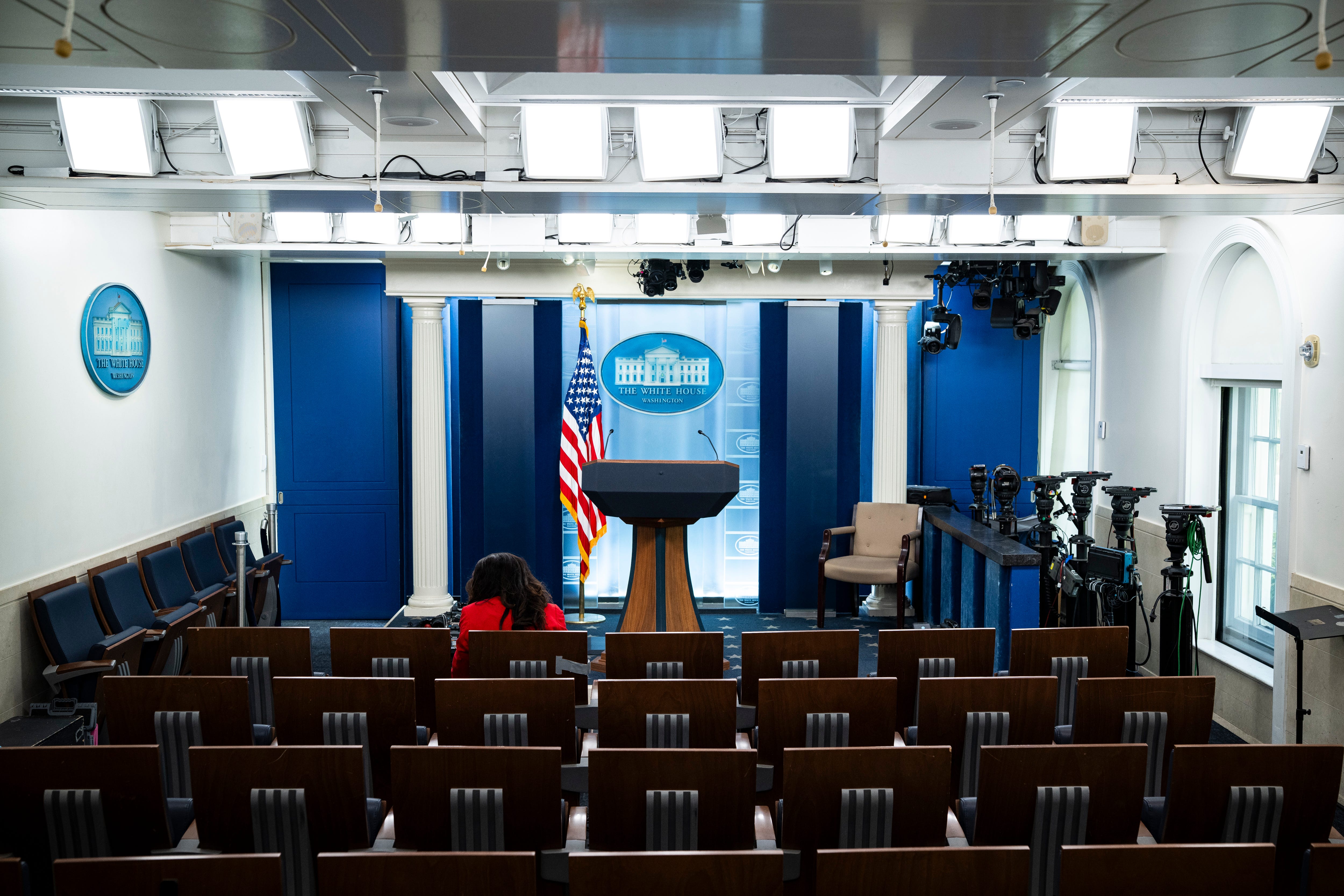
DOJ defends Trump White House media ban, citing national security and "professionalism and decorum"
Washington — Justice Department lawyers on Tuesday defended President Trump's move to bar three news outlets from the White House over coverage of his administration, arguing that their reporting raises national security concerns and claiming their journalists failed to act with "professionalism and decorum."
In a filing with a federal district court in Washington, D.C., the Trump administration argued the president's ban of CNN, MS NOW and Politico is legally sound. Reporters from those news organizations were stripped of their press credentials, also called "hard passes," denying them access to the White House grounds.
"Access to the White House is a privilege, not a right," Justice Department lawyers wrote.
The Trump administration argued the president's ban complies with the First Amendment, because the government has at least two "compelling reasons" for denying the reporters' access: enforcing "minimum standards of professionalism" for the press and protecting classified information.
"The President believes basic journalistic standards require calling, asking for comment, and providing a reasonable opportunity for a response," they said. "At a bare minimum, it is a significant violation of decorum to publish classified and sensitive national security information."
The Justice Department also submitted to the court letters from the White House press office, dated Tuesday, to each of the three outlets notifying them that the president decided to revoke their journalists' hard passes.
The letters claim that the news outlets have "exhibited behavior in violation of the standards of professionalism and decorum expected of those given access to the White House Complex, including by trafficking in verifiable falsehoods about national security and other issues, and publishing sensitive or classified information."
The White House gave CNN, MS NOW and Politico a deadline of 5 p.m. Friday to respond to its claims.
The letters appear designed to address the news outlets' claims that the ban deprived them of due process, since their reporters didn't receive advance notice that they would be denied access to the White House and an opportunity to be heard before revoking their credentials.
"The President provided no notice that he would immediately deny news organizations whose reporting he dislikes access to the White House grounds," lawyers for the organizations said in a filing. "His standard for denying access is arbitrary and vague — indeed, it can hardly be called a standard at all."
The Justice Department's response comes ahead of a hearing, set for Wednesday afternoon, during which a judge will consider whether to order the White House to restore the media organizations' credentials and access. CBS News and dozens of other news organizations have signed onto an amicus brief in support of CNN, MS NOW and Politico.
The three news organizations sued Mr. Trump and top administration officials on Monday, calling his ban a "direct assault on the First Amendment" and a "blatant violation of our most fundamental constitutional principles." The lawsuit names Mr. Trump and three of his top aides: Susie Wiles, the White House chief of staff; Steven Cheung, White House communications director; and Sean Curran, the head of Secret Service.
The news outlets asked U.S. District Judge Timothy Kelly, who was appointed to the federal bench by Mr. Trump during his first term, to rule quickly to once again allow them access to the White House.
The organizations argued in their court filings that the ban violates their due process rights because Mr. Trump "provided no notice" to the companies before banning them, and no opportunity for CNN, MS NOW, or Politico to oppose the ban before it was announced and reporters for the news outlets had their press credentials confiscated.
The ban, the organizations say, also violates the First Amendment because it "brazenly discriminates based on editorial viewpoint," and "to coerce more favorable coverage of the administration from CNN, MS NOW, and POLITICO, and to deter other journalists and news organizations from reporting that the President might view as unfavorable."
Kelly oversaw a lawsuit brought by former CNN reporter Jim Acosta during the first Trump administration after the White House moved to revoke his press credential. The judge sided with Acosta after CNN sued and ordered his press pass to be restored, finding Acosta's due process rights under the Fifth Amendment had been violated. The White House complied with the order, and CNN dropped the lawsuit shortly afterward.
Mr. Trump has also barred The Associated Press from attending certain White House events after the news outlet refused to conform to Mr. Trump's proclamation that changed the name of the Gulf of Mexico to "Gulf of America."
The wire service sued on First Amendment grounds. While a federal judge in D.C. initially ruled that the White House must restore the news outlet's access, an appeals court later allowed the ban to take effect. The litigation in that case is ongoing.
The ruling from the U.S. Court of Appeals for the D.C. Circuit hinged on the fact that the AP was blocked from certain restricted spaces like the Oval Office and Air Force One that only a small subset of the White House press corps can access — a narrower policy than the outright ban imposed on CNN, MS NOW and Politico.
In a 2-1 decision, the two judges in the majority, Neomi Rao and Gregory Katsas, said the White House can't ban journalists from spaces that are "generally open to the press," like the briefing room, based on their viewpoint. Mr. Trump appointed both Rao and Katsas to the D.C. Circuit in his first term.
Since Mr. Trump returned to the White House for his second term, his press office assumed control of the press pool, a rotating group of journalists who cover the president every day and disseminate information and footage to thousands of other news outlets.
The president's ban has already disrupted that information flow: CNN is a member of the television pool system, which includes CBS News, ABC News, NBC News and Fox News, and was scheduled to travel with Mr. Trump to New York on Monday for the United Nations General Assembly.
But the network, which was set to provide coverage in the TV pool slot, was kicked off the trip because of the president's ban. As a result, the four other networks in the rotation decided to suspend the television pool altogether in solidarity with their CNN colleagues.