In California's crowded gubernatorial debate, Democrats go on offense while Republicans lay blame on incumbents
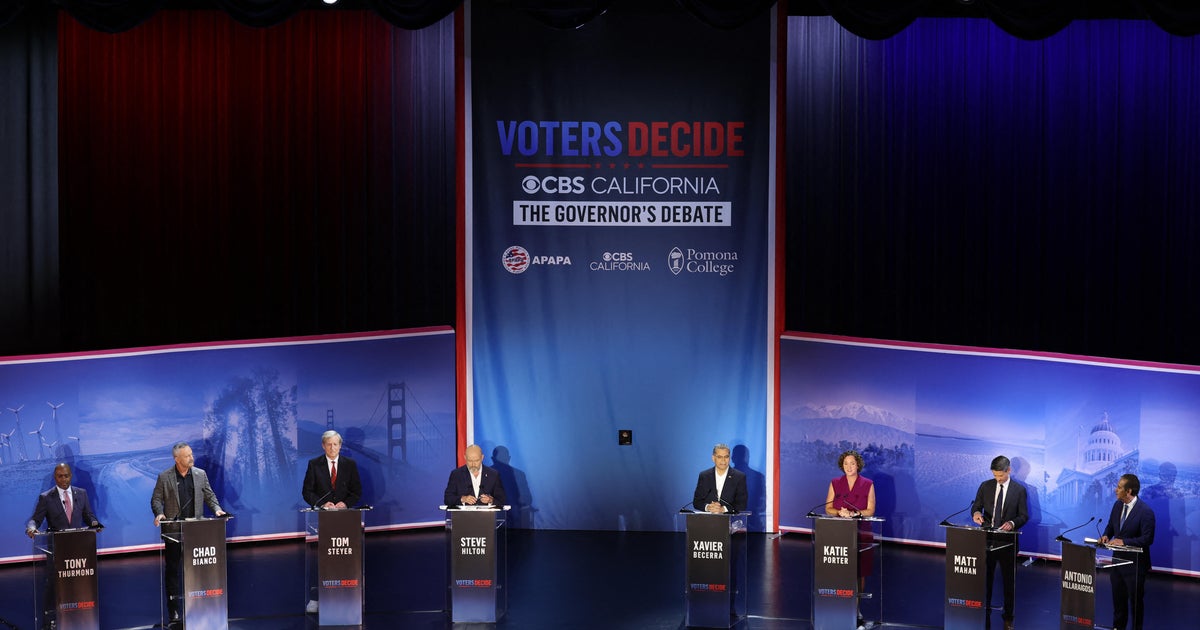
The primary election in California's gubernatorial contest is just over a month away, and the race remains wide open. At a gubernatorial debate this week, a half-dozen Democrats offered divergent views on the state's future — most of whom are within striking distance of each other in the polls — while two Republicans battled for space on the general election ballot.
CBS News' California governor's debate Tuesday night featured the largest number of participants to date. The field includes progressive Democratic candidates Tom Steyer and Katie Porter competing against more moderate contenders Xavier Becerra and Matt Mahan, as well as Antonio Villaraigosa and Tony Thurmond.
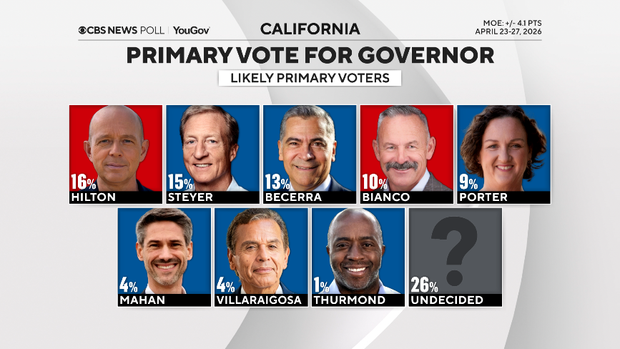
The top-performing candidate in a recent CBS News poll of the deep-blue state is a Republican — Trump-endorsed Steve Hilton — with fellow GOP contender Chad Bianco trailing a few points behind. But the distance between Hilton and second-place Steyer is just one percentage point, and one-fourth of voters are undecided, leaving the race unsettled.
Candidates fielded questions from new CBS News polling on issues that resonate with California voters — healthcare, insurance, education, homelessness and immigration. Affordability permeated every topic, as candidates offered their solutions to the high costs Californians reckon with daily.
Since this debate featured both Democrats and Republicans, the clearest divide on stage was between Republicans, who blamed years of Democratic leadership for the state's high costs, and more progressive candidates who pitched themselves as change agents.
Becerra, who served as health and human services secretary under former President Joe Biden, has made some inroads in the polls following former Rep. Eric Swalwell's departure from the race. He touted his experience in the federal government and credentials as a moderate.
Becerra appeals to moderates — and faces jabs from other candidates
Becerra walked onto the Pomona College stage as the candidate with the most momentum, and therefore was the one most under attack by his opponents on the stage.
Since Swalwell, also a moderate, exited the race amid sexual assault allegations that he has denied, Becerra has risen into double digits in CBS News and Emerson College polling.
Both Republicans and fellow Democrats noticed Becerra's rise, though he's still slightly trailing former Fox News host Hilton and billionaire Steyer in the most recent CBS News poll.
Mahan, the San Jose mayor who is also running in the moderate lane, challenged Becerra on policy specifics. He attacked Becerra's proposal for a home insurance rate freeze, saying, "Xavier's plan won't work."
Porter, a former Orange County-area congresswoman, jabbed at Becerra for his "lovely plans" — with no numbers attached to them.
But when Becerra was asked how he'd respond to expiring healthcare subsidies for Californians, he turned the question into the night's most memorable jab at the GOP frontrunner.
"The first thing we have to do is stop Steve Hilton's daddy," Becerra said, referring to President Trump's endorsement of Hilton. The former California attorney general said that his state needs "someone who's going to fight Donald Trump, not agree with him."
Katie Porter works to distinguish herself
The former congresswoman told CBS News after Tuesday night's debate that she was happy with her performance amid the crosstalk from other participating candidates.
"I thought I had a good chance to make some points of differentiation between me and the other candidates," Porter said. "It was at times — reminded me of my kids a little bit at the dinner table, going bickering back and forth."
As the only woman among the race's top-performing candidates, Porter leaned into her perspective as a mother and acknowledged voters' concerns about the rising cost of living.
"I'm a single mom of three teenagers. I worry that that one kid is never going to get off my couch and get into a home. I'm somebody who's concerned about child care, because I've paid the bills and I've gassed up my minivan," Porter said.
Despite a strong debut in initial Emerson polling back in September 2025, Porter's numbers have been steadily declining. She also faced backlash over an unearthed video that showed her yelling at a former staffer, as well as a tense interview with CBS News California's Julie Watts, who was also one of Tuesday's debate moderators.
Much like Steyer, Porter has embraced progressive stances on various issues, advocating for single-payer healthcare.
Steyer argues he's a "change agent" as other candidates criticize his billionaire status
Steyer, a former presidential candidate, called himself the only "change agent" in the race and the only person who will take on special interest groups.
"The problem in California is: People can't afford to live here anymore, can't afford to buy a house and aren't getting the education they deserve. And in order to change that, we're going to have to take on the corporate special interests that are driving up your costs and profiting off you. I am the person who is willing to do that," Steyer said Tuesday night.
Steyer has an unusual background for a progressive firebrand: Forbes estimates that he's worth $2.4 billion. He made his fortune running a hedge fund, before turning his attention to environmental activism and serving as a Democratic megadonor.
Other candidates took aim at him over that background. At one point, while Steyer was disparaging oil companies in California for pollution, Porter questioned why his hedge fund had previously invested in the same kinds of fossil fuel companies. He has acknowledged these investments in the past and characterized them as "mistakes."
Steyer has been endorsed by Our Revolution, the Bernie Sanders-founded political organization dedicated to electing progressives and "fighting the oligarch agenda." The organization has praised Steyer's efforts to "challenge the very system that benefits people like him."
Speaking of billionaires: The single most divisive and complex issue in the race is a proposed one-time 5% tax on billionaires' assets, which will be put to California voters as a ballot initiative in November. CBS News' polling finds a majority of California voters want the next governor to support an added state tax on billionaires, while Republicans do not.
Neither Republican candidate backs the idea — but not all of the Democratic candidates do, either. Becerra, Porter and Villaraigosa told Politico they oppose the tax, and Mahan said a billionaire tax would "crash [the state's] innovation engine" in an op-ed. Steyer has said he supports higher taxes on billionaires in general but expressed concerns about how the tax is designed. Thurmond has come out in support of the measure.
And Gov. Gavin Newsom is not a supporter — he has said he thinks it could hurt the state's economy and budget if it drives its wealthiest residents to relocate. The tax was proposed by the Service Employees International Healthcare Workers Union West.
Republican anger at Democratic leadership in the state
The two Republicans in the race — Hilton and Bianco — blamed California's overwhelmingly Democratic leadership for the state's dire affordability problems.
"California is broken because of what has been happening in Sacramento, because of an absolute failed Democrat, progressive agenda that is destroying California," Bianco, the sheriff of Riverside County, said Tuesday.
Bianco's comments echoed Republican sentiments expressed in recent CBS News polling, which found that Republicans in the state say things aren't going well. They also believe the economy, under the stewardship of Democrats, is not just bad, but is worse than the nation's.
Both Bianco and Hilton, a former Fox News host, pledged to cut taxes in the state, including getting rid of the state's gas tax, which is currently the highest in the nation. Democrats including Becerra, Porter and Steyer said that they would not get rid of the gas tax if elected.
Voters largely undecided ahead of early June primary
Since California has a nonpartisan "jungle" primary system, the two candidates who receive the most votes on June 2 will head to the November general election, regardless of party.
With the Democratic field deeply divided, some Democrats worry that their party could get locked out of the general election if the field doesn't narrow before the June 2 primary.
The latest CBS News polling shows the race remains wide open. The two highest-polling candidates — Hilton and Steyer — are in the mid-teens, with most of the other candidates close behind. Right now, undecided voters outnumber supporters of any single candidate in the race.