Newsom declares state of emergency in Los Angeles for Boyle Heights warehouse fire
Firefighters faced renewed challenges Saturday at a large Boyle Heights cold storage facility fire, where conditions remain highly complex as Gov. Gavin Newsom and Mayor Karen Bass declared a local emergency to support response efforts.
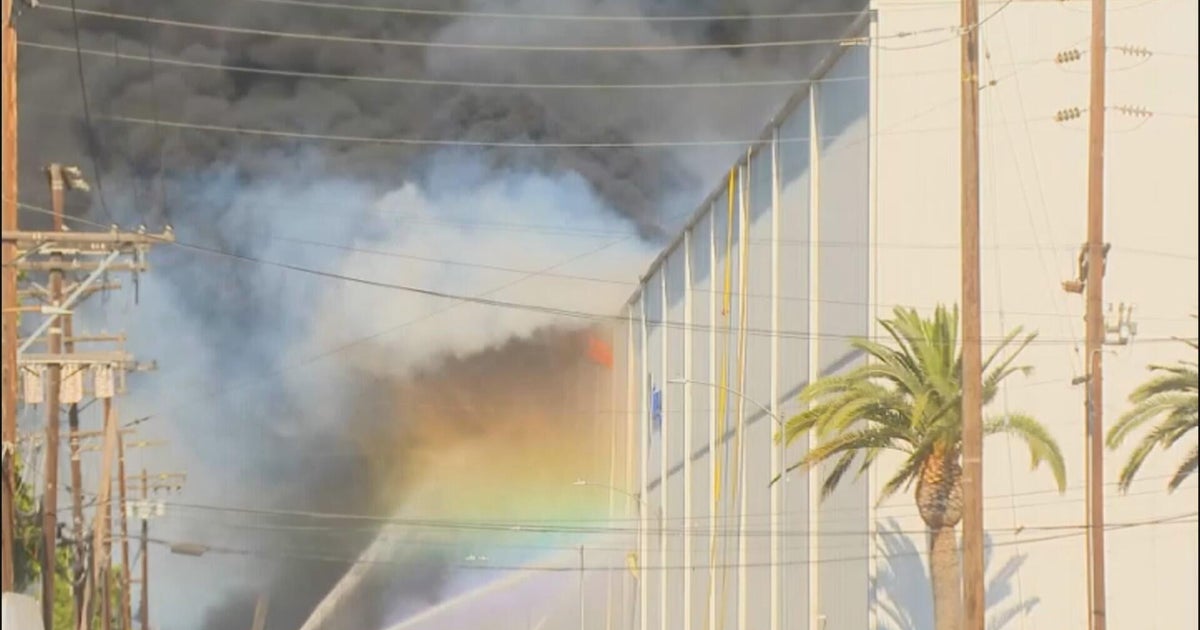
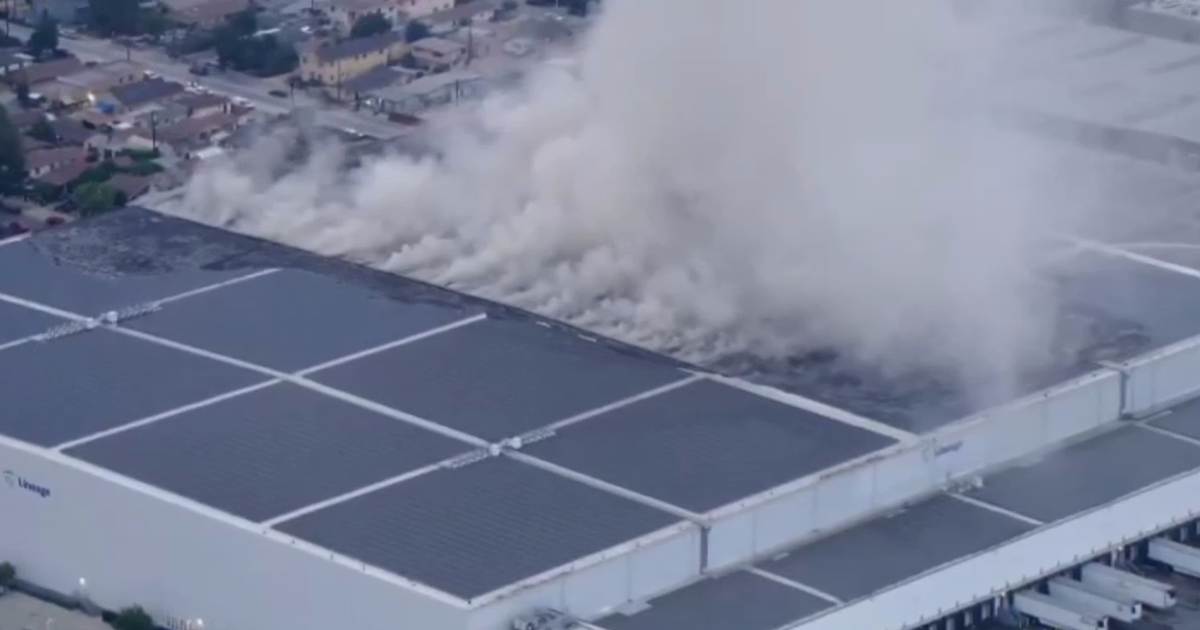
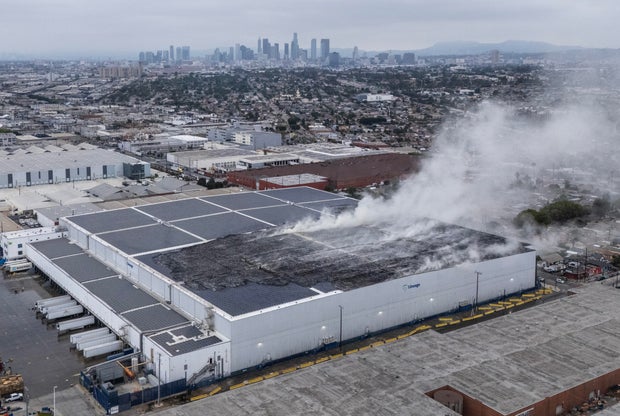
The fire was first reported on Wednesday afternoon at the 500,000-square-foot Lineage Big Bear facility at 1400 S. Los Palos Street, which is used to store frozen foods.
"The best way to describe this is like a giant cooler," said LA Fire Chief Jamie Moore, who added that the structure was built with corrugated steel walls filled with dense foam insulation and reinforced interior steel panels.
The building also used ammonia in its refrigeration system to maintain extremely low temperatures for frozen food storage, which may have fueled the fire on its initial day of burning.
"Imagine your refrigerator having a fire. And so, you have the shell of the outside and the shell on the inside," Moore said during a news conference on Saturday afternoon. "What protects everything from the weather, or whatever the temperature is on the outside, is the rubber. ... If you can imagine, that's exactly what's happening here."
He said that with the help of water-dropping helicopters, LAFD crews have controlled the fire to approximately half of the building. The unaffected half, however, is filled with food that has begun to thaw as they had to turn off the refrigeration system and remove ammonia from inside. He said that the internal temperature of the building remains at around 45 degrees because of the insulation.
Moore said the nature of the materials inside has made the fire difficult to control, as the foam insulation continues to burn slowly once ignited.
Crews have relied on continuous helicopter water drops since the start of the incident to keep the structure cooled and prevent further escalation. Officials have also used large aerial ladder pipes, directing thousands of gallons of water per minute onto the building to contain the blaze.
"We stepped up our game. I reached out to the county and we started using contract helicopters," Moore said. "Our contract helicopters ... drop about 3,000 gallons of water at one time. On top of that, we're able to incorporate blaze tamer gel, which is a fire retardant gel, which is gonna help encapsulate the smoke ... and smother the fire."
So far, he said that the process has been effective as they've helped cool things down and further mitigate the fire burning the roof.
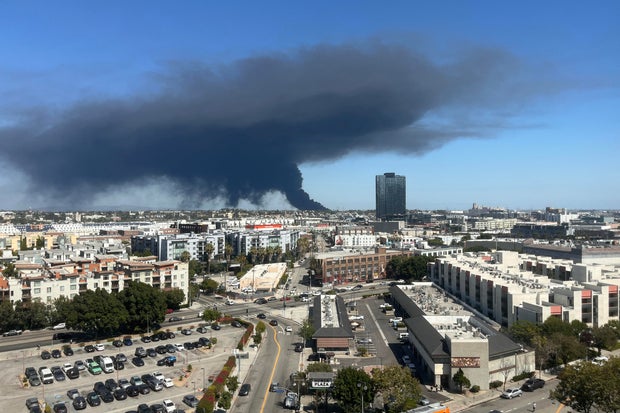
At around 5:10 p.m. on Sunday, aerial footage showed another flare-up in the fire on the roof of the building. Another massive plume of smoke extended into the air as the fire appeared to be burning down the exterior wall and onto a lower roof.
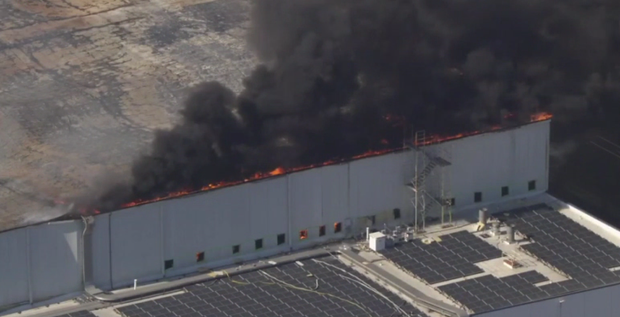
85 million pounds of frozen food complicate firefighting efforts
With an estimated 85 million pounds of frozen food still inside the facility, firefighters say access is extremely limited due to zero visibility and unstable interior conditions.
"All that food is slowly beginning to rot. It's no longer frozen. It's warming up and it's going to start to spoil," Moore said. "Initially it was reported to us that the majority of that product was bread and wheat products. However, we're slowly learning as we get into this building that it's far from that; there's a lot of meat products."
Moore said that chicken, beef, pork and fish were being stored inside.
Officials stressed that crews are not entering the building or attempting to manually remove product. Instead, they are working to isolate unaffected areas while evaluating how to safely remove remaining goods before spoilage creates additional biohazard concerns.
"What we are trying to do now is to figure out the uninvolved area – how we can remove that food before it starts spoiling and becoming a biohazard concern," Moore added.
Authorities said hazardous material risks have largely been mitigated, but the situation is now shifting toward potential biohazard issues as food inside the facility remains unrecovered. Officials emphasized that the priority is determining how to safely manage and remove the stored product while maintaining containment.
No injuries reported; no evacuation or shelter-in-place orders issued
Despite the severity of the incident, officials noted that no firefighters or civilians have been injured. Residents were advised that while smoke may be irritating—particularly for those sensitive to air quality—there is currently no order for evacuation or shelter-in-place, despite a similar order already having been issued and lifted twice since the fire's ignition.
"If you are sensitive to smoke, please be cognizant of that and try to stay indoors," cautioned Moore. "But there is nothing in the air that is so dangerous that we have to do evacuations or even shelter-in-place."
Mayor Karen Bass said her chief concern was for the public's safety and health.
"We're not concerned in terms of the fire spreading or anything like that. But we are concerned about the biohazard smoke. No smoke is good, but especially the smoke that could be toxic because of the chemicals that were needed to keep the food frozen in the facility," Bass said.
Two shelter locations have opened to support anyone affected by the fire, including at the Pecan Recreation Center, which is located at 145 S. Pecan Street, Los Angeles, CA 90033 and City Terrace Park, which is located at 1126 N. Hazard Avenue, Los Angeles, CA 90063.
"We are going to be distributing masks and air filters, thank you to the Red Cross and our other partners," said Bass, who said she anticipates talking to Governor Newsom later in the day to issue a joint emergency declaration.
"The Governor will be prepared to respond to our State of the Emergency when that is ready with whatever resources we need to do what the Chief described, which is moving the toxic materials away from here and disposing of them in a way that we will avert a major environmental disaster," Bass said. "This is about prevention. This is about protecting our public's health."
Bass, Newsom issue emergency declaration for resources
By Saturday night, both the mayor and Gov. Gavin Newsom had issued emergency declarations, citing the scale and complexity of the incident.
The declaration is intended to provide the city with greater flexibility to coordinate emergency response efforts, secure additional resources, conduct environmental remediation, and seek state and federal assistance.
"While the LAFD continues making progress, this is a major, multi-jurisdictional incident. I'm issuing an emergency declaration to ensure the City has the resources it needs as this operation continues and to keep the community safe," said Mayor Bass. "The City and County have opened spaces for families seeking relief from the smoke, and we will continue working around the clock and doing everything possible to put this fire out completely."
During Saturday afternoon's news conference, Bass said that the joint state of emergency was filed with Newsom's office.
She said that the Emergency Operations Center has been activated and that they've asked Newsom to waive regulations that could hinder response and recovery efforts, and that recovery assistance be made available through the state.
"We basically told the governor that we will be in touch from the county and the city in terms of ongoing requests for mutual aid as well as monetary assistance so that we can get this job done," Bass said. "Our concern, obviously, is putting out the fire, but to learn what was in this storage center ... really presents an entirely different picture."
LA County Supervisor Hilda Solis also spoke at Saturday's conference.
"I'm deeply concerned about the impact on our residents," Solis said. "The radius of the fire extends to about 2.5 miles. In unincorporated East Los Angeles we're talking about 250,000 households. That's why this is important."
Gov. Newsom's office shared a statement regarding the emergency proclamation late Sunday night, which they said would enable the state to further support the ongoing local response.
"California is mobilizing to support Los Angeles as firefighters and emergency personnel continue their work to contain this fire and protect surrounding communities," Newsom's statement said. "While local officials continue to lead this response, the State of California is prepared to help safeguard public health, support emergency operations, and assist impacted residents. We are coordinating closely with our local partners, deploying specialized expertise, and pre-positioning critical supplies so communities have the support they need both now and throughout recovery."
Among the resources being deployed to Los Angeles were 5.5 million N95 respirator masks, commercial-grade air purifiers for evacuation centers, bottled water and emergency supplies and additional air quality monitoring equipment.
Additionally, California Office of Emergency Services Fire and Rescue Branch leaders with "specialized technical expertise" are en route to work with local officials to provide consultation on suppression strategies and operational considerations, according to the release.
Residents question long-term health impacts
As suppression efforts continued, residents voiced concerns about the potential long-term environmental and health impacts on the surrounding community.
On Saturday afternoon, South Coast Air Quality Management District officials said that a particle pollution advisory was extended until at least 12:30 p.m. Sunday. They said that after the fire's reignition on Friday night, sensors showed that PM2.5 levels were unhealthy.
Two smoke relief centers have been opened for people impacted by the incident. They can be found at:
- Pecan Recreation Center at 145 S. Pecan Street
- City Terrace Park at 1126 N. Hazard Avenue
Lineage, the building's tenant and operator, released a statement indicating that the fire may have originated from work being performed by a third-party contractor handling solar panels on the roof.
"Lineage is the tenant-operator of this building," the company said in a statement. "At this time, we believe the fire began while testing was being conducted by contractors of the third-party owner of the solar array located on the facility's roof. This facility is not used for the storage of hazardous materials. It primarily serves as a temperature-controlled storage facility for frozen food before it makes its way to Greater Los Angeles area communities and beyond. Our understanding from LAFD and AQMD is that there have been no measurable ammonia concentrations recorded in the community since the fire started. Additionally, Lineage has proactively taken additional steps to pump out the ammonia and transport it offsite, removing the possibility of ammonia posing a risk to the community. This facility and the supply chain it connects with employ hundreds of local jobs. We are grateful that no team members at the facility were harmed."
Meanwhile, fire crews continue to monitor the structure and adjust tactics as they work to contain the long-burning industrial fire and reduce environmental and health impacts to surrounding communities. Authorities cautioned that extinguishing the fire could take days or even weeks.
"I do want to be transparent to the public: this work is far from over. Because of the massive scale of this cold storage facility, deep pockets of smoldering fire remain buried under structural debris and solar panels," said Los Angeles County Fire Chief Jon O'Brien. "Our city firefighting brothers and sisters are executing a meticulous, deeply challenging operation to bring the fire under control. Because of this, incident operations will continue into the foreseeable future."
Residents who notice unusual odors, smoke, dust, or other air quality concerns are urged to report them to the South Coast Air Quality Management District. Complaints can be submitted by calling 1-800-CUT-SMOG (1-800-288-7664), or by using the agency's online complaint system to report air contaminants both indoors and outdoors. To view current air quality, download the South Coast AQMD app or visit www.aqmd.gov/AQImap.