"Do not open until July 4, 2276": What will America's Time Capsule reveal?
As America approaches this milestone anniversary, many celebrations are looking back at our past 250 years, but one looks forward.
Tom Medema, project manager for America's Time Capsule, says, "The time capsule gives everybody the chance to talk to the future. It is a form of time travel for ideas and for physical things."
Medema is responsible for assembling a team of experts across disciplines – scientists, lawmakers, librarians – to fulfill a 2016 mandate from Congress to honor the semiquincentennial, which states a time capsule shall be buried in Philadelphia at Independence National Historical Park on the 4th of July, 2026, to be unearthed on America's 500th birthday, on July 4, 2276. The law mandates the capsule will contain "books, manuscripts, miscellaneous printed matter, memorabilia, relics, and other materials."
Who decides what gets preserved? "We wanted all states and territories and D.C. to be represented, to choose their own objects to submit," said Medema.
According to Rosie Rios, the chair of America 250, "It has to be sea-to-shining-sea. It has to be grassroots community-driven. It has to be personal."
At the White House Visitor Center, guests can compose their own messages to the future. "The goal is to have as many folks as possible participate in this, and then also choose a select few that will be included in our time capsule," said Rios. The messages being submitted, she said, express "a lot of hope. There's a lot of optimism."
But even before choosing what goes inside the time capsule, there's the question of how to ensure those precious items will survive 15 feet below ground until they're unearthed in 2276.
"The existence of a time capsule to last 250 years has never been done," said Mike Berilla, director of the Fabrication Technology Office at the National Institute of Standards and Technology (NIST). "We are taking on this challenge and just doubling, tripling down and saying, yeah, we're going to make another 250 years."
Asked what we've learned from past time capsules, Berilla said, "Most time capsules fail because water comes in. Initially we had three different designs. We had a box, we had a star, and we had a cylinder. And the star would have been a nightmare, but so cool to pull off!" But the edges mean water could get in.
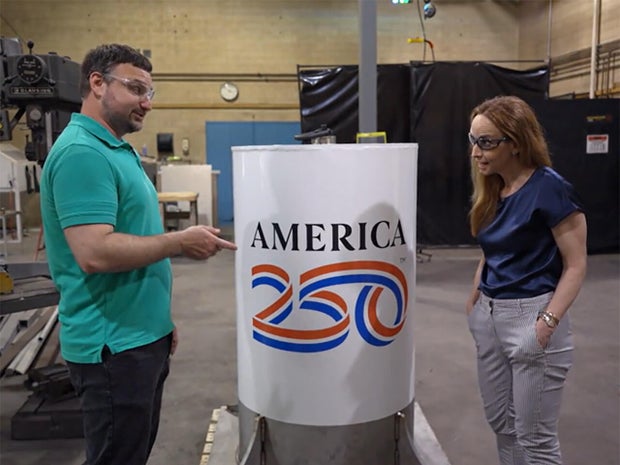
The stainless-steel cylindrical design they settled on weighs one ton even before being loaded with the contents, which have been mailed to NIST from across the 50 states, D.C., and five territories.
West Virginia sent a piece of coal carved into the shape of the state of West Virginia. Ohio sent a piece of fabric from the Wright Flyer, with an original statement from Orville Wright.
Archivists at the Library of Congress determined what will stand the test of time, and rejected submissions that won't, including anything that will decay, decompose, or affect the other objects around them. No adhesive, no leather, no apple pie!
What the capsule will hold includes an iPhone 17; Native American artwork; essays from students; coins and pins; a Coca-Cola bottle; and even a feather from the eagle that accompanied Union soldiers into battle.
And, courtesy of the Library of Congress, our founding documents, with a 2026 high-tech twist: Synthetic DNA encoded with digital copies of Thomas Jefferson's original draft of the Declaration, a rendering of Abraham Lincoln's hand, and music – a recording of "The Star-Spangled Banner," contained in a vessel the size of a thimble. "That something of this size can hold that much power and that much of our history in it, is mind blowing," said Medema.
He believes the time capsule embodies our faith in the continuation of the American experiment. "This time capsule is all tangible things," Medema said. "But it's connected to ideas that are timeless. The ideals that are outlined in the Declaration of Independence are timeless. We haven't always lived up to them, but everyone around the world can agree that they are the aspiration of everybody."
For more info:
Story produced by Lucie Kirk. Editor: Chad Cardin.
See also:
- 1795 Time capsule buried by Sam Adams, Paul Revere opened in Boston
- Opening of NYC time capsule brings 1914 into the present
- Colorado Gov. Jared Polis opens 1907 time capsule found underneath statue at Colorado State Capitol
- Michigan high school students uncover time capsule from 1999
- How to create a back to school time capsule
- That buried car in Tulsa? A bucket of rust