Iran conflict expands as Senate again rejects effort to limit Trump's war powers
Follow updates on the war in the Middle East for Friday, July 31, here. See earlier developments below.
What to know about the Iran war:
- Iran said U.S. strikes killed three of its soldiers Thursday as the latest round of attacks threatened to engulf more countries in the region. Jordan said it intercepted Iranian missiles for a second consecutive day, while Kuwait said a strike there killed one person.
- The Senate on Thursday again narrowly rejected an effort to limit President Trump's Iran war powers. The resolution, brought by New York Democrat Kirsten Gillibrand, lost 49-50. Three Republicans voted in favor of it.
- Drone strikes at Egypt's Mediterranean port of Damietta sparked fires on two natural gas vessels Wednesday, in what appeared to be the first time Egypt has been targeted. The origin of the strike remains unknown, but Iran's Houthi allies have targeted ships in the nearby Red Sea.
- About two-thirds of U.S. adults say the war with Iran has not been worthwhile, according to a poll conducted by The Associated Press and NORC Center for Public Affairs Research. That includes the vast majority of Democrats and independents, as well as about 37% of Republicans.
Iran receives bodies of Revolutionary Guards killed in U.S.-Saudi strikes in Iraq
Iranian state media said Friday that the bodies of five members of the Islamic Revolutionary Guard Corps (IRGC) killed in joint U.S.-Saudi strikes in Iraq this week had been returned.
"The bodies of five IRGC members killed in the recent U.S.-Saudi attacks on Iraq were brought into the country through the Mehran border crossing," in western Ilam province, the IRNA state news agency reported.
The United States and Saudi Arabia said on Wednesday they had struck Iran-backed militants in Iraq in response to recent attacks on the Gulf kingdom.
The strikes targeted positions belonging to the Hashed al-Shaabi, an Iraqi armed coalition that includes several powerful pro-Iran groups, killing at least 20 militants, including the five Iranians.
The IRGC's Quds Force oversees Iran's operations abroad, and Guards members killed outside Iran are often affiliated with the unit.
The United States killed the Quds Force's commander, Qasem Soleimani, in an airstrike in Baghdad in 2020, along with Hashed al-Shaabi's deputy leader, Abu Mahdi al-Muhandis.
U.S. investigating whether Iran was behind cyberattack on Minnesota water systems
Malicious cyber activity affected technology at more than 30 community water systems across Minnesota this week, forcing some utilities to switch to manual operations as state and federal authorities dig into who is behind the attack, CBS News has learned.
Investigators are probing to determine whether the activity is the work of Iranian hackers, according to U.S. officials and sources familiar with the incident. Sources cautioned that since they had not definitively attributed the attack, their assessment could change as additional technical evidence is collected. They are also probing whether the actor could have attempted to appear Iran-based as a way of stirring the pot amid the ongoing U.S. conflict with Iran.
Minnesota and the federal government have not publicly attributed the activity to a particular actor.
Iran military says targeted U.S. base in Kuwait with drones
Iran's military said Friday it launched drone strikes targeting U.S. military facilities in Kuwait.
The army said in a statement that it targeted "fighter aircraft shelters, satellite communications systems and equipment storage facilities at Ahmad al-Jaber Air Base in Kuwait".
There was no immediate comment from the U.S. Central Command.
The Iranian army said the strikes came "in response to the recent aggression by the terrorist U.S. military against our country and its brutal attack on a residential home on Qeshm Island."
Local media reported on Thursday that three members of a family were killed in U.S. strikes on Qeshm Island in the Strait of Hormuz waterway that is crucial for oil and gas trade.
The trade route normally carries around 20 percent of global oil shipments and has been effectively closed by Iran since the outbreak of the war on Feb. 28.
The US has carried out repeated strikes on Iran's southern coastal provinces as it seeks to weaken Tehran's control over the waterway.
Hamas agrees to next phase of Gaza deal, Trump says
President Trump said Thursday evening that the militant group Hamas, an Iran-backed proxy, and his international "Board of Peace," have agreed on the next steps in a peace deal that includes Hamas' disarmament in the Gaza Strip.
In a Truth Social post, the president called it a "HISTORIC agreement for the COMPLETE DISARMAMENT of Hamas and all other armed groups in Gaza," and a "monumental step toward lasting PEACE and SECURITY."
The exact timetable for disarmament isn't clear.
Hamas communicated through mediators that it agreed to the final text of the plan, including decommissioning their weapons, U.S. and Board of Peace officials told reporters Thursday.
U.S. says it has turned around 24 commercial ships in Iran blockade
The U.S. military's Central Command said Thursday it has redirected 24 commercial vessels since restarting a blockade on Iranian ports earlier this month, up from 20 vessels a day earlier.
Since President Trump reinstated the blockade, U.S. forces have boarded two ships accused of violating it and have fired at two other ships to disable them, CENTCOM said.
The U.S. has publicly insisted the Strait of Hormuz is still open to commercial traffic, but transits through the waterway remain extremely low as Iran threatens to strike ships.
New sanctions target Iran's largest airline carrier, Mahan Air
The U.S. Treasury has sanctioned Mahan Air, Iran's biggest airline, in its latest round of financial punishments against the country.
"Although Mahan Air presents itself as a civilian carrier, it has long played a central role in enabling the Islamic Revolutionary Guard Corps (IRGC), providing travel services for IRGC‑Qods Force personnel, facilitating military training, and supporting Iran's procurement and transport of unmanned aerial vehicle (UAV) systems and weapons," the Treasury said in a statement Thursday.
The sanctions also target several, mostly Chinese-based, companies who do business with Mahan Air, including Shanghai Wings, which the U.S. said has "coordinated the transport of electronics from China to Iran." Tang Xin, the company's managing director, has also been sanctioned.
The U.S. has announced several rounds of sanctions targeting Iran — at least 12 since the war began on Feb. 28. The last round was announced just yesterday and targeted the Persian Gulf Marine Insurance Company and Hormuz Safe Marine Services Authority, two entities involved in coordinating transit through the Strait of Hormuz.
Iran war powers vote fails again in Senate
A vote in the Senate to limit President Trump's war powers has failed again, likely the last one before the recess begins Aug. 10.
The resolution, brought by New York Sen. Kirsten Gillibrand, lost 49-50. Three Republicans voted in favor of limiting Mr. Trump's power to continue the war — Lisa Murkowski, Susan Collins and Rand Paul — while one Democrat voted against it, John Fetterman. Republican Mitch McConnell, who remains in a rehabilitation facility, is the one senator who did not vote.
The resolution, if passed, would've "direct[ed] the removal of United States Armed Forces from hostilities within or against the Islamic Republic of Iran that have not been authorized by Congress."
The vote came exactly one week after the last Democratic effort failed.
NBA will not play preseason games in Abu Dhabi, sources say
The NBA will not be holding any preseason games in Abu Dhabi due to the ongoing war in the Middle East, according to sources.
There have been games at Etihad Arena in Abu Dhabi, in the United Arab Emirates, as part of its Global Games initiative every year since 2022. The defending champion New York Knicks played two games against the Philadelphia 76ers in October 2025. Historically, two teams have played a pair of games each year.
The NBA does still plan to hold future games in Abu Dhabi, the sources said.
In January, the NBA announced a continuation of its relationship with Abu Dhabi's Department of Culture and Tourism. At the time, the league said teams participating in the fall edition of the games would be named at a later date.
The league also announced the NBA Global Academy would move to Abu Dhabi in the future. The academy provides both education and basketball development for elite high school-age players around the world.
Abu Dhabi is among the locations targeted by Iran as retribution for Israeli and American attacks beginning Feb. 28. Attacks in the UAE have decreased in recent months, but the country has intercepted hundreds of missile and drone attacks.
U.S. rejects several claims made by IRGC, including attack on F-35s in Jordan
The U.S. military rejected several claims by Iran's Islamic Revolutionary Guard Corps on Thursday, including the assertion three U.S. F-35 stealth fighters were destroyed in a missile attack.
Iran had claimed the attack earlier Thursday, saying the Muwaffaq al-Salti Air Base in Jordan was targeted and several F-35s were hit.
"No U.S. aircraft were destroyed or damaged in recent attempted Iranian attacks," U.S. Central Command said on X. "All missiles and drones were intercepted or failed to reach targeted areas."
The U.S. also denied an alleged Iranian claim that an oil tanker, M/T Nora, had been able to elude the U.S. blockade on the Strait of Hormuz. CENTCOM highlighted that more than 20 ships have now been redirected by the reinstated blockade on commercial vessels entering or exiting Iranian ports.
U.S. Central Command also countered Iran's claims that it is dangerous for ships to pass through the Strait of Hormuz, saying, "The immediate dangers posed to commercial vessels and their civilian crews are the IRGC's verbal threats and attempted attacks."
Several ships have come under fire from Iran in the strait, however, as recently as Wednesday. Three oil tankers were targeted, the IRGC said, after four days of there being no strikes.
Iran claims Jordanians provided information "from inside U.S. bases on their soil"
Iran's army claimed on Thursday to have received help from Jordanians with "information from inside U.S. bases on their soil," according to state broadcaster IRIB.
In a post on X, IRIB wrote, "Iranian armed forces thanked the people of Jordan for providing useful information from inside U.S. bases on their soil, saying their sincere cooperation and the outspoken stance of Jordanian elites have tightened the space on the enemy and left it under pressure."
In recent weeks, Iran has targeted Jordan repeatedly. The kingdom is home to several U.S. bases, though it doesn't officially admit it.
Earlier in July, three U.S. soldiers were killed in an Iranian attack on Jordan's Muwaffaq Salti Air Base.
Vance and Netanyahu had "cordial and productive conversation," says U.S. official
Vice President JD Vance and Israeli Prime Minister Benjamin Netanyahu had a "cordial and productive conversation" on Wednesday, a U.S. official told CBS News.
On a podcast earlier this month, Vance said some figures in the Israeli government were "manipulating and trying to change American public opinion to keep the war going on indefinitely."
Speaking to ABC News on Wednesday, Netanyahu denied the charge, saying: "I had a very good conversation with the vice president this morning, and I think we straightened that out, because we're not. That's not our policy."
A U.S. official told CBS News that Vance and Netanyahu "had a cordial and productive conversation about Middle East issues that are important to both countries. They agreed to continue pursuing opportunities for Israel and the United States to cooperate in areas of mutual interest and shared goals."
U.S. and Israeli officials told Axios the conversation was "frank" and "direct."
London insurers expand Red Sea high-risk area over attacks from Yemen's Houthis
London's marine insurers have expanded the zone in the Red Sea it considers high-risk in light of Houthi attacks on ships, according to a July 29 bulletin.
The advisory comes from the influential Joint War Committee, which is made up of members from the Lloyd's Market association and other major British maritime insurers.
As of Wednesday, the group's high-risk area includes more of the northern Red Sea.
On July 20, the Iranian-backed Houthi rebels in Yemen opened a new front against the U.S. and its Gulf allies by announcing a maritime blockade of Saudi Arabia's Red Sea ports and vessels. Soon after, the Houthis attacked two Saudi oil tankers.
The Houthis' have also threatened to close the Bab el-Mandeb Strait - the southern gateway to the Red Sea - to Saudi ships as part of their blockade.
"Two [Saudi linked vessels] were attacked in the first few days after the [Houthi] announcement," the JWC said in its report. "The JWC has adjusted the Red Sea notification line northwards to reflect this development."
The JWC has not yet labeled Egypt's coastal waters high-risk, but Wednesday brought the first apparent attack on energy infrastructure in the country. Drones hit Egypt's Damietta port on the Mediterranean coast, near the entrance to the Suez Canal, which provides northern access to the Red Sea.
No entity has claimed the attack.
Houthis say they were not behind drone strike on Egypt port
Yemen's Iranian-backed Houthi rebels said Thursday that they were not behind a drone strike the previous day that hit a U.S.-owned-and-operated natural gas storage ship in Egypt's Mediterranean port of Damietta.
According to the Houthi-affiliated news agency Saba, an official in the movement's foreign affairs office said "rumors claiming Yemen targeted a ship in Damietta Port in the Arab Republic of Egypt are unfounded."
The Houthis have in recent weeks targeted Saudi-linked ships in the Red Sea and threatened to close the Bab el-Mandeb Strait – a key oil and gas transit point – to Saudi vessels, in what appears to be a bid to to increase pressure on U.S. allies in the region and reaffirm Iran's leverage over global energy supply.
CBS/AFP
Iran says it targeted a U.S. air base in Kuwait
Iran's powerful Islamic Revolutionary Guard Corps said Thursday that it had targeted the Ali Al-Salem U.S. Air Base in central Kuwait, and it claimed to have destroyed "two drone hangars and a fuel tank for military aircraft and helicopters" in the strike.
Neither U.S. nor Kuwaiti officials confirmed any impact on the base.
Earlier Thursday, the Kuwaiti army said a building in the north of the country, belonging to a Chinese company, was hit, killing one worker, whose nationality was not given.
Kuwait, like other Persian Gulf states and Jordan, has come under repeated attack by Iranian missiles and drones this week, amid a new exchange of attacks with the U.S.
Netanyahu denies Israel trying to persuade Trump to continue attacking Iran after Vance accusations
Israeli Prime Minister Benjamin Netanyahu has denied that Israel is trying to scupper efforts to broker a peace deal between Iran and the United States.
Speaking Wednesday to ABC News, Netanyahu was asked about comments made by Vice President JD Vance on a podcast earlier this month. Vance alleged that some people in the Israeli government were "manipulating and trying to change American public opinion to keep the war going on indefinitely."
"Well, we're not actually," Netanyahu said. "I had a very good conversation with the vice president this morning, and I think we straightened that out, because we're not. That's not our policy."
U.S. and Israeli officials told Axios the conversation was "frank" and "direct."
Netanyahu said President Trump is driving decision-making when it comes to the Iran war.
"The truth is, we're partners," he told ABC. "We're allies. He's the senior partner. It's the United States of America, let's not forget, and I'm a junior partner. But I'm the Prime Minister of Israel, and when I have to stand up for the interest of my country and the security of my country, I do so."
"But I always do so with a deep appreciation of the role that the United States under President Trump has played in joining forces with us against our common enemy that wants to destroy us both," Netanyahu added.
Asked about prospects for a diplomatic resolution to the war, he replied: "I don't know if it's unlikely, but I'm skeptical about Iran's modus operandi."
"They always lie, they always cheat, and they always play for time," Netanyahu added. "Could that, within sufficient pressure – diplomatic, economic pressure – could that change? Give it a try."
Pakistan says U.S.-Iran talks ongoing despite trade attacks
Pakistan said Thursday that negotiations between Iran and the United States were ongoing, even as U.S. Central Command announced another "heavy wave of strikes" on targets in Iran in retaliation for further attacks targeting a U.S. air base in Jordan.
It appeared Pakistan, which has acted as a mediator for months, was referring to indirect talks, as Iran has repeatedly denied any direct negotiations with U.S. officials this week. Tehran said earlier this week that it had held further talks with Omani officials, over future mechanisms to control traffic in the Strait of Hormuz, but the foreign ministry insists there is no current dialogue with American officials.
The last two days have seen Saudi Arabia join the U.S. in striking militant groups in Iraq, and Egypt come under fire for the first time with a drone attack at a Mediterranean port – though the perpetrator of the attack is unclear. On Thursday morning, Jordan and Kuwait reported incoming Iranian strikes.
The return to direct hostilities followed a brief pause in fighting meant to give talks a boost.
"Negotiations between parties are ongoing, particularly on [the] Strait of Hormuz and to de-escalate," Pakistani foreign ministry spokesman Tahir Andrabi told reporters in Islamabad, the AFP news agency reported.
Pakistan previously helped broker a deal between the warring sides that laid the groundwork for negotiations on a permanent resolution. Andrabi said it was doing its "utmost to bring all parties back" to technical talks under the agreement.
Previous direct and indirect talks between Iran and the U.S. following an April truce have stalled, with the ceasefire collapsing earlier this month and Iran again declaring itself the sole authority over the Strait of Hormuz, a vital conduit for global oil and gas.
Iran's paramilitary Revolutionary Guard said Thursday that two oil tankers attempting to transit the strait with U.S. support turned back after one of them caught fire.
CBS/AFP
Iran's Revolutionary Guard claims strike on U.S. base in Jordan killed personnel, destroyed F-35s
Iran's paramilitary Revolutionary Guards Corps claimed Thursday to have killed "a number" of U.S. personnel with a strike on the Al-Azraq Air Base in eastern Jordan, which the force said also destroyed three F-35 fighter jets.
A statement published by Sepah News, the official outlet of the IRGC, claimed the force's aerospace unit had "attacked the deployment ramp and maintenance shed of the American enemy F-35 fighter jets at the Al-Azraq Air Base with several ballistic missiles, completely destroying three F-35 aircraft" and damaging three others.
The IRGC said the attack was retaliation for the U.S. killing three members of a family, including a child, on Iran's Qeshm Island, in the Strait of Hormuz, with recent strikes.
The IRGC and Iranian state media often greatly exaggerate battlefield successes, and there was no immediate confirmation from the U.S. military of an Iranian attack hitting a base housing American forces in Jordan on Thursday.
An Iranian attack on another facility, the Muwaffaq Salti Air Base in southern Jordan, killed three U.S. soldiers in mid-July, and Iran has targeted American forces in Jordan relentlessly since then.
Saudi Arabia's GDP drops 4.8%, oil activities 24.7%
Saudi Arabia's Gross Domestic Product, a key measure of its economic health, fell 4.8% in the second quarter of 2026 compared to the previous year, while its "oil activities" fell a staggering 24.7% in the same period, Saudi's state-owned Al-Arabiya TV said Thursday.
The kingdom acknowledged joining the U.S. to carry out strikes on Iranian-backed militias in Iraq Wednesday - the first public engagement of any Persian Gulf nation during the five-month war. At least 20 people, some of them Iranian military advisers, were killed in the U.S.-Saudi strikes, according to the Iran-backed militia groups.
Two-thirds of adult Americans say the war in Iran has not been worth fighting, says new poll
Most Americans say the war in Iran has not been worth fighting, and President Trump's approval rating on Iran has fallen slightly since last month, according to a new AP-NORC poll.
The results are a stark repudiation of Trump's approach to the conflict, which has dragged on far longer than he originally predicted.
About two-thirds of U.S. adults say the war with Iran, which began Feb. 28, has not been worthwhile, according to the new poll from The Associated Press-NORC Center for Public Affairs Research. That includes the vast majority of Democrats and independents, as well as about 37% of Republicans.
The poll was conducted July 23-27, as the U.S. and Iran paused attacks following a nearly two-week escalation in the war. During the flare-up, the U.S. targeted Iranian military and commercial sites while Iran attacked U.S. military facilities in the Middle East, resulting in additional deaths of American service members. Since the war began, 18 U.S. service members have been killed, though the Trump administration has sought to revise those numbers.
The survey reinforces how unpopular the Iran war has become at home, a potential problem for congressional Republicans up for reelection in November who have defended Trump's military actions. Just 28% of U.S. adults now approve of how Trump is handling Iran, a slight decline from 34% last month. Even Republicans appear to be increasingly unhappy with the prolonged conflict. Roughly 61% of Republicans approve of how Trump is handling Iran, an apparent decline from 71% in June. The margin of sampling error for Republicans is 6 points, so the decline is considered slight, but it's still noteworthy given Republicans' much higher approval of how Trump is handling the presidency overall.
Trump's overall approval rating is at 33%, slightly below where he stood at this point in his first term and similar to where former President Joe Biden stood about one and a half years into his presidency, when inflation peaked.
AP
Iran's Revolutionary Guards say three members killed in U.S. attack on country's northwest
Iran's paramilitary Revolutionary Guard Corps (IRGC) said on Thursday that three of its members were killed in an attack by the United States on the northwestern province of Zanjan.
Iran's state-run news agency IRNA said Thursday that three members of the same family were killed and two others wounded in the U.S. strike, which hit Qeshm island in the Strait of Hormuz.
CBS/AFP
Surprise Iranian attack shattered four-day lull in fighting
A four-day lull in the fighting between the U.S. and Iran to allow for diplomacy was shattered overnight after Tehran launched a surprise attack – targeting a U.S. base in Jordan.
After President Donald Trump vowed to hit Iran "very hard" in relation, American fighter jets launched what U.S. Central Command described as a "powerful response" of air strikes on military command centers, missile and drone facilities, coastal surveillance and defense sites and maritime capabilities.
Iranian state media said U.S. strikes in Qeshm island in the Strait of Hormuz killed three members of the same family and wounded two others.
Jordan then said on Thursday that it had intercepted more Iranian missiles, while Kuwait said a strike killed one person in the north of the country.
The war is expanding through the Middle East.
On Wednesday, drones caused fires on two ships at the Egyptian Mediterranean port of Damietta, and for the first time Saudi Arabia joined the U.S. in a joint bombing campaign targeting powerful Iranian-backed militias in Iraq that had launched multiple drone strikes against Saudi oil facilities.
CBS News has learned that Iranians are among the at least 20 killed in those strikes – coffins were draped with Iranian as well as Iraqi flags during the funeral procession.
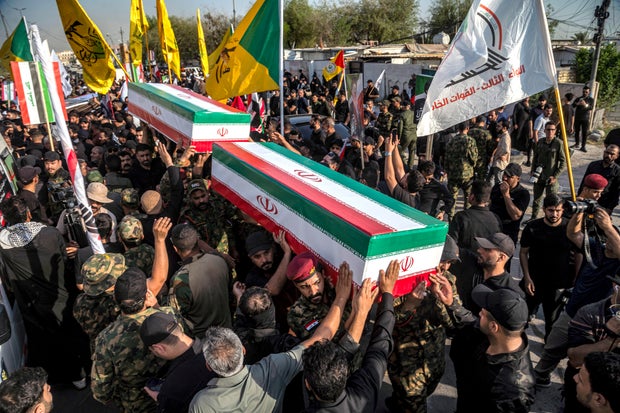
A war that President Trump said would be over in a few weeks back in February has now stretched to five months, with no end – or even clear objectives – in sight.
Fire at Egypt's Damietta port caused by drone attack, says prime minister's office
The Egyptian government said Thursday that a drone attack caused a fire at the port of Damietta the day before, in what appears to be the first time the country has been targeted since the outbreak of the Middle East war.
Authorities had reported two gas ships were damaged by Wednesday's blaze, which maritime trade tracking firm Kpler said had disrupted operations at a key LNG import hub.
While energy facilities elsewhere in the region have been hit by drones and missiles over the course of the United States and Israel's war on Iran, Egypt had so far been spared.
The presidency of the country's council of ministers said that a preliminary investigation into the incident determined "it resulted from a drone," noting no one had claimed responsibility.
It added that the inquiry was ongoing "to determine the circumstances of the incident and to take the necessary measures to preserve Egypt's interests and national security."
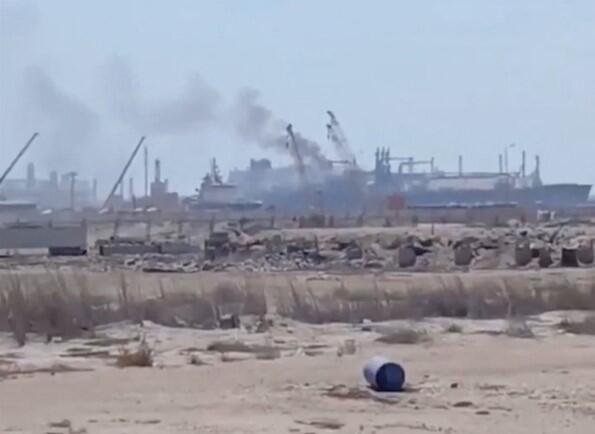
Keplr identified the damaged ships as the Energos Winter storage and regasification vessel and the GasLog Salem tanker, saying they had been moved offshore after the incident.
A private security monitor, U.K.-based Ambrey, previously reported that the Greek-owned and Bermuda-flagged tanker and the U.S.-owned-and-operated floating storage vessel were hit by at least one unidentified drone.
The former head of the Damietta Port Authority, Major General Ayman Salah, told the AFP news agency on Wednesday that the regasification ship was moored next to the LNG tanker in the harbour.
"The regasification process takes place under very high pressure," he said, explaining that any leak could lead to a fire.
Wednesday's attack took place as the U.S and Iran returned to hostilities following a brief lull in fighting aimed at reviving negotiations.
Iran fired a salvo of missiles at U.S. assets in Jordan, while Washington retaliated with a "heavy wave of strikes" on the Islamic republic.
CBS/AFP
Pakistan says U.S.-Iran talks "ongoing" on de-escalation, Strait of Hormuz
Pakistan, which has been acting as a mediator between the U.S. and Iran, said Thursday that negotiations between the United States and Iran were "ongoing" despite a flare-up in fighting across the Middle East.
"Negotiations between parties are ongoing, particularly on (the) Strait of Hormuz and to de-escalate," Pakistani foreign ministry spokesman Tahir Andrabi told reporters in Islamabad.
CBS/AFP
Revolutionary Guard says 2 tankers turned around in Strait of Hormuz
Iran's Revolutionary Guard Corps said Thursday that two oil tankers attempting to transit the Strait of Hormuz with U.S. support turned back after one of them caught fire.
"Last night, two oil tankers, encouraged by American aircraft, attempted to leave through the unsafe southern route of the Strait of Hormuz," the Guards said in a statement. "After a major fire broke out on one of them, both vessels quickly turned back."
Iran has kept control of the strait since the outbreak of the war in the Middle East on Feb. 28.
It has since insisted that ships in the waterway crucial for energy trade should cross through a route designated by Iran after requesting permission and paying service fees.
On Thursday, the powerful Guard reiterated that the strait is "our territory" and "cannot be reopened as long as the excessive rhetoric and threats of American officials and their interference in maritime movements in the region continue."
Jordan says it intercepted 5 missiles from Iran
Jordan's air defenses shot down five missiles launched from Iran Thursday morning, the country's state-run Petra news agency said, hours after the U.S. military announced it had completed "a heavy wave of strikes against Iran" in response to an earlier Iranian missile attack on a U.S. base in Jordan.
No casualties were reported from Jordan's interception of the missiles, the news agency quoted the spokesman for the country's armed forces as saying.
The U.S. Central Command said in a social media post that for over two hours, the U.S. had struck "dozens" of targets belonging to Iran's Revolutionary Guard Corps, including military command centers as well as missile and drone facilities, and coastal surveillance and defense sites.
The new strikes came hours after President Trump vowed to hit Iran "very hard" after it targeted a base in Jordan that hosts U.S. troops.
The latest barrage came after the U.S. partnered with Saudi Arabia to strike Iran-backed militias in neighboring Iraq, killing at least 20 fighters and six Iranian advisers on Wednesday.
U.S. wraps up strikes for the night, CENTCOM says
The U.S. concluded Wednesday night's strikes against Iran at around 10 p.m. ET, U.S. Central Command said.
"CENTCOM assets struck dozens of Islamic Revolutionary Guard Corps (IRGC) targets in Iran, including military command centers, missile and drone facilities, coastal surveillance and defense sites, and maritime capabilities," CENTCOM said.
U.S. strikes areas around Qeshm Island, Abadan, Iranian media says
The U.S. military struck locations around Iran's Qeshm Island and the southwestern city of Abadan, Iranian media reported on Thursday, local time, citing regional authorities.
"A point near Qeshm was attacked by the American enemy military," said Ahmad Nafisi, the deputy governor of the southern Hormozgan province, according to news agency Mehr.
Qeshm Island is located in the Strait of Hormuz and has been frequently targeted by the U.S. since the war began.
Fars news agency, citing the deputy governor of Khuzestan, said, "Points around Abadan city were attacked by missiles."
U.S. launches new round of strikes on Iran, CENTCOM says
The U.S. began launching a new round of strikes on Iran around 8 p.m. ET Wednesday, U.S. Central Command said.
"The strikes are a powerful response to yesterday's attempted Iranian attacks on U.S. forces based in the Middle East," CENTCOM said.
Wednesday night's strikes mark the first direct attacks by the U.S. on Iran since last week.
State Dept. announces sanctions targeting alleged scheme to collect fees in Strait of Hormuz
The State Department on Wednesday announced new sanctions on several entities that it alleges are involved in a scheme to extract fees from ships transiting the Strait of Hormuz.
The State Department accused the Persian Gulf Marine Insurance Company and Hormuz Safe Marine Services Authority, which it claims are both backed by the IRGC, of "running coercive 'insurance' schemes that extort international shipping transiting the Strait of Hormuz. These entities manufacture risk—including the threat of vessel seizures—and then charge commercial vessels for coverage against dangers created by the regime itself, generating revenue that sustains IRGC operations and Iran's broader campaign of regional destabilization."
The department also announced it had designated eight companies "operating vessels that have transported illicit Iranian crude oil and petrochemical products to China and the United Arab Emirates," alleging those vessels are part of Iran's shadow fleet.
Trump briefed on drone attack at Egyptian port
President Trump said he's been briefed on the drone attack at an Egyptian port.
Asked by a reporter in the Oval Office if there was any indication the attack was linked to Iran, Mr. Trump said, "I've been briefed. It's a little more of the same, but it's going to be straightening out."
CENTCOM says it's redirected 20 ships in Iran blockade
The U.S. military's Central Command said Wednesday it has redirected 20 commercial ships that it accuses of trying to evade its blockade on Iranian ports, up from 12 on Saturday.
U.S. forces have also boarded two ships and disabled two.
President Trump ordered the blockade to restart about two weeks ago.
Meanwhile, transits of the Strait of Hormuz by all ships — both Iranian and non-Iranian — remain extremely limited, amid Iranian threats to strike ships that don't comply with its rules, according to analytics firm Kpler.
"We're going to be hitting them very hard," Trump says
President Trump reiterated that the U.S. would strike back at Iran in retaliation for the latest attack by the country's Revolutionary Guard.
"We're going to be hitting them very hard because it's our turn to hit them," Mr. Trump told reporters in the Oval Office. "They know it's coming, they're asking us not to do it."
Drone strikes ignite fires at Egyptian port, maritime security firm says
Drone strikes ignited fires Wednesday on two natural gas vessels at an Egyptian port, a maritime security firm said.
The attacks were on a U.S.-owned floating storage facility and a Greek-owned tanker at Damietta, according to Ambrey, a British maritime security firm.
No injuries were reported from the fires, according to the Egyptian Petroleum Ministry, which gave no information on the cause.
It was not immediately clear who was responsible for the strikes.
Egypt, a close U.S. ally and regional mediator, is one of the countries in the Middle East to have been spared from direct military action during the war. A strike by Iran or its allies, if confirmed, would mark a significant widening of the conflict.
Fed holds interest rates steady, but 3 officials vote for hike
The Federal Reserve said on Wednesday that it is leaving its benchmark interest rate unchanged, a sign policymakers expect inflation to ebb despite higher energy costs due to the war in Iran.
This marks the fifth consecutive time the central bank has kept interest rates in the target range of 3.5% to 3.75%. The last time Fed officials voted to change interest rates was in December 2025, when it reduced its key rate by 0.25 percentage points.
Yet while the Fed voted to stand pat, three of the Federal Open Market Committee's 12 voting members dissented from the decision. Such disagreement on the rate-setting panel is unusual, suggesting that some Fed officials are inclined to act now to extinguish inflation, according to Wall Street analysts.
Explosion reported at Egyptian port near Suez Canal entrance amid Houthi threat to Red Sea shipping
A British shipping firm reported an explosion Wednesday at an Egyptian commercial port on the Mediterranean Sea, near the mouth of the Suez Canal, which links Europe to the Red Sea and Saudi Arabia's major oil and gas port of Yanbu.
London-based Inchcape said in a statement that an explosion at Egypt's Damietta Port "specifically at the LNG [liquefied natural gas] terminal during cargo discharge operations," had caused a partial closure of the facility, though local authorities responded promptly to bring the situation under control.
"The vessels involved have been safely relocated outside the port area," the company said, adding that port operations were expected to resume overnight "at other berths and terminals."
Inchcape's main office told CBS News it could not provide any further information, and there was no immediate response from its Egypt office.
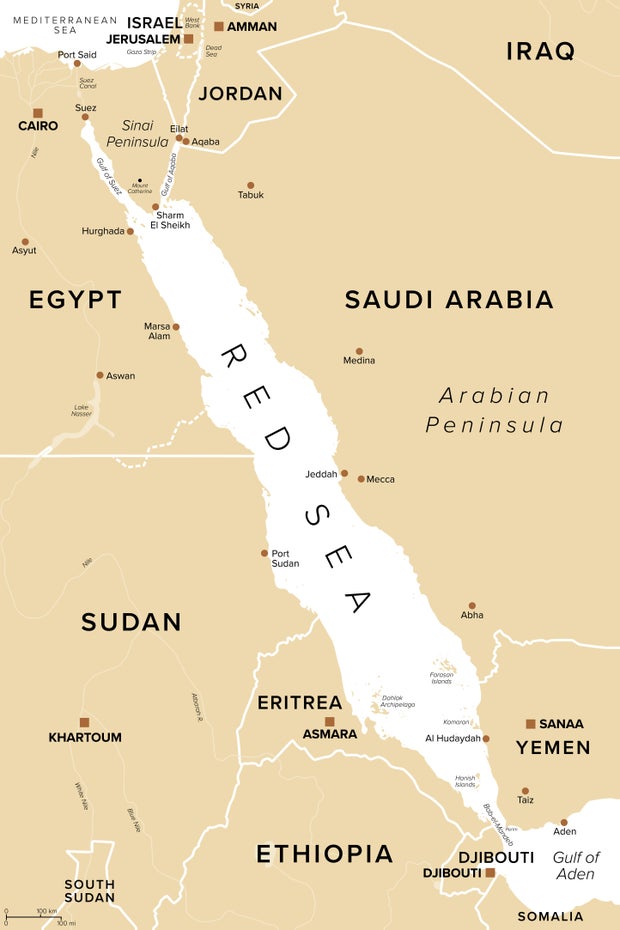
Iran's Houthi allies in Yemen have attacked several ships in the Red Sea recently, after announcing a blockade of Saudi Arabia's Red Sea shipping operations.
The Ambrey Maritime Security company said Wednesday that at least one drone struck a U.S. LNG storage facility at Damietta, but there was no immediate claim of responsibility by Iran or the Houthis.
If an attack is confirmed, it would be one of the first targeting energy infrastructure to extend beyond the immediate Persian Gulf and Red Sea regions into the Mediterranean since the war with Iran began five months ago.
U.S. announces new sanctions "countering Iran's exploitation of the Strait of Hormuz"
The U.S. government announced further sanctions against Iranian entities on Wednesday as part of efforts to cut off Iran's energy income and counter the Islamic Republic's efforts to exert control over commercial shipping and charge fees for use of the Strait of Hormuz.
In a statement released by the State Department, spokesperson Tommy Pigott said the new sanctions imposed by the U.S. Treasury targeted two Iranian insurance firms, the Persian Gulf Marine Insurance Company and Hormuz Safe Marine Services Authority, which he said were backed by Iran's Islamic Revolutionary Guard Corps (IRGC).
He said the entities run schemes that extort international shipping by creating risk, "including the threat of vessel seizures — and then charge commercial vessels for coverage against dangers created by the regime itself, generating revenue that sustains IRGC operations and Iran's broader campaign of regional destabilization."
The U.S. also designated eight companies on Wednesday that it said operated vessels "that have transported illicit Iranian crude oil and petrochemical products to China and the United Arab Emirates" as part of Iran's "shadow fleet" of tankers.
Pigott said the sanctions would support the U.S. Navy's "enforcement of a blockade on Iranian ports and coastline and add to a sustained campaign that has now sanctioned more than 100 vessels this year."
Iranian military advisers killed in U.S.-Saudi strikes in Iraq, news outlet linked to Iran-backed militias says
Sabreen News, a media outlet linked to Iran-backed Shiite militias in Iraq that were targeted by joint U.S.-Saudi strikes on Tuesday, said Wednesday that several Iranian military advisers were among those killed in the attacks.
The news outlet released a photo showing coffins wrapped in Iranian flags with a caption reading: "The martyred Iranian advisers who were killed by the fire of the Saudi Wahhabi-American enemy in Iraq at dawn today."
Sabreen did not provide any further details on the identities of those killed, or the number of purported Iranian casualties from the strikes. The timing of the strikes was also unclear, as the U.S. military announced the attacks late Tuesday night Eastern time, which could have been early morning Wednesday in the Middle East.
The Iran-aligned Popular Mobilization Forces, an alliance of Shiite militias in Iraq, said earlier Wednesday that at least 20 of its fighters were killed in the U.S.-Saudi strikes, which the Pentagon's Central Command said had targeted "terrorist logistics and weapons sites across eastern Iraq."
Oil prices soar again, U.S. stocks fall as U.S. and Iran go back on the attack
Oil prices jumped again Wednesday, while the U.S. stock markets fell ahead of a Federal Reserve decision on what to do with interest rates.
The S&P 500 fell 0.4%. The Dow Jones Industrial Average was down 614 points, or 1.2%, as of 10 a.m. Eastern time, and the Nasdaq composite was 0.5% lower.
The action was stronger in the oil market, where the price of international benchmark Brent crude leaped 6.2% to $87.14 per barrel after fighting resumed in the war with Iran, raising concern about the global flow of oil. Iran launched a barrage of missiles at American forces in the Middle East, while the U.S. military partnered with Saudi Arabia to strike Tehran-backed militias in Iraq.
Brent oil's price had swung as low as $72 early this month and as high as $102 last week on uncertainty over whether the U.S. and Iran might reach a deal to allow oil tankers to move freely again through the Strait of Hormuz, from Middle East producers to customers worldwide.
The swings have raised worries that inflation will reaccelerate, just when it had begun to slow more than economists expected. That, in turn, has traders uncertain about what the Federal Reserve will announce after its two-day meeting on interest rates concludes later in the day.
Traders are betting on a roughly 36% probability that the Fed will raise its main interest rate, which would be the first increase in three years. Higher rates can keep a lid on inflation, but they can also slow the economy and undercut prices for stocks and other investments.
Higher rates particularly hurt stocks seen as the most expensive, and scrutiny has already been rising on makers of computer chips and other winners of the frenzy around artificial-intelligence technology. The surges for their stock prices are backed by real growth, but it may not be sustainable if AI does not produce as much profit and productivity as hoped.
Iraqi government condemns U.S.-Saudi strikes, says they killed "a number of innocent martyrs and civilians"
Iraq's National Security Council "expressed its condemnation and denunciation" on Wednesday of joint U.S.-Saudi strikes carried out the previous night against Iran-backed groups in the country, saying they had caused "the deaths and injuries of a number of innocent martyrs and civilians," according to a statement from the Iraqi leader's office.
The council convened Wednesday for an emergency meeting to discuss the U.S.-Saudi attacks, which the Iran-backed PMF militias in Iraq said had killed at least 20 of its fighters.
Prime Minister Ali Al-Zaidi chaired the meeting, and the statement from his office said Iraq's government was "communicating with the concerned parties to verify and address all that had been raised by the Saudi and American sides regarding the targeting of Saudi territory."
U.S. Central Command said the strikes targeted "terrorist logistics and weapons sites across eastern Iraq."
Saudi Arabia's Ministry of Defense confirmed that it took part, citing its right to self-defense, in the first attack against Iran or its regional allies acknowledged by a Persian Gulf state since the Middle East war was launched jointly by the U.S. and Israel five months ago.
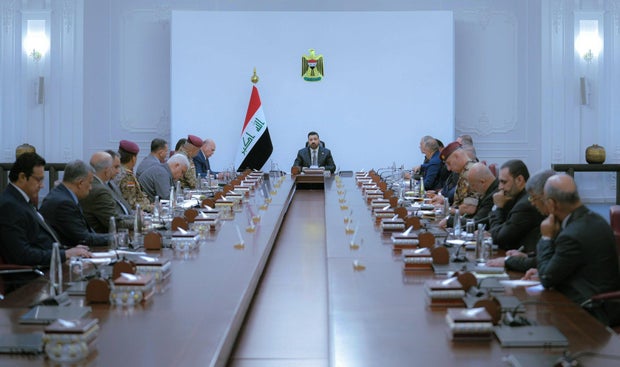
Iraq's National Security Council decided Wednesday to "establish a comprehensive security plan to secure the ground, confront any violation of Iraq's sovereignty, and prevent any source from posing a threat to neighboring countries," Al-Zaidi's office said.
Iran-allied militia in Iraq says U.S. and Saudis will pay "a heavy price" for joint strikes
An Iraqi Shiite militia allied with Iran's powerful Islamic Revolutionary Guard Corps condemned Tuesday night's joint U.S.-Saudi strikes against it and other Iranian proxy groups in Iraq on Wednesday and it threatened to retaliate.
Harakat al-Nujaba, one of numerous Iran-allied factions that fight under the umbrella of the Popular Mobilization Forces (PMF), called on Baghdad to sever ties with Riyadh and expel U.S. forces from Iraq.
"We in the Al-Nujaba Movement will not allow the tyrants of Washington and the Arabs of Saudi Arabia to defile the land of Iraq without paying a heavy price in their interests and security," the group said in a statement shared online.
The group accused the U.S. and Saudi Arabia of launching "a blatant aggression" against "the heart of Iraq's safe cities."
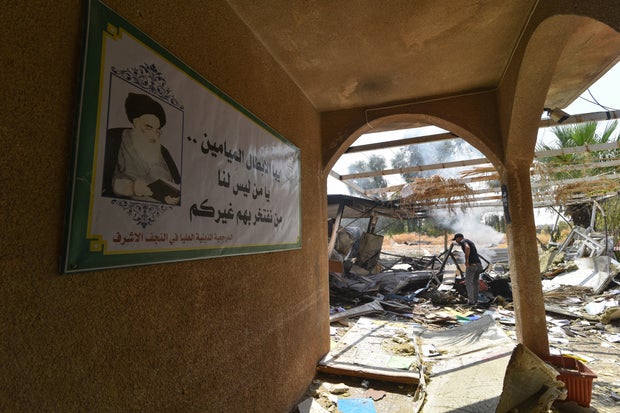
U.S. Central Command announced the joint strikes with the Saudis against Iran's proxy forces late Tuesday, saying they were aimed at "terrorist logistics and weapons sites across eastern Iraq."
The Saudi Ministry of Defense confirmed that it "conducted precise and targeted strikes" in Iraq citing its right to self-defense. It was the first attack against Iran and its regional allies acknowledged by a Persian Gulf state since the Middle East war was launched jointly by the U.S. and Israel five months ago.
Saudi Arabia and its five Gulf Cooperation Council allies in the region have been attacked dozens of times by Iran and its proxy groups during the war.
Trump tells Fox U.S. will hit Iran hard over "surprise attack" targeting U.S. forces in Mideast
President Trump told Fox News on Wednesday that the U.S. would "be hitting them hard" when asked about any looming response to attacks launched by Iran on Tuesday targeting U.S. forces in the Mideast.
"We're going to beat the f*****g s*** out of them," Mr. Trump told the network. "We'll be hitting them hard. … They're going to get a beating."
The U.S. military's Central Command said Tuesday night that it thwarted an "attempted surprise attack" by Iran's Revolutionary Guard Corps targeting U.S. forces in the Middle East with multiple ballistic missiles. CENTCOM said all the missiles were "successfully intercepted."
Yemeni official accuses Houthis of conspiring with Iran to impose fees on Red Sea shipping
A minister in Yemen's internationally recognized government accused Houthi rebels on Wednesday of working under Iranian guidance to try to establish a system to impose fees on commercial vessels transiting the Red Sea and the Bab al-Mandab Strait.
The narrow strait is the southern gateway to the Red Sea, and it has become an even more critical waterway for shipments of Saudi crude oil to reach international markets as energy exports remain largely choked off by fighting between the U.S. and Iran over the Strait of Hormuz, which is the gateway to the Persian Gulf.
Yemeni Information Minister Moammar al-Eryani called the alleged effort by the Houthis and their Iranian benefactors "a dangerous escalation aimed at transforming one of the world's most strategic maritime corridors into a permanent source of funding for the militia's military and terrorist activities."
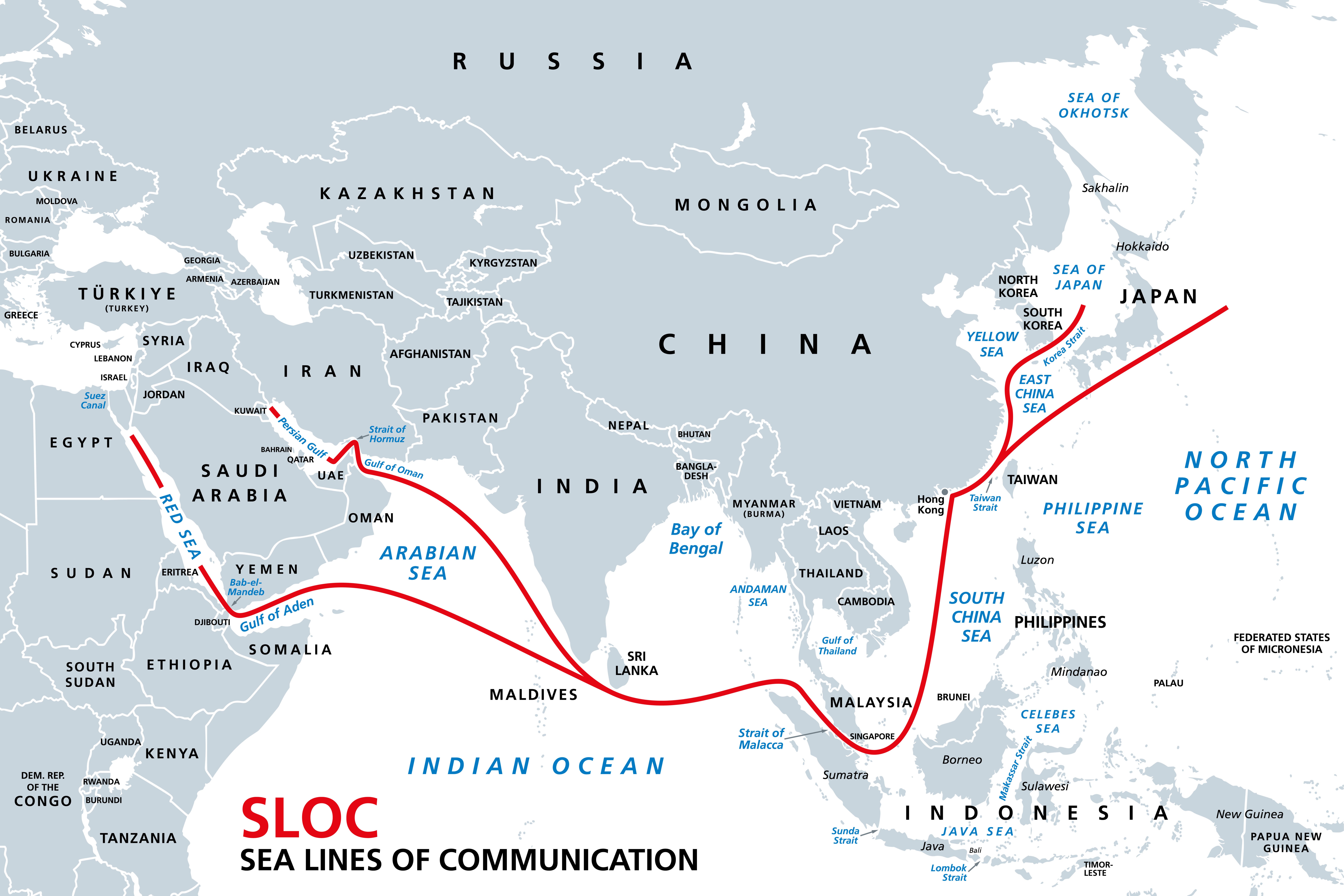
Eryani said recently obtained "confirmed intelligence" indicated that Iran's powerful Revolutionary Guard Corps was helping manage the effort in conjunction with the Houthis.
"The intelligence indicates that IRGC experts and advisers are directly involved in designing the technical and administrative framework of the project," the minister told French news agency AFP.
Last week, the Reuters news agency reported that Iran flew IRGC commanders and equipment related to missiles and drones to Yemen to help bolster the Houthis' ability to threaten global energy supplies in the Red Sea, citing four officials with knowledge of the matter. Reuters said the Iranian commanders and equipment were sent to Yemen about a week before the Houthis declared a blockade of Saudi Arabia and started menacing vessels linked to the kingdom in the Red Sea.
CBS/AFP
Iraq condemns U.S.-Saudi airstrikes, and the Iranian proxies they targeted on its territory
Iraq's president has condemned a joint U.S.-Saudi attack on Iran-backed paramilitary forces in the country, which the militias said had killed at least 20 people and drew yet another country into the five-month Middle East war launched by Israel and the U.S. on Feb. 28.
In a statement, the Iraqi presidency said Wednesday that the strikes, which were the first offensive operations Saudi Arabia has acknowledged taking part in during the current conflict, were "an unacceptable attack and a flagrant violation of Iraq's sovereignty."
The statement condemned "targeting of its official security institutions in a manner that contravenes the rules of international law and the Charter of the United Nations."
The Iraqi president also condemned the Iranian proxy forces targeted by the U.S. and Saudi Arabia for launching attacks "against neighboring countries or for the settling of regional and international scores."
In a statement announcing the attacks against the groups in Iraq, U.S. Central Command accused the militias of attacking U.S. forces and Saudi energy infrastructure under the direction of Iran's Islamic Revolutionary Guard Corps.
Iran state TV says U.S. struck near Iraq border
Iranian state television said Wednesday that a U.S. strike hit a city in the country's northwest, on the border with Iraq.
"A few minutes ago, an area in the Piranshahr border area was attacked by American enemy airstrikes," state television reported, after Fars news agency quoted an official in West Azerbaijan province as saying a missile hit an uninhabited area, leaving no casualties.
The U.S. military's Central Command said late Tuesday that U.S. and Saudi forces conducted joint strikes on Iranian proxies in Iraq.
U.S. commander warns troops not to share video of strikes on bases, says it could be helping Iran
U.S. troops across the Middle East have been warned that cellphone videos they share online could help Iran target American bases, the Reuters news agency reported Wednesday.
Admiral Brad Cooper, overall commander of U.S. Central Command, said in the letter to the forces that Iran was benefiting from videos posted online that could reveal whether strikes targeting American forces were successful in near real-time.
"The direct, unavoidable cost of this open-source intelligence could be measured in the lives of American service members and civilian residents in targeted Gulf countries," Cooper said in the July 28 letter, which a CENTCOM official confirmed to CBS News had been sent.
Cooper called on U.S. forces to "redouble our focus on operational security," without prescribing specific steps in the memo.
Reuters said, citing two anonymous sources, that in Jordan, where three U.S. service members were recently killed in an Iranian strike on an air base, troops had been told their cellphones could soon be confiscated, but the CENTCOM official who spoke to CBS News on Wednesday disputed any such plans.
Oil prices rise again as brief pause in fighting is shattered
Oil prices climbed again Wednesday as a brief pause in fighting in the Iran war was shattered. The price of Brent crude, the international standard, had eased from the two-month high it hit last week, but it rebounded 3.3% Wednesday to sell at about $85 a barrel.
The calm persisted for about three days following weeks of escalation over control of the strategic Strait of Hormuz, the Persian Gulf waterway and narrow chokepoint through which 20% of the world's traded oil normally flows.
Benchmark U.S. crude increased 3.4% to $81.93 a barrel Wednesday.
Saudi Arabia says strikes on Iran-backed paramilitary group in Iraq were self-defense
Saudi Arabia's Foreign Ministry said Wednesday the joint strikes carried out alongside U.S. forces against Iran-backed groups in Iraq were lawful self-defense.
"These Iran-backed terrorist militias chose the path of irresponsible escalation, violating international law," the ministry said in a statement, adding that the strikes were carried out in response to previous attacks by the militia groups on Saudi Arabia.
Iran-backed militia group says at least 20 fighters killed in U.S.-Saudi strikes in Iraq
The U.S. and Saudi militaries launched airstrikes late Tuesday on Iranian-backed groups in Iraq, U.S. Central Command said, after Iran and its proxies allegedly targeted American forces over the last few days.
The U.S.-Saudi operation was aimed at "terrorist logistics and weapons sites across eastern Iraq," CENTCOM said in a statement posted to social media. The Saudi Ministry of Defense also confirmed that it "conducted precise and targeted strikes," citing its right to self-defense.
The Popular Mobilization Forces (PMF), an umbrella group of Iraqi paramilitary forces backed by Iran, said in a statement released Wednesday that at least 20 of its fighters were killed and 32 wounded. The group said its headquarters in Baghdad and six other locations were struck.
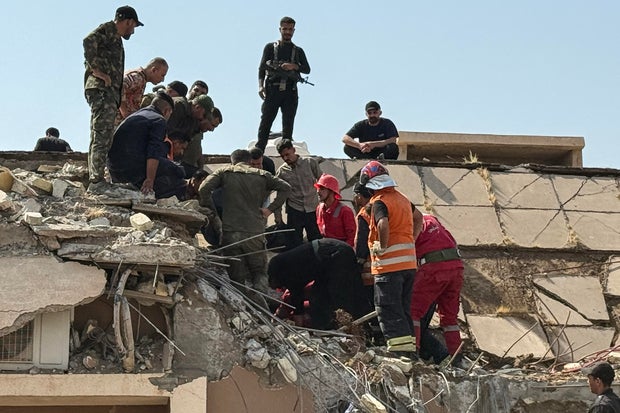
CENTCOM said the strikes were in response to more than 30 attempted drone attacks on U.S. forces and Saudi energy sites over the last three days, describing the attacks on U.S. assets as unsuccessful. Saudi Arabia said it has intercepted drones that were launched from Iraq and targeted petroleum facilities in Riyadh and the country's east.
Jordan says 5 Iranian missiles intercepted
Jordan's military said the country's air defenses intercepted five missiles launched from Iran early Wednesday. In a statement, the military said the missiles had been "intercepted and destroyed." It did not mention any casualties.
Earlier, the U.S. military said it knocked down an Iranian missile barrage and worked with Saudi Arabia's forces to strike sites in Iraq that Tehran-backed militias have used to launch attacks in recent days, shattering a brief pause in fighting.
All Iranian missiles launched against American forces in the Middle East were intercepted, U.S. Central Command said.
Iran strikes 3 oil tankers in Strait of Hormuz, state media says
The Iranian Revolutionary Guards struck and halted three oil tankers in the Strait of Hormuz, according to Iran's semi-official Tasnim News Agency, which is linked to the Revolutionary Guards.
"Three violating oil tankers, which ignored our warnings and continued sailing an unsafe and illegal route, were struck and brought to a halt," the Tasnim News agency reported.
It was not immediately clear if the tankers sustained any significant damage, or if there were any injuries to crewmembers from the attacks.
Earlier Tuesday, the Yemen-based Houthi militant group, which is an Iranian proxy, said it fired several ballistic missiles at a Saudi-flagged tanker in the Red Sea.
Iran launched ballistic missile attack on U.S. forces in Middle East, CENTCOM says
Iran launched multiple ballistic missiles at U.S. forces in the Middle East in what U.S. Central Command described as an "attempted surprise attack."
CENTCOM said the missiles were launched at 5:45 p.m. ET Tuesday by the Iranian Revolutionary Guards. They were all "successfully intercepted," according to CENTCOM.
"U.S. forces remain vigilant and at a high state of readiness," CENTCOM said in its statement.
Netanyahu and Trump had "extremely positive" meeting, source says
The White House meeting between President Trump and Israeli Prime Minister Benjamin Netanyahu was "extremely positive," according to a senior Israeli source who accompanied Netanyahu in the meeting.
"It was an extremely positive meeting," the source said. "The Prime Minister and President held an excellent and comprehensive discussion on the key issues of the day, first and foremost Iran. The leaders reaffirmed their ironclad commitment to ensuring that Iran never has nuclear weapons."
The meeting held the potential to be tense, emphasized by Mr. Trump's comments to Fox News just before the meeting. He pushed back on a reporter's question about Netanyahu wanting to discuss Pickaxe Mountain, a supposed Iranian nuclear facility, saying, "I don't need Bibi to tell me that."
"Bibi's telling me that because he wants me to stay involved," Mr. Trump told Fox News. "I said, 'Why didn't you just tell it to me, why did you have to announce it to the world?'"
"I know exactly what's going on at Pickaxe. It's not a big problem," Mr. Trump added.
The meeting lasted for a little over an hour.