U.S.-Iran Latest: Trump reiterates that ceasefire is over, but says U.S. to continue negotiating
What to know about the Iran war today:
- President Trump reiterated his stance on Friday that the ceasefire with Iran was "over" after less than three weeks, but said the U.S. would continue negotiating.
- The U.S. has remained engaged in conversations with Iran this week, via mediators, despite a dramatic exchange of fire that derailed the truce agreed to under the mid-June memorandum of understanding signed by Mr. Trump and his Iranian counterpart.
- Despite the U.S. insisting Iran is not in control of the Strait of Hormuz, shipping intelligence groups and tracking data indicate commercial traffic through the vital waterway remains much lower than before the war, and analysts say that's likely to be the case until a wider peace deal is reached.
U.S. still in "active conversations" with Iran via mediators, sources tell CBS News
The truce with Iran lasted less than three weeks, and the U.S. continues to try to revive it.
Three sources familiar with the ongoing attempts to revive a ceasefire with Iran told CBS News Thursday that "active conversations" between the U.S. and Iran continued, though the diplomacy was indirect, mediated by Qatar.
Iran's Foreign Minister Abbas Araghchi has been speaking with Qatar's Prime Minister and his team for days, and a source familiar told CBS that Araghchi has been defending the actions of Iran's Revolutionary Guard Corps, which fired on three commercial vessels Tuesday in Omani territorial waters.
The IRGC has also sought to charge ships fees for use of the lane, which the U.S. objects to.
Qatar has been going between the two countries, which both seek to deescalate the fighting that erupted after Iran attempted to exert control over the shipping lanes in Omani and Iranian territory in the Strait of Hormuz.
Article 5 of the 60-day long Memorandum of Understanding was meant to reopen the trade route, but Iran has been attempting to divert all traffic through the lane close to its territory, away from Omani waters.
The MoU was meant to last until roughly Aug. 18. Multiple officials told CBS that Vice President JD Vance has been working the phones, along with Jared Kushner and envoy Steve Witkoff.
CENTCOM conducted two days of intense strikes this week, and a U.S. official told CBS News that railways Iran was using to transport military supplies were among the targets.
There was no further detail shared through official channels about the ongoing discussions.
Trump says U.S. has agreed to continue talks with Iran, but ceasefire "over"
President Trump said Friday on Truth Social that the U.S. had agreed to a request from Iran to continue talks over a potential peace deal, but he reiterated his stance from earlier in the week that the ceasefire is "over."
"The Islamic Republic of Iran has asked us to continue 'talks.' We have agreed to do so, but the United States has stated to them, in no uncertain terms, that the Cease Fire is OVER!" Mr. Trump wrote.
During a NATO summit in Turkey earlier this week, the president said he believed the ceasefire with Iran had ended after the U.S. launched strikes in retaliation for Iranian attacks on commercial ships.
Qatari delegation in Iran to "stabilize" Gulf state's mediation role, Iranian news outlet says
Iran's semi-official Tasnim news agency said a Qatari delegation arrived Friday in the Iran to "stabilize" Qatar's position as a mediator following the events of recent days.
According to the report, the delegation is headed by an adviser to Qatar's foreign minister, and the visiting officials were likely to meet with Iranian Foreign Minister Abbas Araghchi in Mashhad, the northeastern city where memorial services for former supreme leader Ali Khamenei culminated Thursday in his burial.
Tasnim, which is closely linked with Iran's powerful Revolutionary Guard Corps, said the main purpose of the visit was to "stabilize Qatar's mediation position after the events on Tuesday or Thursday."
Qatar accused Iran this week of targeting a Qatari owned tanker in the Strait of Hormuz - one of three vessels struck by weapons in the vital waterway this week.
Iran has denied attacking a Qatari ship.
Vance, Witkoff and Kushner in contact with Qataris amid efforts to bolster diplomacy
A source familiar with the discussions tells CBS News that Vice President JD Vance, as well as U.S. envoys Steve Witkoff and Jared Kushner, have been in touch with Qatari officials this week after the dramatic escalation of attacks by the U.S. and Iran.
It wasn't clear how much progress had been made Friday as mediators from Qatar, Pakistan and other countries work to ease the tension sparked by Iranian attacks on ships in the Strait of Hormuz early this week. The U.S. responded with two days of intense strikes on at least 170 targets, drawing new Iranian attacks targeting U.S. allies in the Persian Gulf.
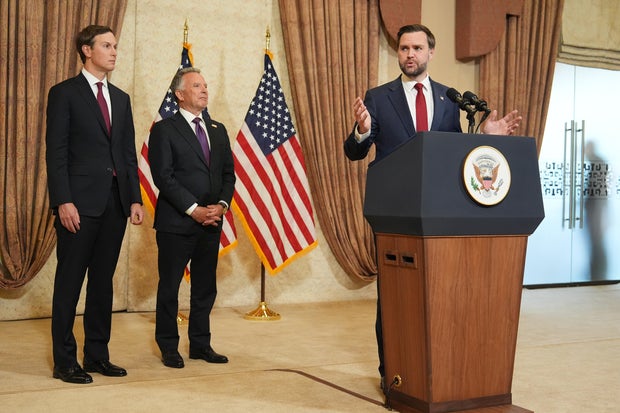
Iran has also confirmed ongoing discussions with mediators, but there's been no indication of any new direct contact between U.S. and Iranian officials.
This week's strikes represented the most serious challenge to date for the ceasefire agreed to by the U.S. and Iran as part of the memorandum of understanding signed in mid-June.
The MoU called for a ceasefire to enable 60-days of talks aimed at brokering a wider peace deal that would resolve contentious issues including the future of the Strait of Hormuz and Iran's nuclear program. So far, however, only two days of direct talks have taken place, though lower level "technical" negotiations had continued until this week's flare-up.
Qatar reaffirms role as mediator between U.S. and Iran, stresses "need to reactivate the diplomatic track"
Qatar will continue to serve as a mediator between the U.S. and Iran, the country's Foreign Ministry spokesman Majed Al Ansari said during a panel discussion at the Chatham House London Conference on Thursday.
Speaking at a session titled "The New Geopolitics of the Middle East," Al Ansari said Qatar remained committed to mediation "despite being directly affected" by the conflict. He stressed that the country's position was rooted in its belief that "military solutions will not achieve lasting stability, and the diplomatic path remains the only option capable of ending crises and achieving regional security and stability."
According to a statement released by Qatar's Foreign Ministry, Al Ansari said the region was facing "not a passing crisis, but rather an extension of accumulated cycles of escalation" causing unprecedented instability.
Al Ansari stressed "the need to reactivate the diplomatic track and create the conditions for sustainable political settlements" to strengthen economic integration and rebuild trust among regional states.
Lasting regional stability, he said, would require "respect for the sovereignty of states, strengthening collective action, and consolidating diplomacy as the best means of addressing crises and building a more stable future."
Israel says it has carried out more than 20 attacks in Lebanon this week
Israel's military said Friday that it had carried out more than 20 attacks in Lebanon over the course of the week, responding, it said, "Hezbollah ceasefire violations."
In a statement, the Israel Defense Forces said troops continued operating in the "security zone" they have occupied across southern Lebanon for weeks, "to remove threats to the State of Israel."
"As part of the activity, two underground routes were destroyed in the village of Majdal Zone. In addition, the Air Force and the forces carried out more than 20 attacks following Hezbollah ceasefire violations and killed a number of terrorists who were a threat to the forces," the IDF said.
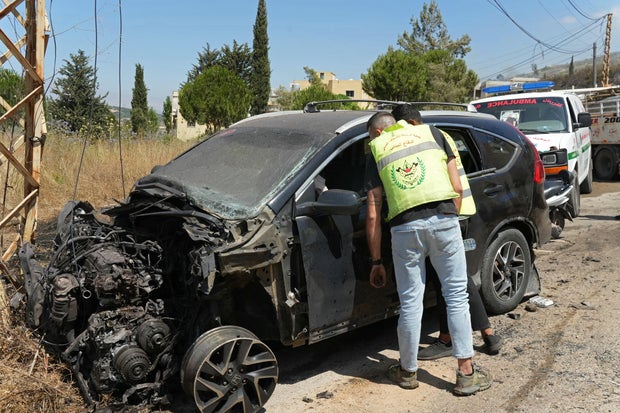
Israel's ongoing fight with Hezbollah, despite a U.S.-brokered ceasefire, has remained a major bone of contention in efforts to forge a peace agreement between the U.S. and Iran.
The memorandum of understanding signed in mid-June by President Trump and his Iranian counterpart calls for an immediate end of hostilities on all fronts, including in Lebanon, and Tehran has insisted that Israel keeping forces in the neighboring nation constitutes a violation of that agreement.
Israel and Hezbollah have continued attacks, albeit at a lower level, despite their ceasefire agreement, consistently justifying their actions as a response to the other side's violations.
30 boats destroyed in U.S. strike on Iranian port, fishermen's cooperative says
At least 30 fishing boats were destroyed by two U.S. projectiles that hit the Panj-Pelleh fishing pier in Bandar Abbas during attacks on Iran's coastline in the southern Hormozgan Province on July 8 and 9, according to a board member of a local fishermen's cooperative.
The official with the Posht-e Shahr Fishermen's Cooperative was quoted by state media as saying each boat was worth around $11,000, with the attacks causing significant financial losses for the local fishing industry.
Iran's IRNA state news agency quoted a deputy governor of the neighboring Bushehr Province, also on Iran's southwest coast near the Strait of Hormuz, as saying Thursday that U.S. strikes had hit the Benoud fishing pier in Asaluyeh, resulting in fishing boats belonging to local residents catching fire.
President Trump has said the U.S. would target small boats used by Iranian forces to lay sea mines in the Strait of Hormuz and surrounding waters.
The U.S. military's Central Command said the strikes earlier this week had been aimed at about 170 Iranian targets, including air defenses, drone and missile storage, naval targets and logistics infrastructure on Iran's coast.
U.S. encourages commercial vessels to use southern Strait of Hormuz route despite attacks
The U.S. Navy continues to encourage commercial ships to use the so-called southern route through the Strait of Hormuz, despite attacks by Iran this week targeting vessels trying to use that route and repeated warnings from Tehran for ships to only use a northern passage close to its coast.
An advisory released Friday by the international Joint Maritime Information Center (JMIC) in Bahrain, of which the U.S. Navy is a core member, reminded mariners in the region that the security threat level in the strait and surrounding waters remained severe, but it added "further information" specifically from U.S. Naval Forces Central Command.
"Notwithstanding recent unprovoked attacks on merchant vessels, mariners are reminded that the southern route of the [Strait of Hormuz] has been expanded and remains available for all traffic," the update, highlighted in red to differentiate it from the previous guidance, says.
JMIC urges mariners to coordinate any passage through the narrow waterway with the joint naval forces, but says it is not mandatory.
"Ships may transit the southern route without coordination," the advisory says.
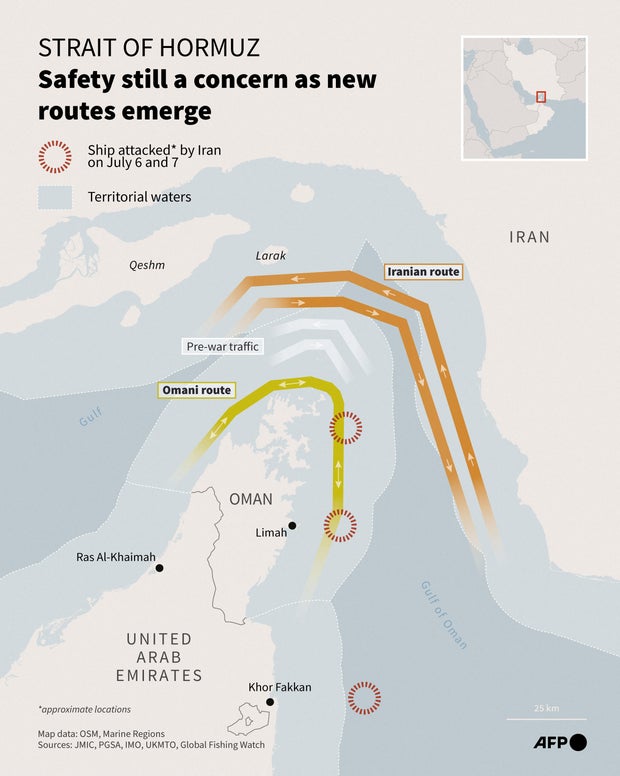
The new guidance added that additional routes are available, but are not "protected." The only other route known to exist, without a risk of potential sea mines laid by Iran, is the northern route designated by Tehran, which Iranian authorities say requires direct coordination with its military.
The Lloyd's List maritime intelligence group said Thursday that no large vessels had transited the southern route, which hugs the coast of Oman, with their location transponders switched on since July 7, though it could not rule out ships using the path with their locators switched off.
A CBS News review of open-source maritime tracking data on Friday found no commercial vessels publicly broadcasting locations that would indicate an intention to transit the southern shipping lane through the Strait of Hormuz.
Iran steps up regional diplomacy after flare-up, holds talks with Oman, Turkey, Pakistan and Saudi Arabia
Iranian Foreign Minister Abbas Araghchi held a series of telephone calls Thursday with senior regional officials, including the foreign ministers of Oman, Turkey and Saudi Arabia, as well as Pakistan's army chief, to discuss regional developments following an intense exchange of attacks with the U.S. this week.
The flare-up, sparked by Iranian strikes on several commercial vessels in the Strait of Hormuz, appeared to ease by Thursday evening after the most intense rounds of U.S. strikes since the ceasefire was agreed in mid-June.
In separate calls with Omani Foreign Minister Sayyid Badr Al-Busaidi and Turkish Foreign Minister Hakan Fidan, Araghchi discussed the latest regional developments, particularly in the Strait of Hormuz.
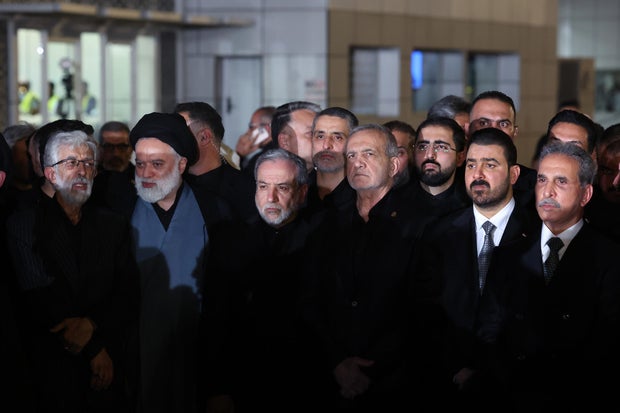
All diplomats on the calls stressed the importance of using diplomatic channels, maintaining contacts and coordination, and working to prevent further escalation, according to the Iranian government's description of the calls.
Araghchi also spoke with Pakistan's Army chief Field Marshal Asim Munir, during which the Iranian minister strongly condemned "aggressive attacks by the U.S. military on various areas of Iran," calling them violations of the ceasefire terms laid out in the memorandum of understanding.
Later Thursday, Araghchi held a phone call with Saudi Foreign Minister Faisal bin Farhan to discuss regional developments following what Tehran described as U.S. aggressive actions, as Iran continued diplomatic engagement with neighboring countries amid heightened regional tensions.
Mediators push to get U.S.-Iran diplomacy back on track
Countries that have mediated between the U.S. and Iran for weeks have been working for the past couple days to ease flaring tension between the two nations and to revive talks aimed at brokering a peace deal that addresses Iranian nuclear ambitions and other sensitive matters.
The diplomacy was set back by a dramatic flare-up early this week, as the U.S. responded to Iranian attacks on commercial vessels in the Strait of Hormuz with the most punishing series of airstrikes since the memorandum of understanding was signed in mid-June. Iran said at least 14 people were killed, and it lashed out with missiles targeting U.S. Gulf allies.
Qatar, Pakistan and other nations in the region have been working to bring Iran and the U.S. back to the negotiating table, sources with knowledge of the discussions told CBS News on Thursday.
While there has been little to indicate serious diplomatic progress over the last day or so, neither Iran nor the U.S. launched more strikes Thursday night into Friday morning.
This week's clash was most intense since U.S.-Iran ceasefire agreed, by significant margin
This week's exchange of strikes by the U.S. and Iran represented a sharp escalation between the countries. The U.S. military said Navy and Air Force weapons had hit a total of at least 170 targets in Iran on Tuesday and Wednesday - 17-times the number struck during the last salvo on June 26.
It was the most intense U.S. assault on Iran since President Trump and his Iranian counterpart signed the memorandum of understanding declaring a ceasefire in mid-June.
This week U.S. Central Command said it specifically targeted military sites, including Iranian air defenses and missile and drone storage and launch sites, along the country's coastline at the mouth of the Strait of Hormuz, suggesting a possible strategic motive to reduce Iran's ability to target ships in the region.
Iran retaliated on a larger scale, too, launching missiles and drones at Kuwait, Bahrain, Qatar, and Jordan. U.S. officials reported no significant damage to U.S. facilities in the allied nations, and U.S. casualties, and most of the weapons were intercepted.
While it was a significant escalation, it did not appear to be a return to full combat operations, however. During the height of the war, Iran was firing hundreds of missiles and drones every day at U.S. allies, and the U.S. was launching hundreds of airstrikes.
Notably, Israel has appeared to stay out of the latest eruption of fighting, and Iran has not targeted Israel this week.
Trump holds call with Netanyahu on latest developments in Middle East
President Trump spoke with Israeli Prime Minister Benjamin Netanyahu on Thursday, according to Netanyahu's office and a White House official.
Netanyahu's office said that Mr. Trump updated Netanyahu about "American moves in the Gulf," and also addressed "continued coordination between the countries in various sectors."
A White House official confirmed the call took place, but did not provide details.
Trump sees Iran's attacks on commercial tankers as terrorism, U.S. official says
A U.S. official told CBS News on Thursday that President Trump views the Iranian strikes earlier this week on three commercial tankers in the Strait of Hormuz as acts of terrorism.
The U.S. official said the 60-day ceasefire signed last month between the U.S. and Iran is performance-based, and Iran's actions in those strikes "failed performance at an unacceptable level."
According to the U.S. official, however, "technical talks" between the two sides are continuing. When asked about the ceasefire on Wednesday, Mr. Trump had said that "as far as I'm concerned, it's over." The president also said peace negotiations would continue, claiming that Iran "wants to make a deal so badly."
The U.S. official also reaffirmed Thursday the U.S. position that Iran cannot have a nuclear weapon.
U.S. insists Iran does not control Strait of Hormuz, despite dramatic slowing of traffic after ships attacked
The U.S. military reiterated its insistence on Thursday that Iran does not control the Strait of Hormuz.
In a social media post, U.S. Central Command said that, since early May, U.S. forces had helped more than 800 commercial vessels and 380 million barrels of crude oil transit the strait.
The statement came after the U.S. said Iran struck three commercial tankers in the strait earlier this week, reigniting fighting between the two sides amid what has been a shaky ceasefire.
The maritime journal Lloyd's List reported Thursday that strait traffic had "fallen sharply" since the two sides began exchanging strikes Tuesday.
The MarineTraffic.com tracking website showed early Thursday that there were just three fuel tankers in the strategic waterway openly broadcasting their positions — two of which are subject to U.S. sanctions for transporting Iranian oil.
"We're certainly better than we were in March and April, but until we have some sort of substantial agreement ... it's just going to remain very, very volatile," Andrew Wilson, head of research at BRS shipbrokers, said of shipping through the strait during a webinar held Thursday by Lloyd's List.
"We're not going back to February 27, and I think everybody understands that," Lloyd's List editor-in-chief Richard Meade said at the briefing. "A tentative 60-day agreement with few guarantees was never really going to change the dial much in terms of shipping decisions."
Iran says Khamenei's eldest son oversaw his final funeral ceremony
The Iranian government said the eldest son of former Supreme Leader Ayatollah Ali Khamenei, who was killed in a strike at the start of the Iran war, oversaw his father's funeral services Thursday as he was laid to rest.
Mostafa Hosseini Khamenei led the funeral prayer, the Iranian government said in an X post.
Khamenei's second son, Mojtaba Hosseini Khamenei, was named the new supreme leader of Iran in March, but he has not been seen in public since before the war and U.S. officials have said he was severely injured in the strike that killed his father, possibly disfigured.
Week-long memorial services for the senior Khamenei, who ruled over Iran for almost four decades before he was killed on the first day of U.S.-Israeli strikes, ended Thursday evening with his state funeral and burial in the city of Mashhad, in northeast Iran.
Tens of thousands of people came out to pay their respects to the late ayatollah at events in Iran and neighboring Iraq over the last week, often holding signs and burning effigies calling for the killing of President Trump.