U.S.-Iran Updates: Nuclear site inspections will happen, but timing "not essential," IAEA chief says
What to know about the Iran war today:
- The head of the International Atomic Energy Agency said Wednesday that the U.N. agency will return to inspect Iran's nuclear sites, as agreed, but he indicated there's no rush after conflicting messages from Washington and Tehran.
- Israel's defense minister said Wednesday that there had been "no American demand for Israel to withdraw from Lebanon," as Israel's fight with Iranian-backed Hezbollah continues to complicate efforts toward a wider U.S.-Iran peace deal.
- The Senate approved a House-passed resolution Tuesday that directs President Trump to "remove United States Armed Forces from hostilities against the Islamic Republic of Iran," in a rare but likely symbolic rebuke of the president's war with Tehran.
Iran war going "very, very well," Trump says
Despite bipartisan criticism, President Trump said the war is going "very, very well" as part of brief comments before a meeting with senators on Capitol Hill.
"As you know, we're winning by a lot," Mr. Trump said. "Iran is making very big concessions. We'll see what happens — but it has been very, very, very powerful."
Trump is on Capitol Hill to talk with GOP senators about the SAVE America Act, a bill imposing strict new rules for registering to vote, casting ballots and more. The bill faces opposition from many in the House and Senate.
However, some of those in the meeting, such as Sens. Thom Tillis and Mike Rounds, have also been critical of Mr. Trump's negotiations with Iran.
Iran foreign ministry spokesperson criticizes Rubio comments
Iranian Foreign Ministry spokesman Esmaeil Baqaei spoke out Wednesday against comments by Secretary of State Marco Rubio a day earlier, throwing back Rubio's words about Iran assisting proxies in the region.
"No one will be fooled; we can't have a peaceful region so long as American militarism and interventionism persist, and their occupying proxy continues, with absolute impunity, to inflict endless wars across the region and perpetrate genocide, terror violence and every atrocities," Baqaei said in a post on X.
Baqaei was responding to comments Rubio made as he traveled to the region on Monday.
"If Iran's leadership makes a decision that they want to be a country, instead of a revolutionary movement that exports terror, they're going to have an opportunity to do incredible things in Iran," Rubio said, in a post shared on X and responded to today by Baqaei.
Rubio says "no country on the planet" supports tolls in Strait of Hormuz
Secretary of State Marco Rubio said on Wednesday that he is unaware of any country that backs Iran imposing tolls for transiting the Strait of Hormuz.
"I know of no country on the planet that supports tolling or fees for the use of the strait," Rubio said in Kuwait during a tour of the region.
CBS News tracked dozens of commercial vessels transiting the crucial strait on Wednesday or are on their way to the designated route. On Tuesday, the U.N.'s International Maritime Organization and Oman announced a temporary corridor being opened to evacuate stranded vessels from the Persian Gulf.
Rubio says U.S. will be "completely aligned" with Gulf allies in Iran talks
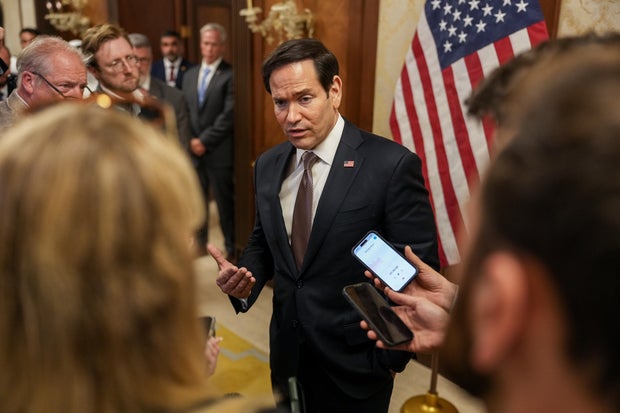
Secretary of State Marco Rubio said Wednesday that the United States would be in lockstep with its allies in the Gulf region during negotiations with Iran.
"We're going to be completely aligned with our partners in the Gulf," Rubio told reporters during a stop in Kuwait. "That's why I've taken these trips now, and it's the reason why I'm here."
He said the U.S. would "engage them on conversations about every decision that's made with regards to this negotiation."
"We're not going to do anything that undermines the security of our allies, our longstanding allies in the region," Rubio said.
Evacuation of stranded sailors in Gulf will take a "few weeks," U.N. agency says
The evacuation of more than 11,000 sailors stranded in the Gulf because of the U.S.-Iran war will take "a few weeks", the head of the International Maritime Organization told AFP Wednesday.
"It will take us a few weeks before we can actually complete the evacuation" of about 600 ships stuck since the start of the conflict, IMO secretary-general Arsenio Dominguez said in an interview.
Dominguez added that the U.N. agency hopes to eventually evacuate "around 50 vessels a day," having begun the operation to allow safe passage Tuesday.
Israeli defense minister says "no American demand" to withdraw forces from Lebanon
Israeli Defense Minister Israel Katz said Wednesday that the United States has not demanded that Israel withdraw its troops from southern Lebanon, a condition reportedly set by Tehran in ceasefire negotiations.
"We have announced that in any case we are not withdrawing and, as of this moment — and this is a diplomatic achievement — there is no American demand for Israel to withdraw from Lebanon," Katz said in an interview at a convention of local leaders in Tel Aviv.
When asked if the army would adhere to such a U.S. request if it arrived, Katz said he told U.S. Defense Secretary Pete Hegseth, and Israeli Prime Minister Benjamin Netanyahu told President Trump, that "we are there to protect the residents of the north."
Iran, and Lebanon's government, have demanded for weeks that Israeli forces withdrawal from the neighboring nation, but the memorandum of understanding signed by the U.S. and Iran calls only for an end to hostilities, without specifically addressing Israel's occupation of Lebanese territory.
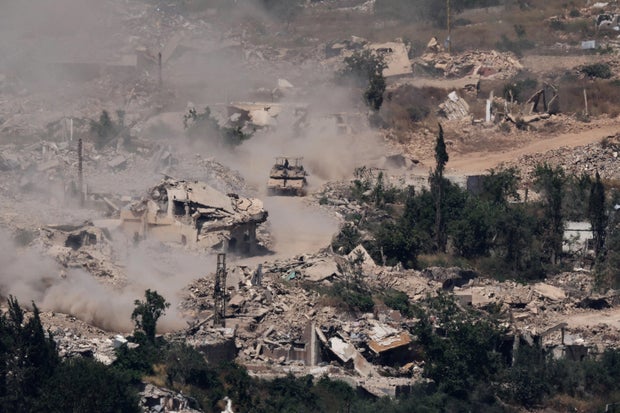
Iran has bristled at the Israeli presence, and ongoing small-scale, tit-for-tat attacks between Israel and Hezbollah, but mediator Pakistan said Wednesday that the 60-day U.S.-Iran negotiations initiated by the memorandum of understanding would likely resume next week.
CBS/AFP
Dozens of ships transiting Strait of Hormuz via Omani evacuation route from Persian Gulf
Following an announcement by the United Nations' International Maritime Organization and Oman on Tuesday of a temporary corridor being opened to evacuate stranded vessels and mariners from the Persian Gulf, CBS News tracked dozens of commercial vessels making the transit on Wednesday or are on their way to the designated route.
Oman authorized the route along its coastline, south of the historic shipping lanes that take a more central path through the strait, which are believed to be mined.
A second corridor runs north of the long-standing shipping lanes, along a route close to Iran's coast, which Iranian authorities have exerted control over since not long after the U.S. and Israel launched their joint war on Iran.
Ships tracked making the crossing along the coast of Oman included a mix of cargo vessels and tankers, many bound for Oman's Shinos port, while others were broadcasting destinations including Singapore, India and Malaysia. At least 24 had transited or were headed to the route close to Oman with their broadcast systems turned on Wednesday, while another 15 were taking the northern corridor, presumably coordinating with Iranian authorities.
The IMO announced the plan Monday, saying over 11,000 seafarers were still stranded in the region. At least 14 civilian seafarers have been killed in the Gulf region since the start of the U.S.-Iran war. The large-scale evacuation operation is being coordinated with Iran and Oman as well as other Gulf nations, the U.S., and the maritime industry, the IMO said.
Pakistan supports "restoration of status quo" in Strait of Hormuz, but gives nod to Iran and Oman laying claim
Pakistan, the primary mediator between the U.S. and Iran, has supported the "restoration of status quo" for shipping in the Strait of Hormuz, foreign ministry spokesman Tahir Andrabi told reporters Wednesday in Islamabad.
He acknowledged, however, Iran and Oman's attempt to lay some claim to the vital waterway and said Islamabad would "support regional efforts" in that regard.
"Pakistan has supported the restoration of status quo ante on the Strait of Hormuz," said Andrabi, referring to the conditions prior to the U.S. and Israel launching their joint war on Iran. Navigation through the international waterway was free and unrestricted until the conflict. Its de-facto closure by Iran in retaliation for the war sent global gas and oil prices skyrocketing.
Iran and Oman have said that, following the current 60-day period of negotiations between Washington and Tehran, they will implement a new system as the two states with coastline in the strait to control maritime traffic, which could include "costs" for shippers.
"We have taken note of the parlays, at least the press releases on the parlays, between Iran and Oman on this subject," Andrabi said Wednesday. "We will support regional efforts, and with a spirit of regional ownership of this process, particularly the littoral states to the Gulf, as such."
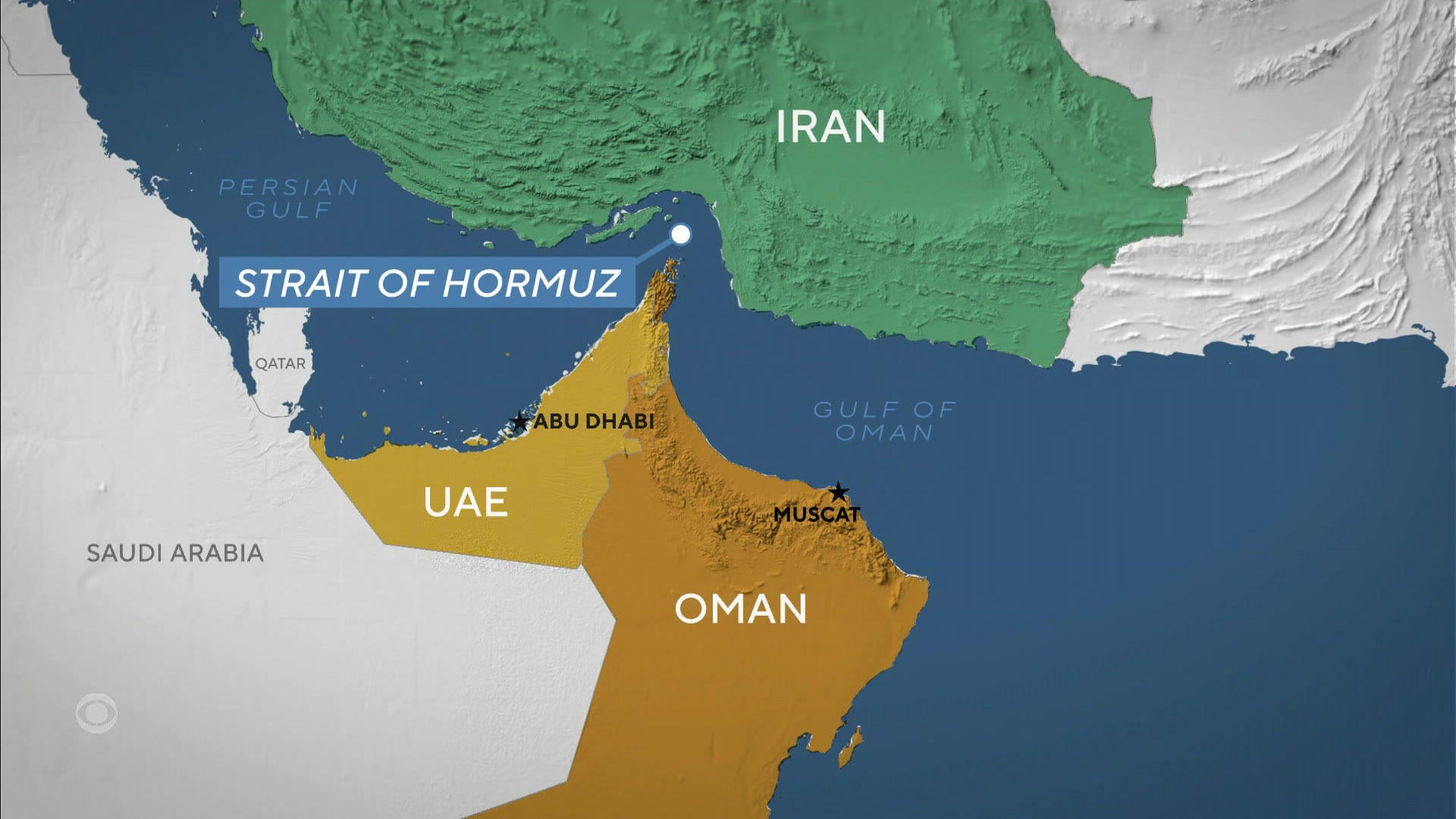
He said the "R4" countries — Pakistan, Saudi Arabia, Turkey and Egypt — "would obviously be supporting any regional solution to this issue, particularly with respect to respecting the sovereignty, territorial integrity and the natural maritime boundaries of the littoral states to the Gulf and Strait of Hormuz."
Technical talks between U.S. and Iran likely to continue next week, Pakistan says
Talks between the U.S. and Iran will likely continue next week, a Pakistani foreign ministry spokesperson said Wednesday.
"Talks are continuing. I believe that the talks will resume next week, probably on Tuesday," Tahir Andrabi told reporters in Islamabad, adding that a current pause in the negotiations was, "a temporary gap, and it is not as such a break."
"The fact that the talks are continuing — the parties are on the table — is a significant positive outcome. We certainly view it very positively," he said.
Pakistan was the primary mediator behind the direct, high-level talks between the U.S. and Iran that began Sunday in Switzerland. That first 18-hour meeting was followed by more in-depth negotiations between lower level officials, described as "technical talks."
The negotiations, aimed at reaching a much broader deal to end the Iran war, were sparked by the memorandum of understanding signed last week by the U.S. and Iran, which calls for 60 days of talks on issues including Iran's nuclear program, the dropping of U.S. and international sanctions against the country, and the un-freezing of billions of dollars of Iranian financial assets.
Qatari officials have also acted as mediators between the two sides.
Price of oil falls under $75 for first time since Iran war started
The price of Brent North Sea crude, the international benchmark for oil, continued falling Wednesday, trading under $75 a barrel for the first time since the start of the Middle East war.
Brent slid 3.1 percent to $74.73, extending its fall since the United States and Iran last week signed the memorandum of understanding and began the process of re-opening the Strait of Hormuz.
Israel says 2 Hezbollah fighters "posing an immediate threat" struck as southern Lebanon fighting simmers
The Israeli military said it struck two Hezbollah fighters Wednesday in southern Lebanon, as low-level fighting between the two sides continues, testing a fragile ceasefire.
In a statement, Israeli Defense Forces said soldiers "identified two armed Hezbollah terrorists near the Security Zone, posing an immediate threat to them. Following the identification, the Israeli Air Force and the soldiers struck the terrorists in order to remove the threat."
Israeli forces currently occupy an area that spans the country's northern border with Lebanon and extends around six miles into Lebanese territory. Israeli leaders say the "security zone" will be held, and expelled residents not permitted to return to their homes, until the threat posed by Iranian-backed Hezbollah is removed.
The fighting has threatened to derail the negotiations between the U.S. and Iran as the memorandum of understanding signed by both parties calls for a cessation fighting on all fronts in the region, including in Lebanon.
Trump says Iran not charging fees "of any kind" in Strait of Hormuz, as Tehran makes plans for the future
President Trump declared defiantly Wednesday that Iran is not charging fees for transiting the Strait of Hormuz. He did not mention, however, Iran's plans to manage traffic through the vital shipping route in conjunction with Oman in the future - which Tehran and Muscat have said could involve "costs" for shippers.
"Iran has informed the U.S. that, despite troublemaking Fake News reporting to the contrary, there are 'NO TOLLS, NO INSURANCE COSTS, & NO OTHER CHARGES OF ANY KIND BEING SOUGHT OR RECEIVED BY IRAN ON SHIPS TRAVELING THE STRAIT OF HORMUZ," Mr. Trump wrote in a post on his Truth Social platform, adding: "If this is false information, negotiations would end, immediately!"
Under the memorandum of understanding signed by Mr. Trump and his Iranian counterpart last week, Tehran agreed to allow ships to transit the strait with no charge during the 60-day negotiation period currently underway.
The memorandum of understanding calls for Iran to "conduct dialogue with the sultanate of Oman to define the future administration and maritime services in the Strait of Hormuz," and specifies that any new system must be in line with applicable international laws. It does not explicitly bar Iran from charging fees for passage in the future, however, which Tehran has said for weeks that it will do, though not during the current 60 days of negotiations with the U.S.
On Tuesday, Iran and Oman reiterated that the two nations were hashing out plans to jointly manage commercial shipping in the strait going forward, and they said services they provide to vessels would have "costs associated."
Iran says nuclear inspections will only be decided in final agreement with U.S.
Iran's deputy foreign minister said Wednesday that the question of nuclear inspections would only be settled in a final agreement with the U.S.
In a social media post, Kazeem Gharibabadi, one of Iran's top negotiators and the country's deputy foreign minister, said Iranian officials had not met with the head of the United Nations' nuclear watchdog agency, the IAEA, in Switzerland over the weekend during the first round of talks with the U.S.
Gharibabadi also reiterated Iran officials' statements from Tuesday, saying there were no plans to allow IAEA inspectors to visit sensitive nuclear sites bombed in June 2025 by the U.S. and Israel.
"These issues will only be examined and settled within the framework of a final agreement, and as a result of the other party's practical action to terminate all sanctions," he said.
The memorandum of understanding signed last week does not set a timeframe for renewed IAEA inspections of Iran's nuclear facilities, saying only that all matters relating to the Iranian enrichment program will be agreed as part of a final deal.
Iranian negotiator calls deal struck with U.S. a "declaration of America's defeat"
Iran's chief negotiator called the deal it struck with the U.S. "a declaration of America's defeat" on Wednesday.
"The Islamabad understanding was not the result of pressure and coercion, but rather the result of the resistance and authority of the brave Iranian nation," Iran's top negotiator Mohammad Bagher Ghalibaf said Wednesday of the agreement signed last week.
"That is why, the Islamabad Memorandum of Understanding became a declaration of America's defeat," he said, adding that security in the Middle East must be ensured by the countries of the region.
President Trump and Iranian President Masoud Pezeshkian signed the agreement last week, launching a designated 60-day negotiating period during which Pakistani and other mediators hope to bring the two sides to a permanent settlement to end the war.
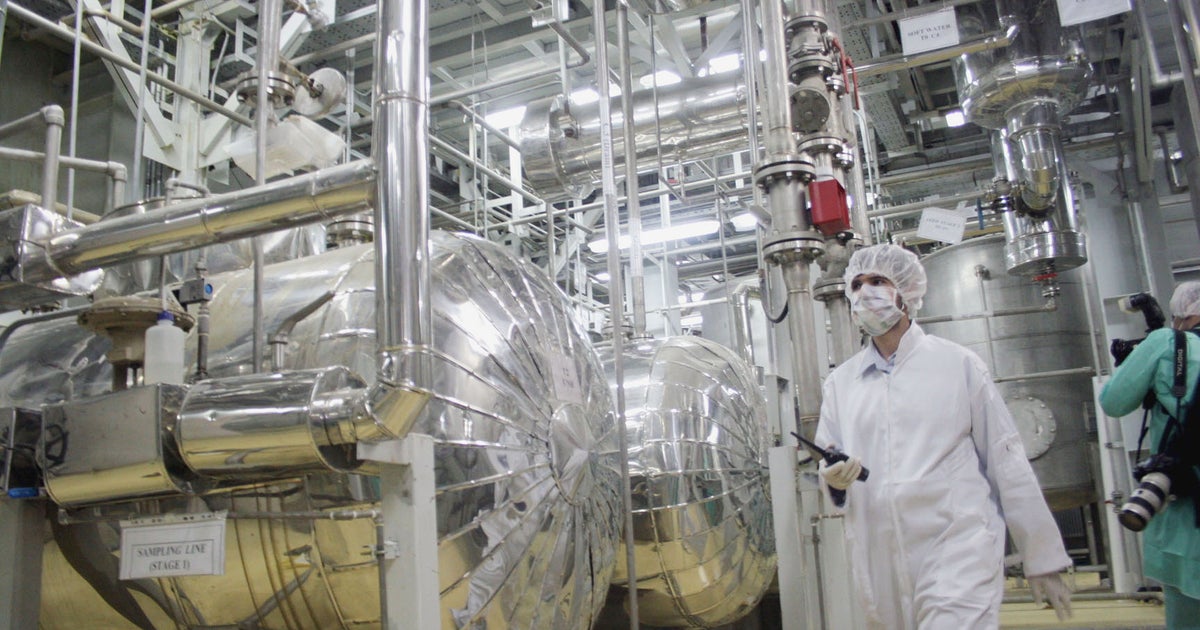
IAEA chief says nuclear inspection of Iranian sites will happen, but timing "not essential"
The head of the U.N.'s nuclear agency signaled Wednesday that Iranian nuclear enrichment sites would be visited by his inspectors, a key component in the interim deal between the United States and Iran to reach an end to the war.
The comment by International Atomic Energy Agency head Rafael Mariano Grossi was the firmest yet from the United Nations agency, which is viewed as key in determining the status of Iran's nuclear stockpile.
The U.S. and Iran offered contradictory remarks Tuesday about whether those sites would be inspected.
"I can understand political statements, they are part of the reality, but the fundamental thing I would like to remind you (of) and draw your attention to is that there has been a Memorandum of Understanding, signed by both presidents," Grossi told journalists at a news conference from the tsunami-hit Fukushima Daiichi nuclear power plant in Japan.
The accord "explicitly states that the nuclear activities that are going to be carried out with the regards of the nuclear material facilities will be supervised by the IAEA — in all letters," he said.
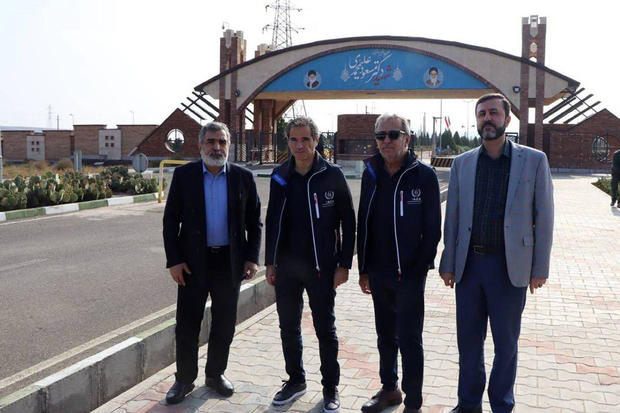
Grossi added: "Obviously, to do that, we have to inspect. Whether this happens the day after tomorrow or in one week or in ten days, it's important, but not essential. This is going to happen."
Those inspections are key for the deal, which calls for Iran's stockpile of uranium to be "downblended" from highly enriched levels.
Rubio visits gulf states to discuss memorandum of understanding
Rubio arrived in the United Arab Emirates on Tuesday and was scheduled to hold closed-door talks with its leader, Sheikh Mohamed bin Zayed, before flying to Kuwait and then Bahrain, where he will attend a Gulf Cooperation Council meeting.
Rubio said he intended to discuss the US-Iran memorandum of understanding with gulf leaders, which does not address Iran's missile programme and proxies.
He insisted that no country is allowed to impose tolls on the Strait of Hormuz after Oman and Iran, which border the waterway, said they were considering charging "costs" for navigating the key exit route for oil and gas.
"It's an international waterway," he said as he arrived in Abu Dhabi, repeating a position the US has stated throughout the war.
"No country is allowed to charge tolls or fees on an international waterway. That's existing international law."
Senate adopts House-passed Iran resolution in symbolic rebuke of Trump
The Senate on Tuesday approved a House-passed war powers resolution on Iran, marking the first time such a measure has made it through both chambers and signifying a rare rebuke of President Trump's handling of the conflict.
In a 50 to 48 vote, four Republicans — Sens. Susan Collins of Maine, Bill Cassidy of Louisiana, Lisa Murkowski of Alaska and Rand Paul of Kentucky — joined the bulk of Senate Democrats in support of the measure. One Democrat, Sen. John Fetterman of Pennsylvania, opposed. Two Republicans — Mitch McConnell and Dave McCormick — did not vote.
The resolution directs the president to "remove United States Armed Forces from hostilities against the Islamic Republic of Iran," unless Congress declares war or authorizes the use of military force. But the measure is a concurrent resolution, which doesn't carry the force of law and doesn't require the president's signature, meaning it is largely symbolic.
Trump pressures oil companies over gas prices, orders DOJ probe
President Trump said early Wednesday that consumers are being "gouged" because gas prices haven't been falling as fast as crude oil prices have on world markets — so he's told the Department of Justice to begin an investigation.
He said on his Truth Social platform that, "The big Oil Companies are not dropping their price at the pump commensurate with the sharply lower prices they are paying for Oil. Those prices are dropping like a rock! In other words, customers are being 'gouged.' I have instructed the DOJ to immediately start looking into this. Gasoline prices better start going down a lot faster than what I'm seeing!"
Oil prices increased sharply when the Iran war began and gas prices followed. But while crude prices have dropped significantly since an interim agreement was reached to end the fighting, the decline in gas prices hasn't been as rapid. Gas prices generally tend to dip more slowly than they rise with respect to oil costs.