Iran says Strait of Hormuz won't open until the U.S. "corrects" behavior
Follow the latest updates on the war in the Middle East for Monday, Aug. 10, here. See earlier coverage is below.
What to know about the Iran war:
- Iran targeted a vessel owned by the Abu Dhabi National Oil Company in the Strait of Hormuz on Saturday, despite ongoing talks with Oman over how to manage the disputed waterway.
- Iranian Foreign Minister Abbas Araghchi on Saturday said talks with Oman were "approaching the final stages," but cautioned that "this is not a sign of the reopening of the Strait of Hormuz."
- The Supreme National Security Council of Iran issued a list of highly unlikely demands from the U.S. in order to fully reopen the Strait of Hormuz, saying the U.S. must never threaten Iran again, end the blockade, withdraw all military assets from the region, lift sanctions, unfreeze assets and compensate Iran for war damages.
Iran names new head of top national security body
Iran named a new head of its powerful Supreme National Security Council, state media reported. Mohsen Rezaei had been a military adviser to Supreme Leader Ayatollah Mojtaba Khamenei and a former Revolutionary Guard commander.
It was the latest shuffle at the top for the politburo-like body, which has a range of political opinions and rivalries and is adapting to the loss of several senior officials in the war.
Rezaei replaces Mohammad Bagher Zolghadr, who took up the role after Ali Larijani was killed by an Israeli strike in March. Zolghadr will become a political adviser to Khamenei.
Rezaei earlier this month said Iran will never allow an unauthorized route through the Strait of Hormuz, which was considered an international waterway before the war and Tehran's assertion of control.
Trump says U.S. is "semi-negotiating" with Iran
President Trump said on Sunday that the U.S. is "low-keying" negotiations with Iran and signaled a willingness to allow economic pressure to mount on the Islamic Republic.
"We are only semi-negotiating with them. We are just watching Iran with its huge inflation and the fact they have no money," Mr. Trump told Axios during a phone interview.
He said Iran is in "very bad shape" and that the U.S. blockade on the Strait of Hormuz has exacerbated the country's economy.
"It will work out. It always works out. It's like a chess game," Mr. Trump said.
Iran's president met with supreme leader, state media says
Iranian President Masoud Pezeshkian recently met with Supreme Leader Ayatollah Mojtaba Khamenei, the supreme leader's office said Sunday.
"Dr. Masoud Pezeshkian met Ayatollah Mojtaba Khamenei and spoke with him at the start of his third year in the presidency," the supreme leader's office said in a statement. It did not indicate the date of the meeting.
Pezeshkian, who took office in July 2024, had said in early May that he met with Khamenei, also without specifying the date, but the supreme leader's office did not issue any statements at the time.
Khamenei has not been seen in public since the start of the U.S.-Iran war. His office said the two "discussed in detail the country's issues and problems", including the "current military situation and future prospects."
- CBS/AFP
GOP Sen. Bill Cassidy says Trump needs to "come out and speak forcefully on what the path forward is" in Iran
GOP Sen. Bill Cassidy of Louisiana said President Trump needs to speak to the American public about the path forward in Iran, after diplomatic efforts collapsed and hostilities resumed in recent weeks.
In an appearance on "Face the Nation with Margaret Brennan" on Sunday, Cassidy noted that Vice President JD Vance attended a Senate GOP lunch last week, where Cassidy said Vance "did a good job of explaining the perspective as to how to go forward." The Louisiana Republican said someone else at the lunch told the vice president that the president needs to share the same message with the American people.
"And J.D. said, 'Well, the president has," Cassidy said. "I mean, they may have, but it's being kind of overwhelmed by everything else being said, and so I think the president needs to come out and speak forcefully on what the path forward is, and and at some point it may be that that that path forward works or not, but at least there needs to be that dialogue with the American people."
Cassidy reiterated the path forward that he said Vance outlined to the GOP senators, which he said involved putting pressure on Iran, like with blockades, to cause them "enough discomfort that they will actually come back to the bargaining table." Meanwhile, the strategy includes the U.S. working to blunt the effectiveness of Iran's efforts in the Strait of Hormuz by getting oil through.
"That continued economic pressure, while alleviating the pressure on the West, as well as continued selective operations, is part of a long-term strategy," Cassidy said. "It's not something that ends it tomorrow, but something which gradually brings it to a close."
Netanyahu vows no Gaza withdrawal until Hamas disarms
Israeli Prime Minister Benjamin Netanyahu on Sunday rejected a U.S.-backed Gaza peace plan and vowed there would be no military withdrawal until Hamas is "genuinely" disarmed.
On Sunday, after more than a week of gradually escalating criticism of the plan, Netanyahu explicitly opposed it as he faced pushback from his right-wing base ahead of elections.
"Israel rejects the 15-point document," he said in a cabinet meeting, adding that the military "will not make any withdrawal until Hamas is truly disarmed and will continue to thwart threats against our forces and citizens."
Iranian state TV releases undated footage of Khamenei
Iranian state media have released an undated video they claim shows Supreme Leader Ayatollah Mojtaba Khamenei. It is unclear when the footage was taken, and CBS News could not independently verify it.
If the video is recent, it marks the first time Iran's supreme leader appears to be seen since the war with the U.S. and Israel reignited in February. He reportedly sustained serious injuries during the opening stages of the war.
The absence of the ayatollah from the public eye since his father's death and his own ascension into power raised questions about his health and who exactly was running the country.
Netanyahu vows Iran will 'not have nuclear weapons' with or without deal
Israeli Prime Minister Benjamin Netanyahu vowed Sunday to prevent Iran from having nuclear weapons, a goal he has long alleged Tehran is pursuing, regardless of the course of diplomacy with Washington and Arab states.
"I want to emphasise once again: with an agreement or without an agreement, as long as I am prime minister, Iran will not have nuclear weapons," Netanyahu said at a cabinet meeting.
Houthis claim attack on crucial port on the Red Sea
A Yemeni government official said Sunday that the Iran-backed Houthi group also attacked a crucial port on the Red Sea.
Fayed al-Noman, assistant undersecretary of the information ministry, said the Houthis fired missiles and drones on the Mocha port. It's one of the main ports under Yemen's internationally recognized government, renovated in recent years to handle shipping that avoids the Houthi-held ports in Hodeida.
The Houthis later claimed the attack, saying they fired "a large number of ballistic missiles and drones" that targeted military enforcement and warehouses in the area.
Iran insists it is not engaged in negotiations with the United States
Iran's Foreign Minister insisted on Sunday that Iran is not engaged in negotiations with the United States.
"Until the violations of the memorandum of understanding by the United States come to an end and the United States compensates for what it has violated, from our perspective, there is no possibility of resuming negotiations," Abbas Araghchi told Iran's Tasnim news agency.
Iran has been engaged in negotiations with Oman, the other country whose coastline includes part of the Strait of Hormuz, regarding the future management of the waterway. Araghchi on Saturday said talks with Oman were "approaching the final stages."
Tehran insists Strait of Hormuz will be closed until U.S. accepts all demands
Iran's Revolutionary Guards on Sunday said they would not reopen the Strait of Hormuz until the United States accepts all of Tehran's demands.
"Our current strategy is to maintain this strait until the enemy accepts all our conditions," said Guards spokesman Hossein Mohebi, as quoted by state TV, adding that "the strait is now actually a theatre of war for us and not just a waterway".
Houthis claim attack on Saudi refinery
Yemen's Iran-backed Houthi rebels claimed on Sunday an attack on an Aramco oil refinery in Saudi Arabia.
The group's spokesperson said they had "succeeded in targeting the Aramco refinery in Jazan with a drone, and the strike was precise."
Saudi Arabia's Ministry of Energy had earlier reported a fire at the facility in Jazan, adding that no injuries had been reported and the flames had been extinguished.
Pentagon calls on U.S. defense industry to boost weapons production
The Pentagon is pressing the U.S. defense industry to accelerate production of weapons to help replenish its diminished stockpile of munitions, including those depleted in the ongoing war with Iran.
Pentagon spokesman Sean Parnell said in a statement Saturday that the department was actively focused on boosting munitions acquisitions to provide "the weapons our warfighters need at the pace the threat demands."
He confirmed department efforts in the last week to significantly speed the process but insisted it was part of a broader modernization effort that predated the five-month-old conflict.
Deputy Defense Secretary Steve Feinberg wrote to industry leaders on Wednesday, giving them no more than 21 days to submit plans to "drive significantly faster, more aggressive delivery schedules and/or increased production for critical capabilities," according to a memo obtained by The Washington Post.
"Years-long development cycles are not acceptable," Feinberg wrote. "We must dramatically accelerate our program schedules and expand our production capacity now."
Two sources with direct knowledge of the matter told CBS News earlier this week that the U.S. has used nearly all of its global stockpile of long-range precision missiles during the war with Iran.
Specifically, the U.S. has used virtually all of its Army Tactical Missile Systems, known as ATACMS, and Precision Strike Missiles, the sources said.
President Trump in recent days has bristled over public reports of a munitions shortage, posting on Truth Social on Thursday that the U.S. has "massive amounts." He added that "large amounts are being manufactured and shipped to the U.S. as needed."
On Saturday, Parnell affirmed that Feinberg's memo seeking a rapid escalation of weapons production is "real," adding that it "will inform the fiscal year 2028 budget submitted to Congress for funding, and it is entirely consistent with our ongoing push to rebuild the defense industrial base."
CBS/AP
Yemen's military conducts retaliatory attacks on Iran-backed Houthis
Yemen's military conducted retaliatory attacks Saturday on the Houthi militant group, an Iranian proxy.
The attacks were in response to the Houthis' recent strikes in central and eastern Yemen.
Col. Majed al-Nazili, spokesperson for Yemen's military, said the attacks targeted the rebels' "sites and capabilities" on multiple front lines, without elaborating.
The escalation between the Houthis and Yemen's internationally recognized government and its backer, a Saudi-supported coalition, threatens to reignite Yemen's civil war following a 2022 truce.
U.S. blockade has redirected 53 ships in Strait of Hormuz, military says
The renewed U.S. blockade on the Strait of Hormuz has redirected 53 ships trying to enter or exit Iranian ports, according to U.S. Central Command.
The total is an increase of two ships since yesterday. The blockade was reinstated on July 14 after Iran targeted ships in the strait and a ceasefire between the two sides fell apart. The first blockade had redirected over 140 ships from April 14 to June 18.
Central Command also noted it has let through more than 30 ships carrying humanitarian aid, a number it does not regularly release.
On Saturday, Mohammad Bagher Zolghadr, a member of Iran's Supreme National Security Council, issued a string of demands for the strait to be reopened to traffic, one of which was for the U.S. to rescind the blockade.
Egypt could join Mecca defense agreement in next phase of deal: Turkish foreign minister
The defense agreement between Turkey, Saudi Arabia and Pakistan may not be done adding countries, according to Turkey's foreign minister.
Hakan Fidan told Anadolu Agency's "Editors' Desk" show on Saturday that Egypt may join the defense pact in the next phase of the deal.
The deal states an attack on any of the three countries will be considered an attack on all three and merit a response — similar to Article 5 of the NATO agreement. Like the other three countries, Egypt is also a majority Sunni Muslim country, unlike Iran. Egypt is one of the most heavily Sunni countries in the region.
Fidan said Turkish President Recep Tayyip Erdoğan's vision is to widen the pact to other countries in the region, however, it will only be a defensive arrangement, and they have no expansionist ambitions.
While Turkey and Pakistan have not faced strikes during the widening war, both Saudi Arabia and Egypt have come under fire. The Saudis have been attacked by both Iran and the Houthi rebel group, an Iranian proxy, in Yemen.
The port of Damietta on Egypt's Mediterranean coast was struck in a drone attack on July 29, igniting two oil tankers on fire. No one claimed responsibility for the attack and it's not clear a drone launched from Iran could even reach that distance, meaning it could have been one of their proxies.
Iran says strait won't open until the U.S. "corrects" behavior
Iran's politburo-like body known as the Supreme National Security Council said the Strait of Hormuz will not open until the United States "corrects its behavior," issuing new demands that could shake up talks on a deal to manage the waterway and traffic on it.
Iran's state broadcaster published the statement by the council's secretary, Mohammad Bagher Zolghadr, who is also a commander in the powerful Revolutionary Guard.
The U.S. must never threaten Iran again, the statement said, and must permanently end the war with Iran and its armed allies in the region. The U.S. must lift the naval blockade of Iranian ports and withdraw its military from the area. It also must "completely compensate" Iran for war damage, lift sanctions and "unconditionally" release frozen assets.
There was no immediate comment from the U.S., which has wanted an acceptable deal first on the strait before ending the blockade. According to the interim deal signed in June, a schedule to end sanctions and plan on compensation would be part of the final deal, and negotiations would address frozen assets.
Negotiations ongoing despite Iranian attack on ship in Strait of Hormuz, Oman says
Despite a missile attack on an oil tanker in the Strait of Hormuz on Saturday, Oman said it is continuing talks with Iran over management of the strait and they are going well.
Oman condemned the strike, but said "the ongoing negotiations regarding arrangements related to navigation in the Strait of Hormuz are proceeding in a positive and constructive atmosphere, and emphasizes the importance of avoiding any actions that could affect these negotiations and the progress achieved, which takes into account the interests of all parties."
Iran launched a missile strike on a tanker belonging to the state-owned Abu Dhabi National Oil Company while it was transiting the Strait of Hormuz. The ship owner said no one was injured, though a fire was reported and later extinguished.
While Iran has also said the talks are going well, the Iranian Foreign Ministry downplayed their significance and said the U.S. would need to stop its aggression for the Strait of Hormuz to be opened freely to traffic like before the war.
Iran-Oman negotiations entering "final stages," but not a full reopening, foreign minister says
Iranian Foreign Minister Abbas Araghchi on Saturday said talks with Oman were "approaching the final stages," but cautioned that "this is not a sign of the reopening of the Strait of Hormuz."
"The reopening of the Strait of Hormuz is subject to other conditions and compensation for the violation of the memorandum of understanding by the United States," he said, referencing a June agreement between the U.S. and Iran to set terms for peace talks.
The Revolutionary Guards, the ideological arm of the Iranian military, underscored the point on Saturday, saying, "The opening of the Strait of Hormuz has its own mechanism and has nothing to do with the negotiations between Iran and Oman."
"The enemy is forced to accept Iran's conditions for the opening of the strait and to refrain from the interference that it is currently making in the negotiations — which have almost reached their end — between Iran, Oman and other countries," it continued.
Israeli troops built earth barrier in Lebanese army-held village, Lebanon says
Israeli troops infiltrated a Lebanese village placed under the control of Lebanon's army as part of a June agreement and built an earthen barrier overnight Friday, Lebanese state media and the local mayor said.
"An Israeli occupation army force advanced into the village of Zawtar al-Gharbiya shortly after midnight ... and erected a new earthen barrier near the town square," Lebanon's state-run National News Agency reported on Saturday.
An AFP correspondent saw the barrier, built at the village's eastern entrance. The local authorities said it was unclear if any Israeli forces remained in the area.
Zawtar al-Gharbiya was one of two designated "pilot zones" where the Lebanese army was to take over as part of a U.S.-sponsored framework agreement signed with Israel in the wake of the latter's invasion and occupation of southern Lebanon.
Under the June agreement, Lebanon is meant to disarm Hezbollah while Israel is supposed to gradually withdraw its forces. Confirming the incident, a Lebanese military source told AFP it was a violation of the framework agreement.
Iran targets UAE vessel with missile in Strait of Hormuz
The United Arab Emirates on Saturday said Iran had targeted a tanker belonging to the state-owned Abu Dhabi National Oil Company while it was transiting the Strait of Hormuz.
Iran has imposed an effective blockade of the strait and wants to charge users for passage, which the U.S. fiercely opposes, and is in talks with nearby Oman over arrangements for the strait's future management.
The UAE foreign ministry in a statement condemned what it called a "hostile Iranian attack that targeted a tanker belonging to ADNOC with a missile while it was transiting the Strait of Hormuz, without causing casualties."
On Friday, ADNOC had put out a statement saying that since the start of the war, 15 of its vessels had been attacked in Hormuz, "including three vessels this week alone."
Iranian lawmakers warn Saudi Arabia against new defense pact
Iranian officials warned Saudi Arabia that its new defense pact with Turkey and Pakistan won't guarantee the country's security.
In a social media post on Friday, Mahmoud Nabavian, a member of the Iranian Parliament, said: "Saudi rulers must know that just as America's bases could not bring them security, clinging to America's lackeys will not bring them security either."
Another lawmaker, Ebrahim Razaei, echoed the message in a separate post where he argued the defense pact is a "paper agreement" which would not bring security "just as years of one-sided nursing to the Americans did not bring [Turkey and Pakistan] security."
U.S. targets Iran's banking system, companies with new sanctions
The Trump administration on Friday announced its eighth round of Iran-related sanctions as diplomats race to secure a deal on the Strait of Hormuz.
The new sanctions target Iran's banking system and companies across multiple countries that the Treasury Department says launder hundreds of millions of dollars.
"Every facilitator that keeps the regime afloat is putting a target on its own back," Treasury Secretary Scott Bessent said in a statement. "Treasury will continue to expose these networks and cut them off from the U.S. financial system."
The department designated Shahr Bank and two Dubai-based exchange houses, Titan Exchange and Alps International, that it says helped the bank retrieve oil revenue for major Iranian exporters, including the National Iranian Oil Company and Naftiran Intertrade Co.
Titan Exchange allegedly held tens of millions of dollars on Shahr Bank's behalf, and the Treasury Department says the exchange is linked to a financier who was previously sanctioned for aiding a separate shipping and sanctions-evasion network.
U.S. citizen gives update on conditions inside Iran's Evin Prison
CBS News has received another recording from inside the notorious Evin Prison in Iran with an update from U.S. citizen and journalist Reza Valizadeh.
He last reached out in June, and he wants his most recent statement to be made public, as well, according to his attorney Ryan Fayhee.
Valizadeh is one of the five U.S. citizens still trapped in Iran, two of them at Evin. Three others are believed to be under exit bans, which means Iranian authorities are preventing them from leaving the country.
In this latest recording obtained by CBS News, Valizadeh shared updates about his condition and that of fellow American Kamran Hekmati, who was just ordered back to prison after having been granted medical leave that lasted under 30 days.
Iranian foreign minister calls for Muslims to "stand together"
Iranian Foreign Minister Abbas Araghchi, the top diplomat involved in prior negotiations with the U.S., urged Muslims to come together in an apparent effort to defeat the United States.
"Iran's Powerful Armed Forces have shown their readiness, capability, and might in face of the world's most expensive military," Araghchi shared on X. "When Muslims stand together, we can face every challenge by malicious outsiders head-on."
The comments by Araghchi come on the same day Pakistan, Turkey and Saudi Arabia, largely Sunni Muslim countries, signed a defense agreement promising any attack on one country would merit a response from all three countries.
It was unclear whether Araghchi was referring to the pact in his statement, but Iran is almost entirely a Shiite Muslim country, and has often feuded with Sunni Muslim countries.
"Time to rely only on ourselves and embrace true brotherhood," Araghchi added in his post.
Meanwhile, Ebrahim Rezaei, a member of Iran's Parliament and another prominent politician, criticized the defense agreement directly, saying, "Saudi Arabia should understand that a paper agreement with Türkiye and Pakistan will not provide them with security, just as years of one-sided dependence on the Americans did not bring them security."
Iraqi prime minister invited to visit Saudi Arabia after strikes
Iraqi Prime Minister Ali al-Zaidi received an invitation to visit Saudi Arabia, his office said Friday, as Tehran-backed groups announced they would delay their response to deadly U.S.-Saudi strikes in Iraq last month.
Zaidi was supposed to visit Riyadh in late July, but the trip was canceled due to the strikes, which killed 20 militants, including five Iranians, on July 29.
His media office said Zaidi met Saudi intelligence chief Khalid bin Ali al-Humaidan, who "conveyed a message from the Saudi leadership renewing the invitation for the prime minister to visit the Saudi capital, Riyadh."
The U.S.-Saudi strikes came after Riyadh said its forces had intercepted drones targeting oil facilities, blaming Iran-backed groups in Iraq.
They also followed growing U.S. pressure on Baghdad to disarm pro-Iran armed groups, which targeted U.S. facilities hundreds of times during the Iran war.
Zaidi, who came to power this year with Washington's blessing, vowed to ensure those groups would hand over their weapons, but has faced pushback from some powerful factions.
10 killed, including eight soldiers, in Houthi attack on Yemeni forces
The situation in the Middle East involving Iranian proxies continued to escalate on Friday.
Attacks by the Iran-backed Houthi rebels on Yemen's Marib province killed at least 10 people Friday, according to a minister and military source, as the rebels escalated strikes on the oil-rich region a day after their deadliest attack in years.
The latest violence has raised the spectre of a return to war in the Arabian Peninsula's poorest country, where a 2022 truce between the Houthis and the Saudi-backed government had largely held before unravelling last month.
A Yemeni military source told AFP that Houthi attacks in Marib province killed eight members of government forces and wounded 12 others.
The health minister for the Saudi-backed government said the rebels had shelled residential areas and displacement camps in Marib city, killing at least two civilians and wounding 14 others.
The attack Thursday with missiles and drones killed at least 58 government troops, mainly in Marib, an army source told AFP earlier, one of the deadliest incidents between the two sides in years.
Army opens test ranges to small companies to try to get weapons quicker to the battlefield
The U.S. Army said Friday it is opening up test ranges to private companies developing missiles, drones and other weapons in hopes of buying them more quickly for use on the battlefield.
Army Secretary Dan Driscoll told reporters at a military testing range in Michigan that the effort will cut months and sometimes years of the red tape that typically stifles military contractors. He pledged to grant companies access to ranges in the U.S. or those belonging to allies abroad within 30 days of them making a request through an online marketplace that went live Friday.
"It can take 12 to 18 months for a company that wants to go test the thing that can make a soldier's life better, that can increase their lethality and that can keep them safer," Driscoll said. "That is not sufficient."
The Army is also opening its ranges as the Pentagon grapples with the costs of the Iran war, which has diminished the nation's stockpiles of advanced weapons that sometimes cost millions of dollars for a single missile or interceptor.
Driscoll deflected questions about the nation's munitions stockpiles. He said, "We have a larger arsenal than any nation in the history of the world, and we will have an even larger arsenal with new and different and layered defenses."
Iraqi resistance group says it will not launch attacks on Saudi Arabia after plea
The Islamic Resistance in Iraq, a Shiite Muslim group aligned with Iran, said it will not launch a planned attack on Saudi Arabia after a plea from influential leader Hadi al-Amiri, head of Iraq's Badr Organization, a fellow Shiite group.
"It has been decided to postpone the response scheduled for today, in deference to Al-Amiri's appeal and in response to the positions of certain political leaders," the Islamic Resistance in Iraq said in a statement.
Several loosely organized pro-Iran and anti-Saudi groups have launched attacks against the Saudis from within Iraqi territory since the U.S. and Israel launched attacks against Iran on Feb. 28.
Al-Amiri, though, said Friday, "I address my message to my sons and brothers in the Islamic Resistance in Iraq, the heroic mujahideen. I call on you to postpone any response to the American-Saudi aggression that targeted Iraq, and to bear the pain for the sake of Iraq's supreme national interest."
The U.S. and Saudi Arabia carried out strikes on some of those militias within Iraq on July 28. The U.S. said Iraqi militias carried out 600 attempted attacks on Saudi and American targets from February through April.
The announcement by the Islamic Resistance in Iraq also coincided with Saudi Arabia signing a defense pact on Friday with Pakistan and Turkey, Iraq's northern neighbor. The agreement states an attack on one country will be considered an attack on all three countries and merit a response.
Trump administration working to lower gas prices, Hassett says
Gas prices remain high, but National Economic Council Director Kevin Hassett, President Trump's top economic adviser, said the administration is aware and trying to fix the problem.
"Oil energy prices are a little bit inflated, but we could say that [prices are] way less than people expected," Hassett told reporters outside the White House. "But we're mindful of the fact that gasoline prices are high, and we're making many steps to help reduce the stress of that for people."
Hassett spoke to reporters on a day when employment numbers came in well below what they were expected, shedding 23,000 jobs.
The national average for a gallon of regular gas is currently $4.04, according to AAA. A month ago, the average was $3.79, and a year ago, they were $3.17.
The U.S. war with Iran has caused gas prices to spike, and after a slight dip during a brief ceasefire, the average is on the rise again. Brent crude, the international standard for oil prices, was up to over $83 a barrel as of 11:15 a.m. Eastern time on Friday, a slight increase after the price rose by 4% on Thursday.
Marine traffic drops in Strait of Hormuz, stabilizes in Bab el-Mandeb, data shows
Marine traffic continues to be minimal in both the Strait of Hormuz and Bab el-Mandeb Strait, though the latter has stabilized, if at a highly reduced volume, the latest tracking data shows.
There were just eight commercial vessels to transit the Strait of Hormuz on Thursday, a drop from 15 on Tuesday and 12 on Thursday, according to data firm Kpler. Prior to the start of the war, about 130 ships transited the key strait and carried 20% of the world's oil and gas shipments.
Even with no new attacks in either strait, vessels remain hesitant to make the crossings. In the Bab el-Mandeb Strait, the southern exit or entrance to the Red Sea, 26 vessels made the crossing on Thursday, according to Kpler. On Tuesday, 32 ships made the crossing, while 22 made the crossing on Wednesday.
About 50 to 70 ships crossed the Bab el-Mandeb Strait before the Iran-backed Houthi rebels said they would target Saudi-flagged ships. The Houthis have fired missiles or drones at about half a dozen Saudi ships in the past several weeks.
Iran criticizes Mecca Defense Agreement, says it won't provide them security
Iranian politicians are weighing in for the first time on the new trilateral agreement between Saudi Arabia, Pakistan and Turkey, saying it isn't worth the paper it is signed on.
"Saudi Arabia should understand that a paper agreement with Türkiye and Pakistan will not provide them with security, just as years of one-sided dependence on the Americans did not bring them security," Ebrahim Rezaei, a member of the Iranian Parliament's National Security and Foreign Policy Commission, said in a statement on X. "Correct your policies so that you no longer have to beg others for security."
The pact, dubbed the Mecca Joint Deterrence Agreement, since it was signed in the Saudi holy city of Mecca, is an agreement between three Sunni Muslim countries. Iran is a majority Shiite Muslim country.
While officials have said the deal is not about nuclear weapons, it does provide defense for each of the countries similar to Article 5 of the NATO agreement. An attack on one of the three countries will be treated as an attack on all three, and Saudi Arabia has faced repeated aggression from the Iran-backed Houthi rebels based in Yemen in recent weeks.
Trilateral pact not tied to nuclear ambitions, Saudi official says
The joint defense pact signed with Turkey and Pakistan was not linked to "any nuclear ambitions" and was not a threat to any country in the region, a Saudi official said Friday.
"The agreement does not represent an effort to establish a military axis or a sectarian bloc. Nor is it linked to any nuclear ambitions or arms race, rather it is focused on building sustainable capabilities," Deputy Minister for Public Diplomacy Rayed Krimly said in a post on X.
He said the deal "does not constitute a threat to the security of any country in the region, nor does it represent an escalation of tensions between any two states."
Pakistan is a nuclear power, unlike Saudi Arabia and Turkey, but each of the three countries, all Sunni Muslim in nature, brings something to the pact. Turkey has the industrial capabilities to build weapons, including drones, at scale and Saudi Arabia brings significant money to the partnership.
Turkey, however, insisted on Friday its joint defense pact signed amid the U.S.-Iran war was "not aimed at any particular country."
-CBS/AFP
Saudi army won't "stand idly by" on Houthi attacks in Yemen: Report
The Saudi-led coalition supporting Yemen's government since 2015 will not "stand idly by" as the Houthi rebels escalated their attacks on Yemeni troops, a source close to the Saudi military told the AFP news agency on Friday.
"The Coalition does not seek escalation, but we will not allow the current balance of power on the ground to be changed," the source added, speaking on condition of anonymity to discuss sensitive matters.
It was unclear what the Saudis would do in retaliation for the Houthi attacks.
Houthi rebels launched fresh missile and drone attacks on the eastern Yemeni city of Marib, Yemen's state-run Saba news agency reported on Friday, a day after a series of strikes on government military positions left dozens dead and wounded.
At least five people, including three members of the government forces, were killed in today's strike in Marib and 14 others were injured, the country's health minister said.
-AFP/CBS
Saudi Arabia, Turkey and Pakistan have signed key defense accord, officials say
Saudi Arabia, Turkey and Pakistan have signed a defense agreement on Friday, Pakistan's Foreign Ministry said, deepening cooperation between the three regional powers at a time of growing security concerns.
The agreement was signed during a meeting between Saudi Crown Prince Mohammed bin Salman, Turkish President Recep Tayyip Erdogan and Pakistan's Prime Minister Shehbaz Sharif in Saudi Arabia.
"The Agreement is intended to strengthen collective deterrence against any act of aggression, and stipulates that any armed attack against any one of the three States shall be regarded as an attack against them all. It further provides for the enhancement of all aspects of defence cooperation among the three States," the ministry said in a statement.
Houthis strike Saudi-backed government positions in Yemen's Marib
Yemen's state-run Saba news agency reported on Friday that Houthi rebels had launched fresh missile and drone attacks on the eastern Yemeni city of Marib, a day after a series of strikes on government military positions left dozens dead and wounded.
Yemeni armed forces shot down several Houthi drones over Marib, according to the report. Videos circulating on social media showed smoke rising over the city.
The Houthis have not issued a statement on this latest attack.
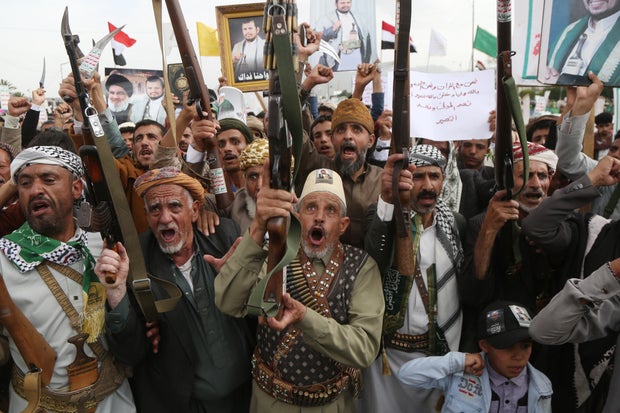
The new strikes came after Houthi military spokesman Yahya Saree announced Thursday that the group carried out a "large-scale and special military operation" targeting "Saudi military build-ups in Marib and Hadramawt."
He claimed the operation killed and wounded hundreds of Yemeni soldiers and destroyed military camps, weapons depots and equipment in the Al-Wadiah area in eastern Yemen.
The Saudi-backed Yemeni Joint Operations Command, however, confirmed the deaths of 17 soldiers and officers in the Houthi attacks. The AFP news agency put the death toll at at least 58 government troops.
The Saudi-led coalition in Yemen said on Friday that 11 civilians were wounded in what it described as "Houthi terrorist attacks" targeting the southern Saudi city of Najran.
Coalition spokesman Turki al-Maliki said the injured included seven Saudi nationals, among them a woman and a 4-year-old child, as well as one Yemeni, two Egyptians and one Pakistani. He added that some of the victims suffered second-degree burns.
Al-Maliki accused the Houthis of using indiscriminate projectiles against civilian areas, describing the attack as "a flagrant violation of international humanitarian law and its customary rules" through the deliberate targeting of civilians and civilian infrastructure.
He said the Joint Forces Command would continue taking the necessary measures to respond to the attacks and ensure the protection of civilians.
Sen. Ted Cruz calls for Trump to arm Iranian protesters: "Our objective should be regime collapse"
With the U.S.-Iran conflict in its sixth month, the Trump administration is angling for a deal. But Sen. Ted Cruz argues the U.S. should heap more pressure on Iran's regime — including by arming Iranians who oppose their government.
"I think our objective should be regime collapse," the Texas Republican told CBS News national security analyst and Free Press columnist Aaron MacLean on the "School of War" podcast.
Cruz first pushed for the U.S. to arm protesters in late January, after Iran cracked down on the country's largest wave of demonstrations in years, killing at least 12,000 people, sources told CBS News.
He has since criticized many of the U.S.'s diplomatic overtures toward Iran. He told MacLean the memorandum of understanding was a "disaster" and a "terrible deal," warning it would set the stage for Iran to get billions of dollars in sanctions relief and $300 billion in economic development funds, and could let Iran assume "a permanent role with the Strait of Hormuz."
"You'll forgive me if I'm not terribly eager to give them $300 billion to facilitate their carrying out their stated intent of murdering us," Cruz said.
Houthis launch deadly attacks on Saudi-backed Yemeni government forces
Iran-backed Houthi rebels in Yemen killed at least 58 government troops and injured dozens in missile and drone attacks on Thursday, a military source told the AFP news agency, in one of the deadliest days of the country's civil war in four years.
The attacks come as Yemen is increasingly drawn into the U.S.-Israeli war with Iran, with the rebels stepping up attacks against both government forces and neighboring Saudi Arabia, a key U.S. ally and supporter of the internationally recognized Yemeni government.
The evolving regional situation has prompted Saudi Arabia, Turkey and Pakistan to seek closer security ties, with the three Muslim-majority nations set to sign a joint defense agreement in Jeddah on Friday, according to Saudi sources with knowledge of the matter.
Houthi military spokesman Yahya Saree said the rebels attacked government positions with ballistic missiles and drones in response to an alleged military buildup backed by neighboring Saudi Arabia.
A military official, who also spoke on condition of anonymity, said Thursday's attacks on troop camps were the worst in Yemen since 2022.
Yemen's defense ministry said in a statement that its armed forces would respond to the attacks "at the appropriate place and time."
The escalation spilled across the border on Thursday, with Saudi officials saying Houthi attacks wounded 11 civilians in the southern Najran region.
AFP
Trump denies munitions shortage, but says there are some weapons "where it's a little bit tighter"
President Trump again denied reports that the U.S. military is running low on munitions amid the war with Iran.
"We have certain types of munitions that are very powerful, yeah, that we have unlimited, virtual unlimited supply," Mr. Trump said Thursday in the Oval Office. "We have others where it's a little bit tighter, and we're getting them in on a daily basis."
"But we have certain types of munitions which are very, they may not be as accurate. They may not be, you know, they're not as elite," Mr. Trump said. "We have elite too, but we're, we're watching that very closely. But we have certain types which are very powerful, very good, and we have an unlimited supply, and so we're in great shape."
"But with that being said, we always want more," he added. "We have to have more. We have other things … maybe come up, and maybe don't come up. Hopefully, nothing else does come up. But we're in very good shape. We have literally massive amounts of ammunition."
Trump insists Strait of Hormuz "sort of open right now"
President Trump on Thursday told reporters he didn't want to say that a deal to reopen the Strait of Hormuz had been reached, but insisted it is "sort of open right now."
"We control it, but they can always shoot something, they always have something, or drop a mine, and if you have one mine out there you sort of mess things up, because people don't want to take their billion-dollar boats and accidentally get hit by a mine, but I think we're doing very well," Mr. Trump said in the Oval Office after signing several executive orders.
Mr. Trump also said he was involved in the ongoing negotiations with Iran, but did not specify how.
Transits through the strait remain extremely limited, as Iran demands that ships travel close to its coast and seek permission before sailing through it. Fewer than 10 ships per day traveled through the waterway from Sunday to Tuesday, according to analytics firm Kpler.
Iran-Oman talks nearing deal but not for full Strait of Hormuz reopening, Iran state news agency says
Iran and Oman are nearing a new arrangement for managing traffic through the Strait of Hormuz, with Tehran insisting the framework represents a new security model for the strategic waterway rather than a full reopening of the strait, Iran's state news agency IRNA reported Thursday.
According to IRNA, the proposed mechanism would regulate the movement of commercial vessels, with ships entering through Iranian waters and exiting through Omani waters.
IRNA said the talks are aimed at defining "a new model that is different from the 60-year-old practice of the past" in which ships passed through the strait at will.
President Trump has said the talks could result in a deal concerning the strait being announced as soon as Thursday.
IRNA asserted that the Iran war has changed the security situation around the waterway and that previous arrangements can't address the new realities.
The agency said the success of the arrangement would depend on whether other nations in the region and worldwide accept it.
There was no mention in the IRNA report of an intention to charge vessels fees to get through the strait — a potentially contentious condition.
Iranian Parliament speaker mocks Trump's propensity to threaten attacks and then call them off
The speaker of Iran's Parliament posted a statement mocking President Trump's pattern of threatening major strikes and then calling them off in favor of talks.
"'Massive attack coming… wait, never mind, they want to negotiate.' That's theater diplomacy on loop," Mohammad Bagher Ghalibaf wrote on X.
He also accused the U.S. of "bullying [and] broken promises."
"Acknowledge the facts and fulfill your commitments. We don't need more theater," he said.
Ghalibaf has been one of the main figures in negotiations between the U.S. and Iran to broker a lasting peace. But he has also regularly taunted the U.S. and Mr. Trump on social media.
In late July, the speaker posted a meme of a cyclist jamming his own front wheel along with the comment, "They wanted to punish Iran. Punished themselves with triple-digit oil instead."