Trump expects talks with Iran to resume this week after rejecting proposal
Follow updates on the war in the Middle East for Monday, September 28, here. See earlier developments below.
What to know about the Iran war:
- President Trump said Saturday he had rejected Iran's latest proposal to reopen the Strait of Hormuz and restart talks aimed at reaching a deal on the country's nuclear program.
- Iranian President Masoud Pezeshkian told CBS News in an interview that despite an "atmosphere of distrust," Iran would allow U.N. nuclear inspectors into the country as part of a potential long-term ceasefire deal.
- Iran's deputy foreign minister on Friday accused Israeli Prime Minister Benjamin Netanyahu of using his U.N. General Assembly address for "justifying war and aggression," and said mass walkouts during his remarks "spoke louder than any speech."
Trump won't rule out more strikes on Iran before midterms
President Trump on Sunday said he hasn't ruled out more military strikes on Iran before the midterm elections in November.
Asked by Fox News' Aishah Hasnie if strikes in the coming weeks were still an option, Mr. Trump replied: "I don't want to say that. I don't want to say that. I mean, it's possible, but I just don't want to say that."
As he has several times in recent months, Mr. Trump predicted the war would end soon and that "the oil will go down way down to what it was before the war, and the key is Iran will not have a nuclear weapon. That's the key to the whole thing."
Trump expects talks with Iran to resume this week
President Trump said Sunday he expects talks with Iran to resume in the coming week, a day after he rejected a truce proposal put forward by Tehran.
"They want to make a deal, but it is not the deal that I want to make," Mr. Trump told Axios in a phone interview on Sunday. "It is what we would have maybe agreed to a year ago."
Iran said Friday it had submitted a proposal to the U.S. to reopen the Strait of Hormuz, but Mr. Trump rejected it, asserting that Iranian leaders wanted the deal because "they are losing so badly."
"They overplayed their hand," Mr. Trump told Axios.
The president said resuming strikes against Iran is not off the table, saying "I am always thinking about it."
Iran's Foreign Minister Abbas Araghchi said Tehran has not been notified of Mr. Trump's refusal of the proposal to reopen the Strait of Hormuz.
Speaking from New York, Araghchi told NBC that Iran is "fully prepared for the war to be resumed."
He added, however: "At the same time, we stand ready for diplomacy. It is up to President Trump to choose."
-CBS/AP
Rep. Jim Himes says Trump's "threat to annihilate Iran is nonsensical"
Democratic Rep. Jim Himes of Connecticut, the ranking member on the House Intelligence Committee, said President Trump's "threat to annihilate Iran is nonsensical," while warning about the power Iran could wield over the midterm elections.
"He's been trying that for six months now, and he's not wrong — we sank their navy, we destroyed a lot of their planes — but, you know, the Iranians have, for six months, sustained the very worst that we and the Israelis can throw at them," Himes said on "Face the Nation with Margaret Brennan." "Unless the president wants to start sort of killing civilians in cities, we've shown what we can do, and the Iranians have shown that they can sustain that."
Himes argued that, "The Iranians now, in some sense, control what happens on election day."
"If the Iranian regime wants to make sure that Mike Lawler loses in New York-17, or that Ashley Hinson is not a senator in the Midwest, they will call their friends the Houthis and say, 'Fire five missiles at five ships,' or they'll fire a couple of missiles or drones at ships in the Strait of Hormuz," he said.
Himes continued, "Oil goes up to $120 a barrel, diesel, already at record highs, goes to $8 a gallon, and guess what? Mike Lawler and Ashley Hinson lose their elections, right?"
"The Iranians are not stupid people. They've been negotiating literally for thousands of years, and they understand that they now have a massive impact on what happens in November simply because they control the flow of oil and fertilizer and other stuff out of the strait," Himes said. "So, do you think they're giving up that position before the election? Of course, they're not."
Sen. Kennedy says Iran's plan was "not a serious offer"
Republican Sen. John Kennedy of Louisiana said that Iran's proposed plan to reopen the Strait of Hormuz and restart talks was "not a serious offer."
"The president's not Bambi's baby brother. He turned it down," Kennedy said on "Face the Nation with Margaret Brennan" on Sunday. "We need to continue doing what we're doing — the sanctions, the blockade."
"The truth is, if you're fair-minded at all, Iran is a sucking chest wound, and the world is safer for it," Kennedy said. "Now there's just one problem: the strait is at least partially closed, and it's affected the price of oil. And oil's in everything, including gasoline, and it's painful as hell."
Kennedy said, "We've got to either figure out a way to settle this thing, to get the strait open, or to escalate," though he noted that he would not support sending in troops.
Saudi strike on Yemen's Taiz reportedly kills seven
A Saudi airstrike on Taiz in southwest Yemen killed seven people and wounded dozens more, Houthi media reported on Sunday.
The Iran-backed Houthis' Al-Masirah TV channel said the strike killed seven and wounded 40 in a central marketplace in Taiz, minutes after reporting that a Saudi fighter jet had targeted the area.
Fighting intensified in September as the Houthis launched a lightning offensive that saw them seize Yemen's entire Red Sea coast, including the Bab al-Mandab Strait, a vital shipping lane.
The Houthis have in parallel launched a blockade on Saudi energy exports, already choked off by Iran's closure of the Strait of Hormuz.
Despite Saudi backing, Yemen's government forces have been unable to repel the latest Houthi offensive.
Iranian forces say they captured U.S. underwater drone
Iran's Revolutionary Guards said on Sunday that they seized an American submarine drone in the strategic Strait of Hormuz, which Tehran has blockaded in the months-long Middle East war.
"Through a coordinated, complex operation involving intelligence oversight and electronic warfare, IRGC naval forces' personnel successfully captured an advanced unmanned underwater vehicle (UUV) belonging to the terrorist U.S. military," the IRGC naval forces said in a statement, according to state TV.
They added that the drone was "operating in the Strait of Hormuz for espionage purposes", identifying the model as a Remus 600 autonomous underwater vehicle that was "now in the hands of the force's specialists for data recovery".
Saudi authorities shift schools in Riyadh to remote learning for a week
Parents across Riyadh received emails from schools on Sunday announcing a last-minute plan to shift to remote learning for a week, according to messages seen by AFP.
"We have just been informed by Saudi authorities that schools must remain closed all week," read two separate messages seen by Agence France-Presse news agency.
There was no official reason given but the move comes amid heightened tensions in the Gulf and near-daily attacks aimed at Saudi Arabia by Iran-backed Houthi fighters in Yemen.
Iran stands by proposal to reopen Strait of Hormuz
Iran on Sunday insisted on its conditions for reopening the Strait of Hormuz, despite President Trump's rejection of the proposal.
Iran's plan called for a cessation of all hostilities in the Middle East, including in Lebanon, according to Foreign Minister Abbas Araghchi, and fulfilling conditions in the ceasefire deal that fell apart months ago.
Araghchi said on Sunday that the Iranians "saw the first reaction from the U.S. president, but so far, nothing has been conveyed to us by the mediators".
"We are waiting for the mediators to convey the definitive positions to us, and we will make a decision based on them," the foreign minister added.
CBS/AP
Bessent says U.S. has been successful in isolating Iran's economy
Treasury Secretary Scott Bessent said Saturday that he had sent envoys around the world to pressure countries to economically isolate Iran, hailing new restrictions targeting the country's airlines and banks.
"At my direction, teams were dispatched across the globe to engage with countries and demand action against the Iranian regime," Bessent said on X. "These efforts are delivering results."
Bessent noted that Turkey and Oman have halted incoming flights from private carrier Mahan Air, while the United Arab Emirates has stopped all flights by Iranian airlines.
Dubai, the UAE's commercial hub, is a major destination for Iran's carriers, with multiple daily flights, a large Iranian community and close business links.
Bessent also highlighted new banking restrictions.
On Wednesday, the UAE central bank blocked transactions to and from Iran by branches of Iran's Bank Melli, accusing it of violating laws on money laundering, terrorism and arms proliferation.
Last week, Turkey revoked the license of Iran's Bank Mellat, a semi-private financial entity that has been subject to Western sanctions for years.
Last month, Bessent announced what he called Operation Economic Outcast, a plan designed to use economic pressure on Iran to reopen the Strait of Hormuz and end the war.
The operation expanded the categories for secondary sanctions on entities and countries that transact with Tehran, and also introduced new sanctions across a variety of sectors, including digital assets, gold, aviation, technology and shipping.
Bessent said at the time that any entity that facilitates money laundering on behalf of Iran "will be removed from the U.S. dollar system."
CBS/AFP
Oman calls for self-restraint, dialogue in Middle East conflict
Omani Foreign Minister Badr Albusaidi called at the United Nations Saturday for "self-restraint" from all sides in the Middle East war, while stressing that Muscat was ready to mediate.
"We call upon all parties concerned to settle their outstanding disputes through pursuing a policy of self-restraint and foresight, and through engaging in dialog to reach consensual, political solutions and sustainable understandings for the benefit of all," Albusaidi said, addressing world leaders gathered in New York.
"Oman once again reaffirms its steadfast commitment to continuing its efforts aimed at safeguarding navigation in the Strait of Hormuz ... We also call upon all parties to cooperate with Oman in these efforts."
Oman sits across the Strait of Hormuz from Iran, and ships seeking to skirt Tehran's restrictions have recently been taking a route that hugs the Omani coast.
At U.N., Saudi FM warns world failing to protect Gulf shipping
Saudi Arabia warned U.N. members Saturday that attempts to block Middle East waterways are a threat to global energy security and demanded the international community do more to defend freedom of navigation.
"The international community has been absent from assuming its responsibilities in confronting all that threatens international peace and security," Foreign Minister Faisal bin Farhan told the United Nations General Assembly.
"The kingdom stresses the importance of guaranteeing the protection of freedom of navigation in all international waterways, foremost among them the Strait of Hormuz, the Bab el-Mandeb Strait, the Red Sea, the Gulf of Aden," he said.
The minister further demanded the return of conditions in the Strait of Hormuz to what they were before Feb. 28, without imposing any fees or taxes.
"The kingdom rejects any party's use of these vital passages as a tool for pressure, threat, or harm to the interests of states, in a manner consistent with international law and relevant United Nations resolutions," he said.
Bin Farhan was speaking shortly after President Trump had rejected an Iranian proposal of a deal to reopen Hormuz, in exchange for — among other conditions — a Middle East ceasefire and the release of frozen Iranian assets.
Reopening the Strait of Hormuz has been the focal point of much of the negotiations, but the Saudis have been facing increased difficulties transporting oil due to the Iran-backed Houthi militia in Yemen effectively closing the Bab el-Mandeb Strait, the southern exit to the Red Sea, through targeting Saudi-flagged tankers and attacks on the East-West pipeline through inland Saudi Arabia.
AFP/CBS
Trump urged China to increase oil production during meeting, White House says
As the world deals with decreasing oil supplies and increasing prices, President Trump asked his Chinese counterpart Xi Jinping to increase petroleum production in his country, according to the White House.
The White House provided a fact sheet following Mr. Trump's meeting with Xi for a state visit this week that highlights "President Trump urged President Xi to increase production of refined petroleum products to stabilize global supply."
The war with Iran, and its spread to Saudi Arabia, has tightened global energy supplies even as the U.S. has worked to escort tankers out of the Persian Gulf. Mr. Trump said earlier Saturday that 29 vessels had been guided out of the Strait of Hormuz under military supervision.
But the supply of oil and natural gas have still suffered compared to prewar levels. And the revived fighting between the Iran-backed Houthis and Saudi-backed Yemeni government has now led to the closure of the Bab el-Mandeb Strait to Saudi-flagged oil tankers.
Brent crude, the international standard, closed the week at $104 a barrel, the same as it began the week, despite rising to $108 on Thursday.
Russia ready to help on Strait of Hormuz, foreign minister says
Foreign Minister Sergei Lavrov said Russia is ready to help stabilize the situation in the Strait of Hormuz and the wider Gulf region, as the U.S.-Iran conflict drags on.
"We need trust in the relationships between the Gulf states, the Arab states and Iran. We need stable regional architecture," Lavrov told leaders Saturday at the U.N. General Assembly.
"Russia, together with other responsible states, stands ready to constructively contribute to stabilizing this strategically important region."
Lavrov did not elaborate on how Russia would provide assistance to end the conflict spreading across the Middle East.
Russia has long been an ally of Iran. Iran provided Shahed drones to Russia for its own invasion of Ukraine. Russia in turn has reportedly assisted Iran with satellite coordination to target U.S. forces in the region.
AFP/CBS
Israel destroys alleged Hezbollah weapons storage facility in Lebanon
The Israeli army destroyed an alleged Hezbollah weapons storage facility in southern Lebanon on Saturday.
"Earlier today (Saturday), the IDF struck a weapons storage facility belonging to the Hezbollah terrorist organization in the Sejoud area of southern Lebanon," the IDF said in a statement. "The strike was carried out to remove a threat: the facility stored weapons that were used to target IDF soldiers operating in the Security Zone."
The so-called "security zone" is an area of southern Lebanon set up by Israel that reaches about 6 or 7 miles into the country from the northern Israeli border.
Israel and Hezbollah have signed several short-term ceasefires, mostly recently in late June, but they have all been punctuated by violations from both sides. Deals signed between Israel and the Lebanese government, including the trilateral agreement brokered by the U.S., have each been rejected by Hezbollah.
Trump confirms he rejected latest Iran proposal
President Trump has rejected the latest proposal from Iran to reopen the Strait of Hormuz in seven days and launch in-depth negotiations to end the war.
"I'm rejecting their deal," Mr. Trump told reporters while leaving the White House on Saturday to travel to Tennessee. "They want to make a deal where they open the strait immediately because they are losing so badly. You don't see that in the fake news. We're winning tremendously, we have total control of the Hormuz Strait, massive amounts of oil are coming out of the Hormuz Strait, last night we had 29 ships come out."
"They want to make a deal," he continued. "I think that's fine, I like making a deal too. But that deal [they offered] would not be acceptable."
Both the U.S. and Iran had expressed optimism over talks held in New York during the U.N. General Assembly, though they were short on details of what was discussed. Mr. Trump did not attend the talks directly, but his son-in-law, Jared Kushner, and special envoy Steve Witkoff were involved in the negotiations with Iranian Foreign Minister Abbas Araghchi.
The deal to reopen the Strait of Hormuz was reportedly similar to the Islamabad memorandum signed in June, including ending the blockade, allowing Iranian oil sales and halting fighting in every Middle East theater. The U.S. disputed Iran's interpretation of the MOU over who controlled traffic in the strait and the deal fell apart by July.
Iranian President Masoud Pezeshkian had told CBS News' Margaret Brennan on Friday that his country was standing at the ready to implement the new deal.
"If this message reaches the president of the United States, or the interviewers and those involved in the discussions, naturally the process will begin from the very day they accept it," he said.
China pushes back against U.S. on Iran in U.N. speech
China pushed back against the United States in its speech at the U.N. General Assembly on Saturday, saying sovereignty of countries in the Gulf should be respected.
Vice President Han Zheng did not mention the U.S. by name in his remarks.
The comments stood in sharp contrast to the friendship on display earlier this week at the White House, where President Trump feted Chinese leader Xi Jinping with military flyovers and at a lavish state dinner.
"Major countries should have special responsibilities for safeguarding international peace and security, and they should take the lead in complying with the rules, upholding rule of law, and doing what's right," Han said.
"China holds that the sovereignty and security of countries in the Middle East, including the Gulf, should be respected," he added.
Trump warned Xi against providing support to Iran during the Washington talks and received assurances that China would not do so, the U.S. ambassador to China said on Friday.
The warning followed reports Beijing had supplied Iran with shoulder-fired air-defense missile launchers and Tehran had found ways to evade sanctions on its oil sales with Chinese help.
Iran negotiating with countries over air travel, will not resort to military action, official says
Iran will not resort to violence in order to counter harsh sanctions against its airline industry imposed by the United States, according to Maj. Gen. Mohsen Rezaei, secretary of Iran's Supreme National Security Council, as told to semi-official ISNA news agency.
Rezaei issued a statement on steps Iran will take to address the sanctions after it was reported on Friday, based on comments by an adviser to the country's supreme leader, that Iran would shut down airspace in the Middle East through military action.
He said Iran would not respond with military retaliation as was falsely reported.
"Negotiations between Iran and the countries concerned to lift some of the illegally imposed air restrictions are being pursued and followed up seriously," according to a statement.
It continued, "There are multiple non-military options for retaliation that will be implemented, if necessary, with regard to some airports. We hope, of course, that the matter does not reach this point."
Treasury Secretary Scott Bessent said earlier this week that Iranian airlines would "shut down" from Wednesday, and he threatened countries that allowed them to use their airports with expulsion from the U.S. dollar system.
Wall Street week ahead: August inflation report could be high due to stifled oil supplies
Wall Street has a busy week ahead with important updates on inflation, the jobs market and consumer confidence.
The reports could help provide a clearer picture on how consumers are handling higher prices on a wide range of products and services.
On Wednesday, the U.S. will release a key inflation report, the personal consumption expenditures price index, for August. The PCE is closely monitored by Wall Street and the Federal Reserve.
Inflation remains stubbornly above 3% and the Federal Reserve recently raised interest rates in an effort to tame high prices. The central bank has a target rate for inflation of 2%.
High gasoline prices have been fueling a broader jump in inflation, squeezing household budgets and sapping consumer confidence. The U.S. war with Iran has stifled global oil supplies since late February. It has a direct impact via higher gasoline prices, but higher fuel costs also make shipping more expensive. That raises prices for everything from food to clothing.
President Masoud Pezeshkian has left New York, Iranian outlets say
President Masoud Pezeshkian has departed New York for Tehran after the annual U.N. gathering of world leaders, semi-official media outlets in Iran reported.
Pezeshkian's speech to the gathering pushed back against Trump's latest threat to "annihilate" the Islamic Republic, but he ended by saying Tehran remains open to diplomacy.
Iranian Foreign Minister Abbas Araghchi told journalists Friday night that under Tehran's latest proposal, Iran would reopen the Strait of Hormuz and resume talks on its nuclear program in seven days if the United States lifts its naval blockade of Iranian ports, waives sanctions on Iranian oil sales and observes a ceasefire that would include Lebanon.
President Trump has rejected that proposal, according to The Wall Street Journal. The White House has not officially commented on the deal, though the president posted "IRAN CAN NOT HAVE A NUCLEAR WEAPON!!!" on Truth Social on Saturday morning.
CBS/AP
Iraq seeking exemption from Iranian airlines ban
The Iraqi government said Saturday it was holding talks with the United States to secure an exemption from the ban on Iranian airlines.
All Iraqi airports enforced the ban this week, resulting in major disruption at the airport of the holy city of Najaf, the main destination for Iranian flights to Iraq.
"The Iraqi government is holding direct talks with the American side to exempt certain Iraqi airports from these measures," the prime minister's media office said.
An exemption would allow flights to resume "for humanitarian reasons, including medical treatment, education, religious visits, and for the interest of civilians," it added.
Iranian airlines mainly carry Iraqi Shia pilgrims to Iran's holy cities or Iranians visiting sacred sites in Iraq. The flights also serve Iraqi students studying in Iran and patients seeking medical treatment there.
Iraq has joined several countries including the United Arab Emirates in enforcing the US ban, after Treasury Secretary Scott Bessent said Iranian airlines would be "shut down" on Wednesday.
Relations between between Iraq and neighbouring Iran, both Shia-majority countries, have long been close, due to religious kinship as well as political and economic interests.
Trump reportedly rejects proposal to reopen Strait of Hormuz
President Trump rejected Iran's latest proposal to reopen the Strait of Hormuz and restart talks aimed at reaching a deal on the country's nuclear program, according to U.S. officials quoted by The Wall Street Journal.
Earlier this week, Iran's foreign minister offered a proposal to implement a seven-day ceasefire, reopen the strait and restart talks with the U.S. aimed at reaching a final nuclear deal.
However, U.S. officials quoted by The Wall Street Journal reportedly said Mr. Trump is "skeptical" Iran would meet his demands and that he expects to resume a bombing campaign.
Saudi Arabia says it intercepted more Houthi drones
The Saudi-led coalition battling Yemen's Houthis said on Saturday it had intercepted drones and ballistic missiles, as the Iran-backed group launched fresh attacks, including on Riyadh, despite international condemnation.
The strikes were the latest in a series of escalating Houthi attacks since July, when renewed hostilities shattered a years-long truce and embroiled Yemen in the wider Middle East war.
The United Nations Security Council earlier condemned escalating attacks on Saudi Arabia by Houthi fighters, noting that the strikes have wounded "civilians, including women and children".
The Houthis have imposed a naval blockade on Saudi Arabia, hitting its tankers, seizing swathes of Yemen's Red Sea coast vital for oil exports.
A spokesman for the Saudi-led coalition said on Saturday its air defences "intercepted and destroyed two drones launched by the terrorist Houthi militia towards the Riyadh area".
Saudi air defences also intercepted and destroyed two Houthi-launched ballistic missiles targeting Khamis Mushait, a city in the country's southwest that is home to an air base, the spokesman said.
Hezam Al-Assad, a member of the Houthi Political Bureau, said on Saturday that "despite the operation's strength, scope, and impact, our armed forces view it as merely a small-scale rehearsal for a full-scale escalation."
Iran's president says Iran would allow nuclear inspectors as part of a possible peace deal
In an interview with CBS News Friday, Iranian President Masoud Pezeshkian said that Iran would allow United Nations nuclear inspectors into the country as part of a potential long-term ceasefire deal in its war with the U.S.
"That is absolutely correct," Pezeshkian said when asked by "Face the Nation" moderator Margaret Brennan if Iran would allow the inspectors in.
Brennan pointed out that inspectors from the U.N.'s International Atomic Energy Agency were not given full access when they tried before.
"Will your country allow in weapons inspectors now?" Brennan asked again.
"That is absolutely correct," he responded a second time, adding, "if they wish to come in and have inspections, we can reach accords and agreements vis-à-vis that specific topic within the negotiations."
At the same time, Pezeshkian restated Iran's longstanding claim that it is not trying to build a nuclear weapon.
"Developing nuclear weapons is haram," he said using the word forbidden, maintaining that even if some in Iran wanted to build a nuclear weapon, "religiously speaking, they are not allowed to pursue that path."
Iran's president says his country's supreme leader has no "ongoing health issues"
Mojtaba Khamenei, Iran's supreme leader, has no "specific ongoing health issues or challenges," Iranian President Masoud Pezeshkian told CBS News on Friday.
Mojtaba Khamenei has not been seen in public since the U.S.-Israeli attack that killed his father, Supreme Leader Ali Khamenei, at the outset of the Iran war in February.
Pezeshkian told "Face the Nation" moderator Margaret Brennan that he last met with Mojtaba Khamenei for seven hours.
Pezeshkian said they were seated "for those many hours" and "changed angles and positions" because they were unaccustomed to being seated for so long.
"From a medical standpoint, he's completely healthy," Pezeshkian said, adding that injuries to his face and legs have recovered. "Hear this from me as a physician, and accept it. He has no issues."
When asked whether Mojtaba Khamanei is advising Pezeshkian on diplomacy, the president explained that there is a team "consisting of six members of various organizations, security forces, parliamentary representatives, government agencies, and they sit and conduct talks, consultations about decision-making processes, and reach any decisions through coordination."
EU warns of energy "price crisis," report says
The European Union's energy chief said the Iran war is causing a "price crisis" for the EU, according to a letter seen by the Reuters news agency.
European Commissioner for Energy and Housing Dan Jorgensen urged EU countries to consider ways to limit energy demand in light of the war's impact on oil and gas markets, Reuters reported.
"We are facing a price crisis linking to a supply crisis," Jorgensen said in the letter to other EU energy ministers, adding: "I invite you to consider taking or continuing to take measures that can sustain (gas storage) injections or reduce gas and electricity demand for as long as necessary."
Pakistan PM calls Houthi Mecca attacks "red line" at U.N.
Pakistan's Prime Minister Shehbaz Sharif said at the U.N. on Friday that further attacks on the Islamic holy city of Mecca would be a "red line" for Islamabad.
Pakistan maintains ties with Iran, which backs the Houthi fighters responsible for firing missiles at Saudi Arabia where Mecca is situated.
Last week, Riyadh accused the Houthis of targeting Mecca for the first time since 2017 with a drone that was downed, an accusation the Houthis strenuously denied.
Pakistan is strategically close to Saudi, and entered into a defense agreement with the kingdom, and Turkey, last month.
"We once again condemn, in the strongest possible terms, the recent deplorable attacks by the Houthis against the Kingdom of Saudi Arabia," Sharif said at the U.N.'s gathering of world leaders in New York.
"The attempted drone attack on the holy city of Mecca al-Mukarramah has outraged Muslims across the globe. Any threat to safety and sanctity ... is a red line that must never be crossed. No Muslim can even dare to think of committing such a heinous [act]."
Saudi-backed Yemen leader calls for general mobilization
The head of Yemen's governing body on Friday called for a general mobilization to counter the Iran-backed Houthis, as the group ramps up attacks on government forces and their Saudi backer.
His call comes weeks after Yemen's fragmented government was dealt a major blow by the Houthis, who seized control of the country's entire Red Sea coast and are still fighting its forces in Yemen and attacking Saudi ships and territory.
"I call upon the sons of our great people to engage in general mobilization and national mobilization, to rally around their armed and security forces," Rashad al-Alimi, who heads the Presidential Leadership Council and is also supreme commander of the Yemeni Armed Forces, said in a speech.
Anyone defecting from the Houthis to the government side will be pardoned in an upcoming amnesty, he added.
Alimi heads Yemen's Saudi-backed Presidential Leadership Council, whose forces are fighting the Houthis with air support from the kingdom.
Over the weekend, the Houthis attacked Riyadh for the first time in years, marking a major escalation.
U.S. blockade on Strait of Hormuz has redirected 7 vessels since Wednesday, military says
The U.S. blockade on the Strait of Hormuz has redirected seven commercial vessels in the last two days, according to U.S. Central Command.
The blockade on ships entering or exiting Iranian ports, reinstated on July 14, has now reached 122 total as of Friday, an increase from 115 the last time CENTCOM provided an update Wednesday. In total, the U.S. redirected 12 ships this week.
On Friday, Iran's foreign minister, Abbas Araghchi, presented a seven-day plan to first open the Strait of Hormuz and then restart negotiations on a fuller ceasefire. The plan is reportedly similar to the U.S.-Iran memorandum of understanding signed in June.
However, a U.S. official signaled they weren't in a rush to agree to any deal since they held an advantage in the strait and said nearly 40 million barrels of crude have been taken out through the strait under U.S. military escort in the last 48 hours — a number equal to that of prewar levels.
U.N. Security Council condemns Houthi attacks on Saudi Arabia
The United Nations Security Council on Friday condemned escalating attacks on Saudi Arabia by Yemen's Iran-Backed Houthi rebels in a rare show of unity from the U.N.'s top body.
The Houthis have imposed a naval blockade on Saudi Arabia, hitting its tankers and territory and seizing swathes of Yemen's Red Sea coast, which is vital for Saudi oil exports, causing energy prices to jump.
"The members of the Security Council condemned, in the strongest terms, continued Houthi attacks against the Kingdom of Saudi Arabia, including attacks impacting civilian and energy infrastructure, which have resulted in the injury of civilians, including women and children," said the rotating president of the Council, French U.N. envoy Jerome Bonnafont, delivering a joint statement.
The Council "further stressed the importance of acting in accordance with international law, in particular the United Nations Convention on the Law of the Sea, and of upholding navigation rights and freedoms."
The body "demanded the Houthis immediately cease their military escalation and their attacks impacting civilians and civilian objects," according to the statement.
Washington and its allies, including Saudi Arabia and the Saudi-backed Yemeni government, accuse Iran of backing the Houthi militant movement.
Iran's President Masoud Pezeshkian denied that on Thursday, claiming "the Houthis are responsible for their own actions."
AFP/CBS
U.S. having "positive and constructive" talks with Iran about deal to reopen Strait of Hormuz, U.S. official says
The U.S. is having "positive and constructive" discussions with Iran in the wake of Tehran's plan to open the Strait of Hormuz and restart negotiations if the proposal is accepted, according to a U.S. official.
However, the U.S. is not in a rush because they are in a strong position, the official said, noting that nearly 40 million barrels of oil have transited the Strait of Hormuz in the last 48 hours under U.S. escort.
Iranian Foreign Minister Abbas Aragchi told a group of reporters earlier that Iran had shared a seven-day plan with U.S. mediators this week. If certain conditions of that proposal are met, the Strait of Hormuz would be opened at the end of the seven days and talks would be restarted to try to get a final deal.
The terms of the proposal mimic large portions of what was in the 14-point memorandum of understanding that was signed by President Trump back in June. Steve Witkoff and Jared Kushner, both of whom were involved in the Islamabad MOU, have also been meeting with Iranian officials while they attended the U.N. General Assembly in New York.
U.S. officials, as well as Mr. Trump himself, have described those meetings as going well, but have not provided specifics on what has been discussed.
Oil prices fall slightly on tentative hopes for a U.S.-Iran deal
Oil prices retreated slightly Friday on reports of potential overtures toward ending the U.S.-Iran war, which helped support stock prices after a volatile week.
Wall Street indices opened higher following slight gains in Europe and a mixed performance in Asia, against a backdrop of rising government bond yields and persistent inflation fears.
After falling sharply on hopes of a breakthrough to end the Middle East war during the U.N. General Assembly in New York this week, oil prices jumped when there were no initial signs of progress.
But they fell back modestly Friday, with international benchmark Brent crude trading at about $103 per barrel at midday, down about 2.5% from Thursday, after Iran's foreign minister said the country had submitted an offer to Washington that could reopen the Strait of Hormuz to tanker traffic within seven days if an agreement is reached.
"If certain conditions are met, the strait will be open within seven days and talks will start," Abbas Araghchi told reporters on the sidelines of the U.N. gathering.
"It is a dubious offer considering Iran hasn't changed its conditions from before," said Patrick O'Hare, an analyst at Briefing.com. "We'll see how long the glow of Iran's offer lasts."
Iranian President Masoud Pezeshkian told journalists Thursday that Tehran wanted a peace deal before November's U.S. midterm elections, contradicting claims by President Trump that Iran would only do a deal after the voting.
CBS/AFP
Trump made it clear to Xi that aiding Iran was "totally unacceptable," U.S. ambassador says
President Trump made it clear to China that any help for Iran, direct or indirect, is "totally unacceptable," according to U.S. Ambassador to China David Perdue.
"We made it very clear to them weeks ago that any help that they would give Iran, whether it be direct or indirect, whether it be intelligence or parts or military equipment, was totally unacceptable," Perdue told CNBC on Friday. "President Trump made that very clear again yesterday."
The U.S. has warned China about helping Iran, and even said they were expected to assist the U.S. in enforcing sanctions on Iran — a request that was immediately rejected by China, Iran's largest trade partner.
Perdue did say the U.S. believes China has provided some support, while indirect, in keeping the Strait of Hormuz closed.
"There's been indirect support, we think, but there's no direct evidence," he told CNBC. "We're very concerned about this indirect work, and we've made that very clear."
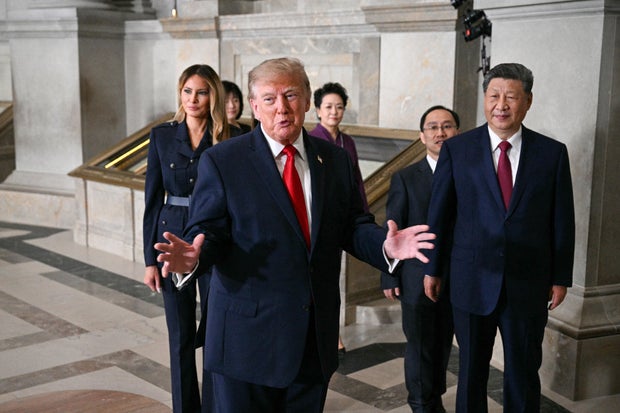
Trump says he discussed Iran war with China's Xi
President Trump said Friday he had discussed the Iran war with visiting Chinese counterpart Xi Jinping, following allegations Beijing has been supporting Tehran.
"We did, we did," Trump said when asked if they had talked about Iran, as he showed Xi around the National Archives in Washington on the last day of the Chinese leader's state visit.
Asked if he thought there would be progress on reopening the Strait of Hormuz, Trump replied, "I think we're going to do great."
Mr. Trump was asked by the television pool reporter if he had asked Xi to stop sharing intelligence with Iran, but the president ignored the question.
CBS/AFP
Iran-U.S. talks enter technical stage, Al-Jazeera journalist reports
Iran-U.S. negotiations in New York have moved beyond initial diplomatic contacts into a more detailed technical phase, with sources in Tehran describing the atmosphere as increasingly positive, Al Jazeera's bureau chief in Tehran, Nourddine Dgheir, reported Friday.
The Qatari-government owned network said technical experts had joined the discussions in New York after a first meeting involving U.S. envoys Steve Witkoff and Jared Kushner. While visas were not initially approved by the U.S. government for the Iranian delegation, they were secured quickly, allowing the team to join the talks, Dgheir said.
There was no immediate confirmation by U.S. officials that the talks had progressed to the technical level, or that additional Iranian officials had been cleared to enter the country.
Qatari officials have acted as mediators between the U.S. and Iran for months.
According to Dgheir, Iran's proposed seven-day plan to reopen the Strait of Hormuz if the U.S. drops its blockade is being discussed as an accelerated version of a previously discussed 60-day process, and would include urgent measures to get both countries back into direct negotiations over Iran's nuclear program.
The key Iranian demands under discussion include sanctions relief, the lifting of restrictions on oil exports and access to frozen Iranian funds.
The two sides also continue to discuss arrangements for the Strait of Hormuz, including whether Iran and Oman could return to a form of joint management under an agreed framework involving regional countries and the United States, as well as arrangements governing the passage of U.S. vessels.
Despite the outstanding issues, Dgheir said his sources in Tehran characterized the negotiations as making some progress, with talks continuing and Qatar working to bridge differences between the two sides.
Iranian and Russian foreign ministers meet in New York
Iranian Foreign Minister Seyed Araghchi held talks with Russian Foreign Minister Sergey Lavrov Thursday afternoon in New York, as part of his ongoing consultations with counterparts attending the United Nations General Assembly, the Iranian foreign ministry said.
During the meeting, the two sides discussed the status of bilateral cooperation in various political, economic, trade, transportation and energy fields, as well as coordination at the level of international organizations, according to a statement from the ministry.
Araghchi briefed his Russian counterpart on the latest status of indirect negotiations between the U.S. and Iran, and the Iran-Oman understanding on establishing a safe route for shipping through the Strait of Hormuz, as well as continued efforts by mediators to convey the conditions and essential components for a return to the diplomatic process, the statement said.
Turkey, Pakistan and Saudi Arabia to hold talks after Houthi attacks
Turkey and Pakistan will join chief of staff-level talks with Saudi Arabia to support the kingdom, the Saudi government said Friday, as Yemen's Iran-backed Houthis ramp up attacks on the world's top crude oil exporter.
The Houthis have escalated their attacks on Saudi Arabia since July, ending a years-long truce and declaring a maritime blockade, hitting Saudi targets and seizing Yemen's entire Red Sea coast as they seek to stifle Saudi energy exports.
Turkey's chief of general staff will travel to Saudi Arabia Friday to attend the meeting, the Turkish defense ministry said. It was unclear if the meeting would be held the same day.
The announcement came after Saudi Foreign Minister Prince Faisal bin Farhan, Pakistani Foreign Minister Ishaq Dar and Turkish Foreign Minister Hakan Fidan met in New York Thursday on the sidelines of the U.N. General Assembly.
The meeting "addressed ongoing arrangements for an urgent meeting of the Chiefs of Staff of the three countries to discuss ways to support the Kingdom," the statement shared by the official Saudi news agency SPA said.
Last month, the three countries signed a joint defense agreement committing them to mutual defense if one is attacked. Despite the NATO-style clause, neither Pakistan nor Turkey have yet hit back against the Houthis for their attacks on Saudi infrastructure.
CBS/AFP
Yemen's civil war is overwhelming hospitals: "A very dangerous situation"
Tarek al-Salami, aged 7, sat in a diaper, looking frail. Normally, the malnutrition and diarrhea that weakened his tiny frame would have been treated within a few days, but nothing is normal in Yemen anymore.
Tarek's father carried him on foot from the southwest city of Mokha as the Iran-backed Houthi rebels swept in this month, bringing the civil war that has embroiled Saudi Arabia, and nearly the United States last week, to the Red Sea coastal city.
Al-Salami reached a hospital two days later in the government-held city of Aden, 170 miles away, but there were no beds available. Like others, the facility was overwhelmed by the war-wounded. His family finally found a therapeutic feeding center.
He arrived in an acute health crisis after the delay in care, according to the center's director, Dr. Arwa Atef, and he only began walking again Wednesday, over a week later.
"I swear to God, when I look at him, my heart breaks," said his father, Mohammed al-Salami. "He looks almost lifeless."
The already-fragile health system in the Arab world's poorest nation is collapsing, caught in a new front of the Iran war.
Some health centers are turning pregnant women and others in need away to focus on trauma patients. Vulnerable children are filling incubators and sharing beds. Millions of people are affected by the fighting backed by two of the Middle East's biggest powers, as the Iran-backed Houthis advance against government forces supported by Saudi Arabia. More than 130,000 people have fled their homes, according to the International Organization for Migration.
"We are in a very dangerous situation," said Fahd al-Nazari, manager of the government health office in Taiz province, which has received most of the newly displaced. "Within a day or two, or a week at most, we might have to close down [some facilities]. In fact, some hospitals are already closed."
CBS/AP
Adviser to Iran's supreme leader says if Iran can't fly, no one in the region will
Mohammad Mokhber, an adviser to Iranian Supreme Leader Ayatollah Mojtaba Khamenei, appeared to threaten civil aviation across the Middle East on Friday, declaring that no country in the region would be able to operate flights and maintain airport services if Iran's airlines are denied permission to operate.
Multiple countries have closed their airports to Iranian airlines this week to comply with recent U.S. sanctions against Iran. Treasury Secretary Scott Bessent said earlier this week that Iranian airlines would "shut down" from Wednesday, and he threatened countries that allowed them to use their airports with expulsion from the U.S. dollar system.
"Aligning with the United States in implementing hostile policies will remain in the memory of the Iranian people," Mokhber warned in a post on X. "Our strategy on this issue is clear: Flights in the region are either free for everyone, or for no one," he added.
"If Iran does not have the possibility of flying and receiving airport services, no country in the region will have this possibility either," Mokhber said.
Iran's U.N. envoy says Netanyahu should not have been allowed to address General Assembly
Iran's representative to the United Nations has condemned Prime Minister Benjamin Netanyahu's address to the General Assembly, questioning why the Israeli leader was allowed to speak at the world body.
"If the General Assembly banned the apartheid regime of South Africa from speaking at this Assembly in the 1970s, why should it today grant this privilege to this criminal?" said Nasser Asadi, Third Counsellor at Iran's Permanent Mission to the U.N., was quoted as saying Friday by Iran's state news agency IRNA.
"This organization was established to save future generations from the scourge of war. Yet today, the main architect of this very scourge, the Prime Minister of the Israeli regime, delivered a speech at this assembly," Asadi said, calling it "a disgraceful act for this institution."
Referring to the International Criminal Court's outstanding arrest warrant for Netanyahu, Asadi asked how it was possible for a man "whose case is currently being examined in two international courts for committing war crimes, crimes against humanity and genocide be allowed to attend this Assembly? Should he have been here to justify his crimes or in court to answer for his genocide?"
Asadi also questioned why Israel had not been expelled from the U.N. "for its continued violation of the principles of the United Nations."
Netanyahu and other Israeli officials have repeatedly rejected accusations that the country's actions in the Gaza Strip amount to genocide against the Palestinian people, and accused Iran of deliberately targeting civilians across the region.
Qatar says talks were held with Iran on conditions for "dialogue"
Qatari Foreign Minister Sheikh Mohammed bin Abdulrahman Al Thani, a key mediator between Tehran and Washington, spoke Friday with Iranian President Masoud Pezeshkian about deescalation and the conditions necessary to renew a direct dialogue between the two sides, Qatar's foreign ministry said.
The pair met Friday on the sidelines of the United Nations General Assembly in New York, according to a statement posted on X.
Pezeshkian invited Al Thani to the meeting, where they "reviewed the latest developments in the region and the efforts being made to deescalate tensions and create a conducive environment for dialogue," the ministry said.
CBS/AFP
Iraq suspends Iranian airline flights to holy city of Najaf, enforcing U.S. sanctions
Iraq's Najaf airport, a top destination for Shiite Muslims, suspended all Iranian flights Friday, enforcing U.S. sanctions, the airport director told the AFP news agency.
Airport director Hussein Muhanna said "all flights were halted between Iran and Najaf airport following a directive from the prime minister's office to the governor" of Najaf.
The airport in the holy city south of Baghdad is a major hub for Iranian flights.They carry many Iraqi Shiite pilgrims to Iran's holy cities and Iranians visiting sacred sites in Iraq. The flights also serve Iraqi students studying in Iran, and patients seeking medical treatment there.
The bond between Iraq and neighboring Iran, both Shiite-majority nations, runs deep and is shaped by both religion and politics.
Iranian airline flights were suspended at Najaf's airport early Thursday morning, the airport director said.
Several sources, including a senior government official, told AFP earlier this week that Iraq would enforce the U.S. ban on Iranian airlines, joining several other countries in the region, including the United Arab Emirates.
U.S. Treasury Secretary Scott Bessent had said Iranian airlines would "shut down" Wednesday, and he threatened countries that did not comply with expulsion from the U.S. dollar system.
Although land routes are available, Iraq remains one of the top destinations for Iranian airlines, especially after Iraqi airlines stopped flying to Iran at the start of the Iran war in February.
CBS/AFP
Walkouts during Netanyahu's U.N. address were "louder than any speech," senior Iranian diplomat says
Iranian Deputy Foreign Minister Kazem Gharibabadi said Israeli Prime Minister Benjamin Netanyahu came to the U.N. General Assembly to use the podium in front of other world leaders as a "loudspeaker for justifying war and aggression," but he argued the mass walkout by dozens of other delegations "spoke louder than any speech."
"The world is not fooled by narrative-building," Gharibabadi wrote in a post on X Thursday evening. "History will judge crime, occupation and aggression, not propaganda displays in New York."
As Netanyahu took the stage in New York Thursday, many attendees walked out, but CBS News has not confirmed Gharibabadi's claim that 77 national delegations left the chamber.
"If there are any other moral cowards who haven't yet left this hall, please do so now," Netanyahu said as the officials filed out, before launching into a defense of his country's actions in Iran and across the Middle East.
"We will continue to defend our state. We will continue to win because we have no other choice," he said, adding his thanks to President Trump for supporting Israel throughout the interlinked wars in the Middle East.
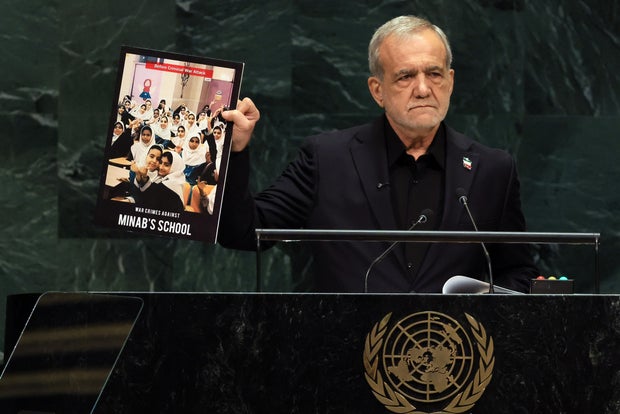
Iran's president wants a deal with the U.S. before November midterm elections
Iran wants to make a deal with the U.S. before the midterm elections in November, Iranian President Masoud Pezeshkian told journalists from several news organizations Thursday in New York on the sidelines of the United Nations General Assembly.
"We don't want it to get to the midterm elections," Pezeshkian said. "We wish Americans to return to the MoU before the midterms," he added, referring to the memorandum of understanding signed between the two countries in June. That agreement formed the basis of a ceasefire that collapsed within several weeks, as Iran accused the U.S. of breaching the deal by keeping its naval blockade in place.
President Trump has said Iran will make a deal "right after the election" because "they're waiting to see how I do in the midterm election."
Pezeshkian also told the journalists on Thursday that Iran was "open" to allowing inspections of its nuclear facilities, and he denied that the regime is seeking to assassinate Mr. Trump or any members of his family.
"This has not been the position of the Iranian government, that we seek to assassinate President Trump or his family members," Pezeshkian said.
Commander rejected plans to rebase farther from Iran before deadly drone strike, sources say
The dozens of U.S. troops bombarded by Iranian drones at a small Kuwaiti port in the opening days of the Iran war could have relocated to safer positions in western Saudi Arabia, multiple sources told CBS News, but those plans were rejected by the unit's commanding general despite intelligence warning of a potential attack on their post.
About one week before the launch of Operation Epic Fury, most American soldiers and Air Force personnel stationed in Kuwait were moved to Jordan and Saudi Arabia — farther away from Iranian missile range. At least two options were scouted, planned and presented to the leadership of the 103rd Sustainment Command, the Army Reserve unit that ran logistics for U.S. Central Command: one was Logistical Support Area Jenkins, a U.S. military base near the southwest port city of Yanbu, and another was Prince Sultan Air Force Base, just southeast of the Saudi capital city Riyadh.
A third option, supported by the commander, Brig. Gen. Clint Barnes, was to follow the playbook from the unit that was previously deployed to Kuwait before the 103rd arrived in September 2025. During the 12-day war between Israel and Iran that July, the active unit briefly moved its home base at Camp Arifjan in Kuwait to Port of Shuaiba, roughly 30 miles south of Kuwait City and just 65 miles southwest of Iran.
"That was a totally different scenario," one service member, speaking on condition of anonymity because he was not authorized to speak with the media, told CBS News. "Missiles and drones were flying overhead between Iran and Israel and we were more worried about one of them being intercepted and falling out of the sky."
Iran delivered 7-day plan to U.S. this week, foreign minister says
Iranian Foreign Minister Abbas Aragchi told a group of reporters in New York City that Iran shared a 7-day plan with U.S. mediators this week. If certain conditions of that proposal are met, the Strait of Hormuz would be opened at the end of the seven days and talks would be restarted to try to get a final deal.
The terms of the proposal mimic large portions of what was in the 14-point Memorandum of Understanding that was signed by President Trump back in June.
A mediator in the talks told CBS News on Thursday that the talks are positive, but still in an early phase.
Earlier this week, Secretary of State Marco Rubio was more circumspect about the diplomacy, saying there had been no breakthroughs. U.S. envoy Steve Witkoff and Mr. Trump's son-in-law, Jared Kushner, have been handling the shuttling back-and-forth with the mediators on the possible terms of a hypothetical truce with follow-on talks.
Israel's Netanyahu addresses U.N. as many leaders walk out
Israeli Prime Minister Benjamin Netanyahu addressed the United Nations General Assembly on Thursday as his country faces broad condemnation and growing isolation.
As Netanyahu took the stage, many attendees walked out.
"If there are any other moral cowards who haven't yet left this hall, please do so now," Netanyahu began.
Netanyahu launched a defense of his country's actions in Iran and across the Middle East.
"With our great American friends, we crushed Iran's army, navy, air force and nuclear facilities," he said, later thanking President Trump for his "bold leadership."
"We will continue to defend our state. We will continue to win because we have no other choice," he said.