Jordan and Bahrain face Iranian missiles and drones as hostilities flare
Follow updates on the war in the Middle East for Wednesday, Sept. 2, here. See earlier developments below.
What to know about the Iran war:
- Iran said it responded to new U.S. strikes on Tuesday by launching missile and drone attacks on U.S. allies. Jordan's armed forces reported intercepting 10 ballistic missiles, and Bahrain said it intercepted Iranian drones.
- U.S. forces launched strikes on targets connected to Iran's Revolutionary Guard, U.S. Central Command said, the latest round of strikes as the two countries return to active hostilities in the six-month war.
- President Trump said the strikes were carried out in retaliation for Iran attempting to place more sea mines in the Strait of Hormuz, and for the Islamic Republic targeting an American base in Jordan earlier this week. Mr. Trump warned Iran would be "hit much harder" if it continues to retaliate.
Iran foreign minister says 50 people killed or wounded in U.S. strike that hit wedding party in home
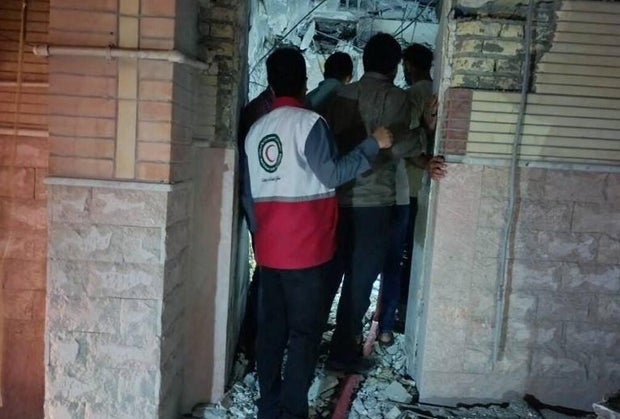
Iran's foreign ministry accused the U.S. of killing or wounding more than 50 people with an airstrike that hit a wedding party in a private home on Tuesday evening in the country's south.
Foreign Ministry spokesman Esmaeil Baqaei said in a post on X that the home in Kuhestak, in the southern Hormozgan province's Sirik district, "was brutally attacked tonight while families were celebrating a wedding. More than 50 innocent men, women and children were martyred or wounded."
Baqaei referred to the purported strike as the latest in a "chain of atrocities" that he said included the strike on a school in Minab early in the war that killed dozens of children. The United States was "likely" responsible for the deadly attack on the school, but did not intentionally target the facility and may have hit it in error, possibly due to the use of dated intelligence which wrongly identified the area as still part of an Iranian military installation, a person briefed on the preliminary intelligence told CBS News in March.
There was no immediate comment from U.S. officials on the allegation of a wedding party being hit by an American strike Tuesday in southern Iran.
"More dangerous than the bomb itself is the normalization of bombing; and more dangerous than silence is the conversion of silence into legitimacy. Iran will respond to these savage crimes with firmness," said Baqaei, warning that "those who remain silent today will not be immune to its consequences tomorrow. Turning a blind eye to injustice does not contain it; it only emboldens the perpetrators."
Global oil prices top $95 a barrel
Oil prices ticked up Tuesday after Iran and the U.S. traded another volley of airstrikes, a return to direct hostilities that could dim hopes that the war is close to wrapping up.
The international Brent crude oil benchmark was trading at just below $96 a barrel for November deliveries as of 10 p.m. ET, and U.S.-based West Texas Intermediate was at over $91 for October deliveries.
Trump urges Iranians to "rise up and fight"
In a social media post defending the U.S.' standing in Iran, President Trump wrote: "When are the Iranian people going to rise up and fight?"
The president also wrote that the Iranian regime is "just playing out the inevitable," with its "economy totally collapsing," and said: "I couldn't care less if they sign a worthless, to them, agreement."
Mr. Trump's call for the Iranian people to "rise up" echoes his message hours after the war began in late February, when he urged Iranians to "take over your government." He also encouraged Iranian protesters prior to the start of the war.
Later on, though, as a war that was initially expected to take a few weeks stretched on for months, Mr. Trump backed away from calling for the Iranian regime's ouster, saying he "never cared about regime change" and considered the deaths of top Iranian officials to be a kind of regime change. He also had previously sought a deal with the Iranian regime, calling them "very rational" in June.
USS Abraham Lincoln arrives in eastern Thailand
The USS Abraham Lincoln aircraft carrier arrived in eastern Thailand early Wednesday local time after its grueling deployment in the Middle East.
Associated Press journalists watched the Lincoln, which is carrying about 5,000 service members, approach Laem Chabang port in Chonburi province shortly after the destroyer USS Frank E. Petersen Jr. sailed past the area.
The USS Abraham Lincoln left San Diego on Nov. 21. The war with Iran, which began in February, extended the mission and intensified their workload. The ship has served as a launch point for thousands of aircraft flights supporting the strikes. Family members have voiced worries about deteriorating mental health conditions aboard the ship, as well as sanitary conditions and food shortages.
The USS George Washington, usually Asia-based, relieved the long-deployed Lincoln in the Middle East in August.
Many service members are expected to visit Pattaya, a nearby popular beach town. Thai officials have said the Lincoln's stop would be for rest and recovery before returning to its U.S. base.
CBS/AP
U.S. has wrapped up tonight's Iran strikes, CENTCOM says
The U.S. military's Central Command said Tuesday it has wrapped up its strikes on Iran.
"U.S. forces struck Islamic Revolutionary Guard Corps (IRGC) targets including air defense sites, radar systems, maritime assets and facilities, mine laying capabilities, and communications sites," CENTCOM said in a statement on social media.
Iran targeted Bahrain with drones, state media says
Iran's armed forces are targeting a military base in Bahrain with drone attacks, Iran's semiofficial Fars and Tasnim news agencies said early Wednesday morning local time, casting the strikes as a response to U.S. attacks on Iran.
Bahrain's state news agency later confirmed that it intercepted Iranian drones.
Jordan says it was targeted by Iranian missiles
The Jordanian military said early Wednesday it was "subjected … to a missile attack originating from Iranian territory," marking the second apparent attack in recent days.
The Arab country's armed forces said it detected 13 ballistic missiles, of which 10 were intercepted and three fell in remote areas. No injuries or deaths were reported.
While Iranian state media claimed U.S. forces were killed in the strike on Jordan, a U.S. official told CBS News this is not true.
The strikes on Jordan — a key U.S. ally that hosts American military personnel — came after Iran announced it had fired missiles and drones in response to U.S. attacks on Iran on Tuesday.
Jordan also said it intercepted Iranian missiles Sunday, following an earlier U.S. strike on Iran.
Trump waves off idea of deal with Iran, and warns: "If they retaliate, they'll be hit much harder"
President Trump warned Iran against retaliating against the U.S. for Tuesday's strikes.
"If they retaliate, they'll be hit much harder. And if they do it again, they'll be no longer," the president told Fox News' Trey Yingst.
Iran said earlier Tuesday it was responding to the strikes with drone and missile attacks.
Asked whether he's interested in a deal with Iran, which the Trump administration has sought on and off for months, the president said: "I think an agreement with them isn't worth the paper it's written on. We gave them a lot of chances."
2 killed by U.S. strike while attending wedding, Iranian official says
An Iranian official said on Tuesday that two people were killed and several others were wounded by a U.S. attack while attending a wedding in the southern part of the country.
"A residential home was attacked while people were holding a wedding ceremony," Ahmad Nafisi, deputy governor of Hormozgan province, told state television, adding that "two people were reported martyred and a number of others wounded."
Iranian state TV says people at wedding ceremony wounded in U.S. strike
Iranian state television reported on Tuesday that several people who were attending a wedding ceremony were wounded by a U.S. attack in the southern part of the country.
"A number of residents were wounded in the attack while attending a wedding ceremony," state television reported, adding that the U.S. strike hit a "residential area" in Bandar Kuhestak in Sirik county.
Iran firing drones and missiles in response to U.S. strikes, Iranian semiofficial media say
Iranian semiofficial media say the country has begun firing missiles and drones in response to U.S. strikes.
The Fars and Tasnim news agencies, seen as close to Iran's security forces, reported late Tuesday that it had launched such operations.
Iran state TV says U.S. hit airport in southern province
The U.S. struck an airport in the southern Iranian province of Kerman on Tuesday, state television reported.
"Minutes ago, the enemy U.S. attack targeted Jiroft airport," state television said, after reporting several strikes along the coast of the Strait of Hormuz and on Iranian islands in the Persian Gulf.
Iran vows U.S. will regret new strikes
Iran's Revolutionary Guard vowed on Tuesday to make the U.S. regret its latest attacks, even as President Trump warned Tehran against striking back.
"Severe punishment awaits the aggressors; the United States will regret its new attacks," said Guard spokesman Hossein Mohebi in a post on social media, after explosions were heard in multiple areas along and east of the Strait of Hormuz.
Trump threatens Iran with "much harder" attack if Iran retaliates for new strikes
President Trump threatened more strikes against Iran on Tuesday as U.S. forces carried out a retaliatory attack against the Islamic Republic.
"If the failed Nation of Iran retaliates for this very justified attack, they will be hit again at a much harder and higher level, but it will not be the biggest attack of them all, that is waiting in the wings and, when it is over, there will be very little left of the Islamic Republic of Iran!" Mr. Trump said on his Truth Social platform.
Iranian state media says 4 projectiles hit areas east of Strait of Hormuz
Iranian state media said on Tuesday that four projectiles hit parts of the southeastern Sistan-Baluchistan province, east of the Strait of Hormuz.
"Four projectiles had hit areas within the counties of Chabahar and Konarak," said the official IRNA news agency, citing provincial official Ali Khalilabadi, without specifying whether there was any damage.
New U.S. strikes on Iran come amid renewed hostilities
The new strikes the U.S. launched against Iran on Tuesday come after American forces struck an Iranian island in the Strait of Hormuz over the weekend.
According to a Central Command spokesperson, Sunday's strikes on Larak Island were conducted after Iran's Revolutionary Guard was seen preparing to place more sea mines in the key waterway.
Iran responded by targeting U.S. forces, unsuccessfully, in Jordan and the United Arab Emirates.
U.S. forces launch new strikes against Iran
U.S. forces launched new strikes Tuesday on targets connected to Iran's Revolutionary Guard, U.S. Central Command announced.
Iranians urged to reduce gas consumption amid U.S. blockade
A top Iranian official called on citizens to curb their gas consumption on Tuesday, as the country faces difficulty importing enough fuel to meet demand due to the U.S. naval blockade.
"Of course, part of the responsibility for this high consumption does not lie with our people; it lies with our industry," parliament speaker and top negotiator Mohammad Bagher Ghalibaf said in a televised address. "But in any case, what is clear is that we need to save gasoline in our consumption."
Treasury chief: "My job is to make sure that they want to have a deal"
Treasury Secretary Scott Bessent said Tuesday that it was his job to make sure the Trump administration's economic pressure campaign on Iran forces its regime to want to deal with the U.S.
"We are going to economically asphyxiate this regime, and as President Trump said, the reason the MOU did not work, they were not ready for a deal," Bessent said in an interview with Fox Business Network's Larry Kudlow, referring to the collapsed memorandum of understanding between Iran and the U.S. "My job is to make sure that they want to have a deal, and they will want to have one."
As part of the pressure campaign, the U.S. was shutting down a branch of an Egyptian bank in the United Arab Emirates that Bessent said had funneled over $1.8 billion to the Iranian regime.
"We did not sanction them because we did not want to go back to the Egyptian parent, but everyone should expect that we know who you are, you know who you are, and we are probably going to announce a bank sanction this week, and we will announce one the week after," Bessent said.
Putin tells Iran's president Russia admires Islamic Republic's courage
Russian President Vladimir Putin told Iran's President Masoud Pezeshkian on Tuesday that Russia admired the Islamic Republic's courage in the war.
"We admire your courage and resilience in the fight for your national interests," the Russian leader said, according to Russian media.
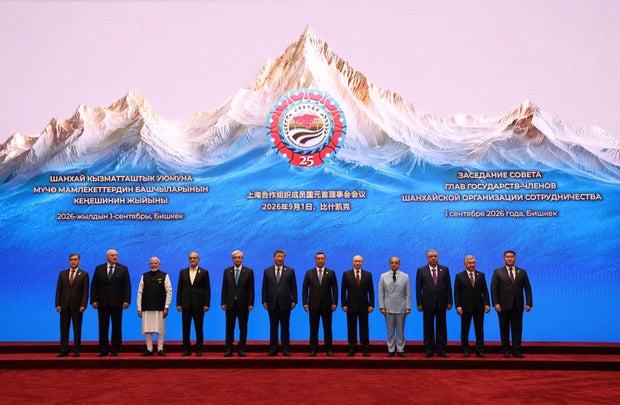
The two presidents held talks on the sidelines of the Shanghai Cooperation Organization summit in Bishkek, Kyrgyzstan, bringing together more than a dozen leaders — including Putin, China's Xi Jinping and Indian Prime Minister Narendra Modi.
Putin told Pezeshkian that Russia was "trying to provide you with the assistance you need."
"Despite the military and political situation, we are maintaining the momentum of our trade and economic relations from last year," he added.
Russia and Iran are both under massive international sanctions and have become increasingly reliant on each other.
CBS/AFP
Vance says Iran's leaders are "really crazy," "willing to do anything"
Vice President JD Vance described Iran's leaders as "really crazy" and "willing to do anything" in an interview with Fox News on Monday.
Asked what he's learned about going to war against Iran, Vance spoke about the Iranian regime.
"They're really crazy, and they're willing to do anything, and I think not with a whole lot of strategic wisdom behind it, in order to accomplish as little flow of oil and gas as possible," Vance said. "Now we expected they would do that. We know that they don't like us, but what's odd to me is they will sometimes fire at their own allies just to prevent the free flow of oil and gas."
The vice president also said that the war was at a phase where "a lot of what we're doing is actually ensuring the free flow of commerce in the Strait of Hormuz."
Iran's president thanks Putin for Russia's stance at "every stage" of war
Iranian President Masoud Pezeshkian thanked Russian President Vladimir Putin on Tuesday for Moscow's stance during the Middle East war, in their first meeting since the conflict broke out.
Moscow has massively deepened military and economic ties with Iran since launching its own full-scale invasion of Ukraine.
"We appreciate and thank you for your positions at every stage, both during the period when the fighting and acts of aggression were taking place and under normal circumstances, when the United States was imposing sanctions on us, both at the United Nations and in international forums," Pezeshkian told Putin at a meeting on the sidelines of the Shanghai Cooperation Organization summit in Kyrgyzstan.
"This shows that our relationship is a strategic relationship; it is not an ordinary relationship," he added.
An earlier statement by the Iranian presidency had said that the two presidents "reviewed bilateral relations" and "discussed ways to strengthen and expand cooperation in various fields."
Pezeshkian and Putin last met during a summit in Turkmenistan in December 2025.
Qatar to "intensify" efforts to rekindle Iran-U.S. talks, as current escalation "will not benefit anyone"
Asked about the resumption of hostilities in recent days between Iran and the U.S. around the Strait of Hormuz, Qatari Foreign Ministry spokesman Dr. Majid Al-Ansari said Tuesday that the small Persian Gulf nation had warned "from day one" that leaving the issue of control over the strait unresolved, "would end in escalation in the region, and this is what we saw yesterday and today."
"This escalation will not benefit anyone. We are all affected by this escalation," Al-Ansari said. "Therefore we urge the parties, first, to exercise wisdom and return to the negotiating track, and we continue and intensify our efforts with our mediation partners to ensure a return to this track."
Al-Ansari noted that Qatar's foreign minister, during a visit to Tehran last week, had "affirmed Qatar's firm position in supporting diplomatic means to reach a solution to this crisis," and he said "discussions are still continuing with our partners in mediation, whether in Pakistan or Oman, and we are moving forward with these contacts."
The Trump administration has said there are no ongoing direct talks with Iranian officials, and no plans to resume any.
President Trump played down the conflict as "a relatively small war" on Monday, dismissed Iran as a "failed nation," and indicated that he's prepared to order new strikes on the country, days after saying he was prepared to give a new tactic of "economic warfare" as long as necessary to force Iran's leadership to capitulate.
Iran's president offers U.S. an olive branch before meeting with Putin
Iran's President Masoud Pezeshkian on Tuesday vowed to match any U.S. move to return to a June deal aimed at ending the war between the two nations, as he prepared to meet Russian counterpart Vladimir Putin at an international summit.
Pezeshkian and Putin were due to hold talks on the sidelines of the Shanghai Cooperation Organization (SCO) summit in Kyrgyzstan, a bloc promoted by Russia and China as an alternative to Western power.
Pezeshkian told the summit that if the U.S. returns to the terms of the memorandum of understanding signed in June, aimed at ending months of hostilities, Iran would "immediately take reciprocal action," according to the Iranian presidency's website.
The deal ushered in a ceasefire that was meant to set the stage for final peace talks, but both the truce and the talks collapsed as both sides accused each other of violating its terms.
Pezeshkian also warned Tuesday that a return by the U.S. to "a policy of pressure and threats" risked derailing diplomatic efforts to end the war.
CBS/AFP
Iranian Army Chief of Staff lauds country's air defenses as a "shield of national security"
Admiral Habibollah Sayyari, the Chief of Staff of the Iranian Army, was quoted Tuesday describing the country's air defenses as a "vigilant shield of national security," while praising personnel killed defending the country's airspace and territory.
In a message marking Iran's Air Defense Day conveyed by Iranian state TV, Sayyari called the force "one of the pillars of the country's defensive power and the vigilant shield of national security."
Iran's airports authority says flights through Iranian airspace increasing
The number of international flights transiting Iranian airspace is increasing, Iran's Airports and Air Navigation Company said Tuesday, as authorities work to restore air traffic capacity following damage sustained during the recent war.
Managing Director Morteza Dehghan was quoted by the state-run IRNA news agency as saying damaged navigation equipment at some airports had been repaired, while alternative flight plans were introduced where equipment suffered more serious damage. He said Iran was also preparing to receive several new radar systems to further increase airspace capacity.
Dehghan said Iran's entire airspace was under domestic control and that foreign airlines were increasingly confident in the safety of Iran's air traffic control services. He said the number of flights transiting the country's airspace was increasing daily.
While some regional carriers are still operating flights in and out of Tehran, U.S. and European aviation authorities continue to warn airlines to avoid the airspace over Iran and many neighboring nations in the Persian Gulf region due to the ongoing war between the U.S. and Iran.
Iranian and Chinese leaders hold brief talks on sidelines of Shanghai Cooperation Organization summit
Iranian President Masoud Pezeshkian and Chinese President Xi Jinping held a brief meeting on Tuesday on the sidelines of the Shanghai Cooperation Organization summit in Bishkek, Kyrgyzstan, according to Iran's state news agency IRNA.
The two presidents spoke for several minutes on the sidelines of the summit.
IRNA did not provide details of the issues discussed or indicate whether any substantive bilateral talks were held.
Russia and China have framed the SCO, which also includes India and Pakistan, as a geopolitical counter to the influence wielded by the U.S. and its democratic Western allies.
Oil prices jump 2% for second day in a row on fear Iran war escalating again
Oil prices jumped about 2% Tuesday amid fears of a fresh military clash between the United States and Iran after a flare-up over the weekend and President Trump's warning that he will hit the country "hard."
The latest strikes between the foes have further stoked worries about inflation that have put pressure on central banks to hike interest rates, which have in turn jolted equity markets.
After six months of war, the conflict remains at an impasse, with Tehran keeping traffic through the strategic Strait of Hormuz to a minimum and Washington continuing a counter-blockade of Iranian ports.
Both main crude contracts were up more than 2%, extending the previous day's similar jump. International benchmark Brent crude was trading early Tuesday over $92 a barrel, while U.S. crude was selling for $88.
"The calibrated nature of the initial actions suggests neither side is actively seeking a return to sustained conflict, but stalled talks and the strategic importance of keeping the Strait open leave the situation vulnerable to further escalation," said National Australia Bank's Rodrigo Catril, referring to the latest strikes by the U.S. and Iran.
President Trump is to meet oil refining executives Tuesday in a bid to tame soaring U.S. domestic gas prices that have been a political headache for his Republican Party heading into November's midterm elections.
CBS/AFP
2 crude oil tankers struck within minutes in Hormuz overnight, risk agency says
Two crude oil tankers were struck by unknown projectiles while transiting the Strait of Hormuz on Monday evening, Greece-based maritime risk organization Marisks said on Tuesday. A South Korean-owned vessel was hit just minutes after a Saudi-flagged tanker, both on their way out of the Persian Gulf via southern shipping lanes touted as open and safe by the Trump administration.
The U.K. Royal Navy's Maritime Trade Operations Center (UKMTO) said late Monday that it had received a report of an incident 17 nautical miles east of Khasab, Oman, along the U.S. Navy's so-called southern corridor out of the gulf.
A tanker reported being struck by three unknown projectiles at 8 p.m. local time, UKMTO said.
Marisks identified the vessel as Senegal Prosperity, operated by South Korea's Sinokor Maritime Co. Ltd. The ship recently departed Saudi Arabia's primary Ras Tanura oil port and it had its AIS tracking system off when it was attacked, Marisks said. CBS News has confirmed that the ship last broadcast its position off the coast of Ras Tanura on August 30.
Marisks said a Saudi-flagged tanker, the Sidr, was attacked eight minutes before the Senegal Prosperity, approximately 17 nautical miles northeast of Khasab. The Sidr last broadcast its position off the Omani coast near Khasab just before midnight local time on Sunday.
UKMTO has not reported the attack on the Sidr, which Marisks said happened nearly simultaneously, suggesting "a coordinated or closely related series of attacks rather than isolated events."
The incidents also "further undermine any assumption that the Omani corridor represents a reliably protected or lower-risk passage" than the route Iran has demanded ships navigate, Marisks said.
President Trump and the U.S. military have insisted recently that the southern shipping lanes are open and "momentum is building" for commercial traffic through them, despite vessels still requiring military cover to use the route.
Oil tanker hit by 3 projectiles on way out of Strait of Hormuz
An oil tanker was struck by three projectiles off the coast of Oman as it left the Strait of Hormuz on Monday evening, according to the U.K. Royal Navy's Maritime Trade Operations center.
"UKMTO has received a report of an incident 17NM east of Khasab, Oman. A tanker has reported being struck by 3 unknown projectiles whilst completing an outbound transit of the Strait of Hormuz," the agency said Tuesday morning, adding that no casualties or environmental impact were reported.
CBS News has confirmed via open-source tracking data that the ship is the Liberia-flagged, South Korean-owned crude tanker Senegal Prosperity.
Iran has resumed targeting both vessels in and around the Strait of Hormuz and U.S. allies in the region this week after the first exchange of strikes with the U.S. in a month over the weekend.
While the Trump administration insists southern shipping lanes through the strait, close to Omani shores, are open and safe to transit, Iran insists that all vessels coordinate with its military and use a northern passage close to its Larak Island, where the U.S. military said it struck rocket launchers and sea drones set to be deployed on Sunday.
Oil prices have risen again over the last few days amid the return to violence in the strait, with international benchmark Brent crude back over $90 per barrel, up about 1.4% on the day, and still over 30% compared to pre-war levels.
Iranian president insists Iran and U.S. should return to memorandum of understanding
Iran's president insisted on Tuesday that his country would return to the commitments agreed to in the memorandum of understanding if the United States did so too.
"Unlike the US, my country has a brilliant record of fulfilling its international commitments and treaties and has always acted in accordance with the principles governing international law," Masoud Pezeshkian said in a post on Telegram.
The Iranian president has in recent weeks called for a return to the terms agreed to in the memorandum of understanding signed in June, which calls for a 60-day negotiation period.
Oil prices rise and stocks fall after U.S. hits Iranian sites in the Strait of Hormuz
Oil prices rose and U.S. stocks fell on Monday after American forces struck Iranian rocket launchers near the Strait of Hormuz, marking the first military action between the two countries in a month.
The global benchmark for crude oil, Brent, rose 2.7%, ending the day above $90 a barrel for November deliveries. Oil prices remain well below their level in April, when Brent spent much of the month over $100 a barrel, but are elevated from early August, when they fell below $80.
The S&P 500 fell 0.3%, the Dow Jones Industrial Average dropped 374 points, or 0.7%, and the Nasdaq slipped 0.1%. Still, all three indexes closed with gains for the month of August.
The yield on the 10-year Treasury rose to 4.75%, around the level seen two weeks ago when the Trump administration took the unusual step of announcing it would intervene in the bond market.
— CBS/AP
Trump calls Iran conflict "a relatively little war" as he weighs new strikes
President Trump called the Iran conflict "a relatively little war" for the U.S. as he weighed additional strikes on the country.
CBS News' Weijia Jiang asked Mr. Trump in the Oval Office about a Washington Post report that several U.S. military leaders are concerned about a prolonged operation in the Middle East weakening Washington's ability to confront threats elsewhere.
Mr. Trump disputed the concerns. "This is a relatively little war for us. This is not a big war," the president said.
Meanwhile, Mr. Trump is considering carrying out new strikes on Iran following hostilities over the weekend.
"They're a failed nation," Mr. Trump said of Iran. He later added, "That doesn't mean we won't smack them. We'll see what happens."
Families of Army's 82nd Airborne told Mideast deployments will last into 2027
Family members of U.S. soldiers in one Army division who were deployed to the Middle East earlier this year have been told the deployments will last into 2027, according to a letter obtained by CBS News that was confirmed by two U.S. officials.
The Sunday-dated letter from the leaders of the Army's 82nd Airborne Division based at Fort Bragg, North Carolina, said that the deployments are expected to last a total of up to 12 months.
"We do not share that lightly, and we understand that a longer tour weighs heavily on every household, including our own," division leaders Maj. Gen. Brandon Tegtmeier and Command Sgt. Maj. James Bradshaw said in the letter.
2 women in Iran sentenced to death over protests, rights groups say
Iranian courts have issued death sentences for two women charged over anti-government protests in January, rights groups said Monday, as Tehran ramps up executions of people arrested in the demonstrations.
The two women were sentenced in separate cases but both were related to incidents in the central city of Isfahan, which was a hub of the nationwide protest activity that peaked on the nights of Jan. 8 and 9.
Against the backdrop of the war, Iran has already executed 29 men on charges related to the demonstrations, according to the Norway-based nongovernmental organization Iran Human Rights.
So far, no woman has been executed over the unrest, although Iran has hanged at least 16 women this year on other charges, according to Iran Human Rights.
Taraneh Rahimi, 20, was sentenced to death along with nine men over incidents during the protests in a square in Isfahan that saw two people killed, including a member of the security forces, the Norway-based Hengaw group and U.S.-based Human Rights Activists News Agency said Monday.
Other defendants in the case were given sentences of up to 36 years in prison, including Taraneh's sister Romina, they added.
"Defendants' lawyers did not have access to a substantial portion of the case file and objected that they had not been given sufficient time to review the documents and evidence," Human Rights Activists News Agency said.
In the other case, Leila Abolhasani, a 43-year-old mother of two teenagers, was convicted by a court in Isfahan of setting fire to a store during the protests, the Dadban legal affairs monitor and Human Rights Activists News Agency said.
Her relatives have denied the accusation, saying she was only present at the scene and was filming the burning store, the groups said.
Will Trump's Venezuela oil deal ease U.S. gas prices?
President Trump on Friday said a U.S. deal with Venezuela to tap its oil reserves "will substantially lower Gas Prices for all Americans, long into the future." With the average U.S. gas price still above $4 a gallon nationwide, American consumers may be wondering if help is on the way.
Don't hold your breath, energy experts said.
Trump to meet with oil refiners, distributors Tuesday
President Trump is expected to meet with a group of oil refiners and distributors Tuesday as gas prices remain above $4 a gallon.
A White House official told CBS News the meeting will include a mix of small, medium and large refiners and distributors as well as Interior Secretary Doug Burgum and Energy Secretary Chris Wright.
"The President will meet with industry leaders to collaborate on the best ways to increase refining capacity, further unleash American energy dominance across the entire supply chain, and bring down prices for the American people," White House spokeswoman Taylor Rogers said in a statement.
The meeting comes after the U.S. struck a deal with Venezuela last week for control of about 65 billion barrels of oil, but experts told CBS News the deal isn't likely to bring down gas prices anytime soon.
According to AAA, a gallon of regular gas in the U.S. cost an average of $4.08 as of Monday.
Bessent says economic pressure campaign aims to drive Iran to negotiating table
Treasury Secretary Scott Bessent said the Trump administration's new economic pressure campaign aims to drive Iran back to the negotiating table.
"The goal here is to create the conditions that they will want to come to the table," Bessent told CNBC on the sidelines of a meeting in North Carolina with finance ministers from the 20 largest economies in the world. "And the president's been very clear: They have to give up their nuclear program, they have to turn over the highly enriched uranium, and they have to stop their support of proxies, and the strait has to be open."
When he was told that increased economic hardship on people in Iran might not influence the regime, Bessent said, "My experience with people like this, the main thing they care about is their head staying attached to their neck."
Vance says Trump was sending Iran a message with AI video of Kharg Island attack
Vice President JD Vance said President Trump was sending a message to Iran when he posted an AI-generated video suggesting the U.S. had attacked Iran's strategic Kharg Island.
"We know that they continue to shoot at commercial shipping," Vance told reporters at Joint Base Andrews in Maryland. "We continue to have a lot of tools at our disposal to prevent them from doing so, or at least cut down on them from doing so, and that's what the president is saying is, 'Look, you guys are shooting at commercial shipping. You guys are behaving like a terrorist country. You've got to stop or there are going to be some consequences.'"
Mr. Trump shared the video on Sunday - a clip from the viewpoint of a helicopter as huge explosions around what looks like oil infrastructure are seen in the background. His only message with the video was: "Kharg Island being blown to smithereens!!!"
Qatar condemns Iran's attacks on Jordan, UAE as "blatant violation" of their sovereignty
The government of Qatar issued a statement Monday condemning "renewed attacks by the Islamic Republic of Iran targeting" Jordan with missiles and the United Arab Emirates with a drone.
Qatar's foreign ministry called the Iranian attacks — which officials in Jordan and the UAE said were all intercepted — "a blatant violation of the sovereignty and territorial integrity of the two states, and a flagrant breach of international law, the Charter of the United Nations, and the principles of good neighborliness."
Iran said it had targeted U.S. forces in the two Middle Eastern states in response to the first American attacks in weeks, which came Sunday as U.S. Central Command said Iranian rocket launchers and sea mines were destroyed in strikes on Larak Island in the Strait of Hormuz.
Iranian officials said the U.S. strikes killed two people and left several others wounded.
"The continuation of these attacks represents a dangerous escalation that would complicate efforts aimed at containing tensions and undermine political and diplomatic efforts seeking to achieve security and stability in the region," Qatar's foreign ministry said, adding a call for "an immediate and complete cessation of all military actions and attacks that threaten the security and stability of the region."
Fox News says Trump vowed "a response" to latest Iranian attacks on Gulf States: "Going to hit them hard"
President Trump said Monday that the U.S. would retaliate for Iran's attacks on Sunday targeting Jordan and the United Arab Emirates, according to Fox News' Trey Yingst, who quoted Mr. Trump as saying in a phone interview: "We're going to hit them hard."
"There will be a response," Mr. Trump said, according to Yingst.
Iran fired missiles at Jordan and a drone at the UAE on Sunday, calling it retaliation for the first U.S. strikes in a month, which the American military said hit rocket launchers and sea drones Sunday on Iran's Larak Island.
Iranian officials said two people were killed in the U.S. strikes. Authorities in Jordan and the UAE said all the Iranian weapons were intercepted or fell without causing damage.
CENTCOM dismisses Iran's claim to hit tanker with mines in Strait of Hormuz as false, "attempt to intimidate" shippers
The U.S. military's Central Command dismissed on Monday a claim by Iran's Islamic Revolutionary Guard Corps to have struck a supertanker in the Strait of Hormuz with sea mines, calling it "yet another IRGC attempt to intimidate regional commercial shipping through disinformation."
The IRGC claimed overnight to have forced an unidentified tanker to turn around after trying to transit the strait without permission from Iranian authorities.
"This is FALSE," CENTCOM said in a brief statement shared on social media. "No ships have hit mines in the Strait of Hormuz."
The Iranian claim was never corroborated by the U.K. navy's Maritime Operations center, which monitors such attacks and is usually among the first reliable resources to report such attacks on ships. The most recent incident involving a commercial ship in the region reported by the UKMTO was a tanker "struck by an unknown projectile whilst transiting inbound in the Strait of Hormuz" on Saturday.
While the Trump administration insists a southern route, close to Oman's coastline, is safe and open for ships to transit the vital waterway, Tehran refuses to recognize the shipping lane and demands that all commercial vessels coordinate with Iranian authorities to use a northern passage, close to its own shores.
Despite U.S. assurances and American military escorts for some vessels, the number of daily transits of the strait remains at less than half the typical number that would have been seen before the war began.
The resumption of strikes by the U.S. and Iran over the weekend sent global oil prices rising again, meanwhile, with a barrel of international benchmark Brent crude selling for over $91 on Monday, up more than 3% compared to the previous day.
Iran state media say 2 killed in U.S. strikes on Larak Island
Iranian state media reported Monday that the U.S. attack on Larak Island in the Strait of Hormuz killed two people and wounded several others.
"During the attack on Larak Island late Sunday, two people were martyred and several others were injured. The injured in the incident are receiving medical services and their treatment is ongoing," the official IRNA news agency said, quoting the governor of nearby Qeshm Island.
U.S. Central Command announced Sunday that it had carried out strikes against what it said were Iranian rocket launchers on Larak Island, and sea mines set to be deployed.
CBS/AP
Trump dismisses Iran as a "failed nation," says regime in "total disarray" after first strikes in weeks
President Trump, in a Monday morning post on his Truth Social platform, dismissed Iran as a "failed nation" and "dead," renewing his claim that the Islamic Republic regime is in "total disarray and incapable of properly representing the country," more than six months into the war that began with U.S. and Israeli strikes.
"Iran is officially a Failed Nation. IT IS DEAD! They have no Navy, they have no Air Force, they have no currency, they are not paying their soldiers or police, Inflation is at 300%, and their leadership is in total disarray and incapable of properly representing the country," said the president. "The only thing they have is FAKE NEWS from the USA, a willingness to kill their protesters (now over 100,000 people dead. They must be tried for war crimes against humanity!)"
Mr. Trump and the Iranian regime have exchanged near-daily insults via social media, while the conflict itself had largely paused in a stalemate over control of the Strait of Hormuz.
The standoff, which Mr. Trump vowed last week to end by imposing further economic sanctions on Iran and its trade partners, turned openly violent again over the weekend, with U.S. strikes on Iran's Larak Island in the strait, and Iran responding with attacks targeting Jordan and the United Arab Emirates.
Oil price jumps after U.S., Iran trade strikes for first time in weeks
Oil prices surged more than 3% after U.S. forces struck Iranian rocket launchers on the Strait of Hormuz, prompting retaliation from Tehran which launched attacks targeting American allies in the region.
Brent crude, the international standard for the price of oil, jumped 3.8% to $91.40 per barrel early Monday. U.S. benchmark crude was also trading 3.8% higher at $86.58 per barrel.
Escalations in the conflict between Iran and the U.S. typically cause the price of oil to spike. The price of Brent crude has soared well over the $100 per barrel mark several times since the war started in February.
CBS/AP
Iran says it seized a cargo ship that polluted Strait of Hormuz
Iranian authorities have seized a bulk carrier they accuse of dumping oil and sludge into the Strait of Hormuz, state media reported Monday.
"Following the publication of images of the discharge of oil into the sea ... expert and cleanup teams were dispatched to the site and seized the ship causing the pollution," the deputy head of the Ports and Maritime Department of the southern Hormozgan province, Esmaeil Makizadeh, told Iran's official IRNA news agency.
"The seized ship was a bulk carrier carrying sugar and had dumped a mixture of burnt oil, bilge water and industrial sludge directly into the sea," he said, without specifying the vessel's flag or the nationalities of its crew.
He said the waste had since been cleaned from the water and the seized ship referred to Iran's judiciary.
CBS/AFP
EU signals support for continued pressure on Iran
The European Union said Monday it would continue to maintain pressure on Iran by working with the United States and other G7 partners.
In a statement issued by the European Commission, the EU said it believed diplomatic efforts were needed to end the war and reopen the Strait of Hormuz, but that it remained ready to expand sanctions and other measures to heap economic pressure on Iran.
"The EU welcomes efforts at ensuring that Iran ceases its destabilizing activities and engages in peace negotiations with good faith, also through additional economic pressure, including through the U.S.-led Operation Economic Outcast," the statement said.
On Aug. 19, the Financial Times newspaper reported that Iranian forces had assessed striking U.S. assets in Europe if President Trump escalated the war. If they do, the hypothetical attack would be a major expansion of the conflict into NATO territory.
Iran's foreign minister accuses Netanyahu of tricking U.S. into war with Iran
Iran's foreign minister on Monday claimed Israeli Prime Minister Benjamin Netanyahu had tricked the U.S. into jointly launching the war with Iran.
"In Hebrew, Netanyahu openly crows that he suckered the U.S. administration into a war on Iran on behalf of Israel," Foreign Minister Abbas Araghchi claimed in a social media post.
"Netanyahu explicitly laughs about how he 'influenced' America through 1,000 hours of airtime on U.S. networks," he said.
The Trump administration has pushed back for months against the narrative that Israel led the U.S. into the war, while offering varying reasons for launching the attacks since the conflict began.
Secretary of State Marco Rubio said just a few days into the war that the Trump administration had decided to join in the attack because Israel was planning to strike Iran, and "we knew that that would precipitate an attack against American forces." For that reason, Rubio said, the U.S. chose to strike Iran "preemptively" to take out many of its missiles.
CBS/AFP
UAE condemns Iran's attack, calls it an escalation
The United Arab Emirates condemned Iran on Monday for launching an attack on the country, which Iran's military called retaliation for U.S. strikes on an Iranian island in the Strait of Hormuz.
The "aggressive attacks" by Iran represent "a dangerous escalation, an unacceptable assault, and direct threat to the country's security, stability, and territorial integrity," the UAE foreign ministry said in a statement.
The ministry said the UAE's military had intercepted a drone launched by Iran over territorial waters.
Iran says it will not hesitate to respond to U.S. attacks
Iran's Ministry of Foreign Affairs said Monday that the Islamic Republic will not hesitate to "respond decisively" to attacks, after the U.S. said it had carried out strikes on Larak Island in the Strait of Hormuz.
"The Armed Forces of the Islamic Republic of Iran will have no hesitation in exercising their inherent right to self-defense and will respond decisively, as appropriate, to any military aggression by the enemy," the ministry said in a statement.
It also warned that other countries that assist the U.S. military in its attacks bear "responsibility for the consequences."
Iran's Revolutionary Guards claimed to have targeted U.S. forces in Jordan and the United Arab Emirates in retaliation for the American strikes on Larak Island.
Trump posts AI-generated video he says shows Kharg Island attack
President Trump shared an AI-generated video on his Truth Social platform late Sunday depicting what he said was Iran's strategic oil hub of Kharg Island under attack.
"Kharg Island being blown to smithereens!!!" Mr. Trump wrote in his post accompanying the video.
It appeared to be a threat to the Iranian island, as there has been no evidence of any recent attack on the territory in the far northern Persian Gulf, which has long been Iran's primary oil export terminal.
Earlier, the U.S. military struck Iran's Larak Island, which sits very close to Iran's coastline in the Strait of Hormuz.
The CEO of the National Iranian Oil Company said Monday that operations on Kharg Island had not stopped, according to Iran's government-affiliated Nour News agency, which was cited by Reuters.
Tanker reportedly hit by sea mines in Strait of Hormuz, Iran's military says
A supertanker was struck by two naval mines while transiting the Strait of Hormuz, sparking a fire and forcing it to stop, according to a statement by the Iranian military quoted by the Reuters news agency.
The Iranian Revolutionary Guard Corps said the tanker had attempted to pass through the strategic waterway illegally, but it did not identify the ship or provide information about its location or crew.
The most recent incident involving a commercial ship in the region reported by the U.K. Navy's Maritime Operations center, which monitors such attacks, was a tanker "struck by an unknown projectile whilst transiting inbound in the Strait of Hormuz" on Saturday.
UKMTO said there were no casualties and no environmental impact reported.
Jordanian military says it intercepted 8 missiles, local media reports
The Jordanian Armed Forces said Sunday it intercepted eight missiles that had entered the country's airspace, according to Jordan's Al-Mamlaka TV broadcaster.
A spokesperson for the military said all eight missiles were destroyed before they could do any damage, according to the broadcaster.
A person familiar with the attack also confirmed to CBS News the missiles were intercepted, although they did not specify how many.
IRGC says it attacked American bases in Jordan
The Islamic Revolutionary Guard Corps said Sunday it launched attacks on American military bases in Jordan in response to the U.S.'s earlier attack on Larak Island.
The IRGC said it launched ballistic missiles at King Hussein and Al-Azraq air bases and claimed it destroyed "technical and maintenance infrastructure and the enemy's fighter jets' deployment sites."
Separately, the IRGC said it targeted U.S. military personnel on an air base in the United Arab Emirates, and that it shot down a U.S. drone over the Strait of Hormuz.
U.S. military strikes 2 Iranian launchers on Larak Island, official says
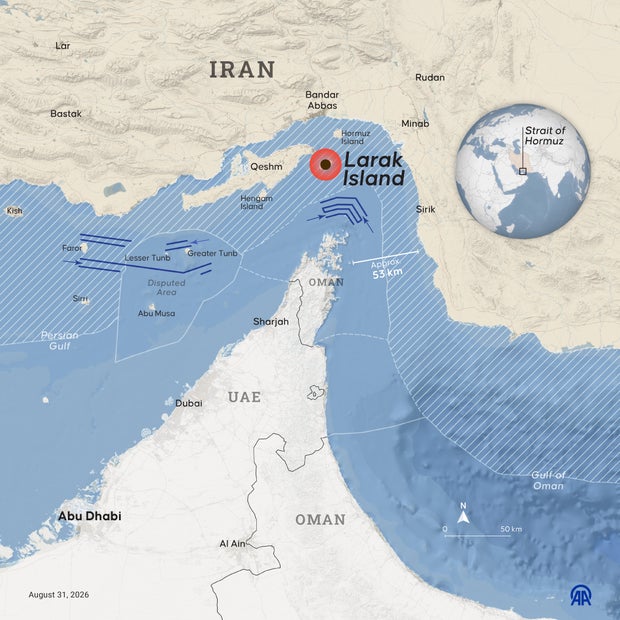
U.S. forces on Sunday struck two rocket launchers on Iran's Larak Island, in the Strait of Hormuz, according to U.S. Central Command spokesman Capt. Tim Hawkins.
Islamic Revolutionary Guard Corps forces were observed preparing to launch rockets and deploy sea mines into the Strait of Hormuz, Hawkins said. CENTCOM commander Admiral Brad Cooper said Friday that U.S. forces had cleared all sea mines from the shipping lanes of the strait.
Larak Island sits in the Strait of Hormuz, just a few miles off Iran's coast, and Tehran is believed to have used the island as a de facto toll booth as it demands ships pay fees to transit the strategic waterway safely.
The IRGC, in a statement conveyed by Iran's state broadcaster, said "several of our fighters and compatriots" were killed and wounded in the U.S. strike, according to The Associated Press.
The statement said the attack would "result in punishment of the aggressor."