Rubio says progress made in Strait of Hormuz talks after Trump threatens "decapitation"
Follow updates on the war in the Middle East for Wednesday, Aug. 5, here. See earlier developments below.
What to know about the Iran war:
- Secretary of State Marco Rubio said Tuesday that progress has been made in talks between Iran and Oman on the Strait of Hormuz, "but not finality yet," adding, "We're hoping that will happen very shortly."
- He made the comments after President Trump again backed down on attacks against Iran to allow for negotiations, saying, "I want to give them every last chance before decapitation. … We'll see what happens."
- Yemen's Iran-backed Houthis claimed Tuesday they carried out a drone strike on "a sensitive target" at an airport in southern Saudi Arabia. The Saudis have not commented on the claim.
Yemen's Houthis say attacked Saudi oil tanker in the Red Sea
Yemen's Iran-backed Houthis said on Wednesday that they attacked a Saudi oil tanker off Yanbu, in the Red Sea, as the rebels pressed on with their declared maritime blockade of the kingdom.
This was the eighth Saudi oil tanker targeted since the start of the blockade on July 22, a Houthi military spokesman said.
The group "successfully targeted the Saudi oil tanker 'Wafa' in the northern Red Sea, off the coast of Yanbu, with a number of ballistic missiles," Yahya Saree said in a video statement.
The Houthis declared they will escalate attacks in the northern Red Sea because Saudi Arabia is diverting its oil tankers there from the south in response to their blockade.
Trump says Strait of Hormuz is "going to be open very soon" or Iran will be "hit very hard"
In an interview with Fox News Tuesday night from Southern California, President Trump said that the Strait of Hormuz would open "very soon," or the U.S. would strike Iran.
"The Strait is going to be open very soon, or they're going to hit very hard, and then the Strait is going to be open," Mr. Trump said.
The president was in the Los Angeles area for a Republican National Committee fundraising dinner hosted at his Rancho Palos Verdes golf course.
The state of commercial traffic through the strait remains murky. Iran and Oman have continued to allege that they have control of the vital waterway, through which about 20% of the world's global oil supply traverses.
Secretary of State Marco Rubio told reporters earlier Tuesday that "there's been progress made" in talks with Iran and Oman regarding the strait, but that no final agreement had been reached.
U.S. has used nearly all its stockpile of long-range missiles in Iran war, sources say
The U.S. has used nearly all of its global stockpile of long-range precision missiles during the war with Iran, two sources with direct knowledge of the matter tell CBS News.
Specifically, the U.S. has used virtually all of its Army Tactical Missile Systems, known as ATACMS, and Precision Strike Missiles, the sources said. Reuters was first to report that the U.S. had used "virtually all" of its long-range precision missiles during Operation Epic Fury.
CBS News has previously reported that the U.S. has dwindling stockpiles of defensive interceptors and long-range missiles, which has become a pressure point within the administration, and that the U.S. cannot sustain the rate at which it expended precision munitions early in the war with Iran.
U.S. officials said there are limited inventories of the ATACMS and Precision Strike Missiles, and that the most pressing concern involves the number of Patriot and Terminal High Altitude Area Defense interceptors, which have been used faster than the industry can replace them.
Chief Pentagon spokesperson Sean Parnell said in a statement to CBS News: "America's military is the most powerful in the world and has everything it needs to execute at the time and place of the President's choosing. We have executed multiple successful operations across combatant commands while ensuring the U.S. military possesses a deep arsenal of capabilities to protect our people and our interests."
Defense Secretary Pete Hegseth has previously dismissed concerns about the U.S. stockpile.
"That is a manufactured story that the media wants to peddle and ultimately our stockpiles are great, and they're only getting stronger," Hegseth said on "Face the Nation with Margaret Brennan" on July 14.
Iran-Oman talks focusing on proposal to reopen Strait of Hormuz, source says
An Iranian source familiar with the direct Iran-Oman talks has told CBS News the discussions between Tehran and Muscat are now focused largely on the mechanics of reopening the Strait of Hormuz.
Under the current proposal, ships entering the strait would use the channel closest to Iran, with Iran coordinating inbound traffic, while vessels leaving the strait would use the Omani side, with Muscat managing outbound traffic.
The proposal also includes a "service fee," with the revenue split between Iran and Oman.
According to the source, the broad outlines have largely been agreed upon, with the remaining discussions focused on implementation and timing.
"The southern route through the Strait of Hormuz remains free and open for all commercial vessels seeking to transit the international waterway," U.S. Central Command said later Tuesday.
The military added that U.S. forces have assisted more than 1,000 vessels in safely transiting through the strait over the past three months.
Lebanon and Israel hold new round of direct talks in Rome
Lebanon and Israel held a fresh round of U.S.-sponsored talks in Rome on Tuesday, with Beirut seeking Israel's phased withdrawal from the country's south.
Convoys carrying delegations from the two countries arrived in the morning to the U.S. Embassy in the Italian capital, where discussions are scheduled to run until Thursday.
"The United States remains fully committed to supporting both governments as they carry this process forward in a manner that delivers lasting security for both countries, eliminates security threats to Israel, and restores Lebanese state authority throughout the south," State Department spokesman Tommy Pigott said on X.
At negotiations in Washington in June, Israel and Lebanon agreed to a framework deal involving the disarmament of Hezbollah, a gradual withdrawal of Israeli forces from Lebanon's south and the deployment of the Lebanese army to the region, starting in test areas known as "pilot zones."
This week's negotiations are the seventh round of Washington-mediated talks since Hezbollah drew Lebanon into the Middle East war in March with rocket fire at Israel in support of its backer Iran.
Hezbollah leader Naim Qassem said on Tuesday the direct negotiations would bring "nothing but shame, humiliation, and successive compromises" for Lebanon.
U.S. military has redirected 45 vessels since blockade reinstated
The U.S. has now redirected 45 commercial vessels heading into or out of Iranian ports since the blockade was restarted last month, according to U.S. Central Command.
The total number was an increase of one vessel since yesterday.
The number of boarded or disabled ships, each two, have not changed recently.
Secretary of State Marco Rubio said on Tuesday there had been some progress in talks about reopening the Strait of Hormuz.
"There's a conversation and a negotiation — that we are involved in — between Oman and Iran on how more ships can be able to go through there safely in the short term as we move towards the longer-term talks about denuclearization," Rubio said. "Suffice it to say there's been progress made in those talks but not finality yet. We're hoping that will happen very shortly."
U.S. stocks leap toward record as profits pile up, oil prices ease
The U.S. stock market is rallying toward a record Tuesday as companies keep piling up profits and oil prices ease.
The S&P 500 climbed 1.9% and is on track to top its all-time high set a couple months ago. The Dow Jones Industrial Average crossed 1,000 points, or 1.9%, to its own record set the day before, while the Nasdaq composite was 2.6% higher, as of 2 p.m. ET.
Despite worries about high inflation, the war in Iran and a possible bubble in stock prices because of euphoria around the boom in artificial-intelligence technology, Wall Street is nearing its latest apex in large part because profits are soaring for companies. That's key because stock prices tend to follow the path of corporate earnings over the long term.
Palantir Technologies helped lead the way and jumped 29.3% after CEO Alex Karp said its overall revenue leaped 93% in what he called an "otherworldly" quarter.
Indian vessel sinks after being hit by projectile near Yemeni waters, official says
An Indian vessel sank Tuesday after it was hit by a projectile near Yemeni waters, according to an official.
The Indian MSV Faize Noore Oliya capsized after it was hit, and all 14 people who were on board, including 13 Indians, were rescued by the Yemeni Coast Guard, said India's Minister for Ports, Shipping and Waterways, in a post on X.
"India strongly condemns this unprovoked attack on the defenseless mechanised sailing vessel," he said.
Those who were rescued were brought to the Port of Mokha in Yemen.
Mediators working "to create the appropriate conditions" for direct talks, says Qatar
Qatar's foreign ministry said Tuesday that mediators in the U.S.-Iran conflict were "consistently working to create the appropriate conditions for the resumption of direct dialogue."
Countries in the Middle East were working collaboratively to avoid any new escalation in fighting, said Majed bin Mohammed Al Ansari, adviser to Qatar's prime minister and spokesperson for Qatar's Ministry of Foreign Affairs.
Al Ansari said in a weekly press briefing that Qatar, Oman and Pakistan have been "bending constant efforts to facilitate engagement" between the U.S. and Iran "to bridge their viewpoints."
Al Ansari also said Qatar is firm in its stance on freedom of navigation through the Strait of Hormuz, and that "the minimum demands at the current stage are to return to the previous status of the Strait, in line with international law and in coordination with all littoral and concerned nations," according to the foreign ministry.
U.S. labor market still resilient amid fighting
U.S. job openings fell slightly in June, but the labor market continued to show resilience in the face of economic shock from fighting in Iran and the closure of the Strait of Hormuz.
Employers posted 7.36 million vacancies in June, down from 7.54 million in May, the Labor Department said Tuesday.
Openings dropped at wholesalers and manufacturers of nondurable goods. Openings rose by 97,000 at warehouse, transportation and utility companies and 39,000 at federal government agencies.
Layoffs were little-changed at 1.8 million, and the number of people quitting their jobs — a sign of confidence in their prospects — rose slightly.
Rubio says U.S. "involved in" Iran-Oman talks and that denuclearization is "ultimate deal"
Secretary of State Marco Rubio said Tuesday the U.S. was "involved in" talks between Iran and Oman, and that Iran's denuclearization is the "ultimate deal."
Asked about the possibilities of a deal with Iran, Rubio said: "There's a big deal, which is the one that has to do with their nuclear ambitions. They can never have a nuclear weapon. So the denuclearization of Iran is the ultimate deal."
"I think the immediate deal, the one that there is focus on, is the Straits," he added, referring to the Strait of Hormuz and the Bab el-Mandeb, two key Middle Eastern energy chokepoints that have been periodically closed by Iran and its Houthi allies over the course of the war.
"The Straits are open," Rubio said, repeating a line often touted by the Trump administration. "Nonetheless, I think that there's a conversation and a negotiation - that we are involved in - between Oman and Iran on how more ships can be able to go through there safely in the short term as we move towards the longer-term talks about denuclearization."
"Suffice it to say there's been progress made in those talks but not finality yet," he said. "We're hoping that will happen very shortly."
Rubio did not go into any specifics about U.S. involvement in talks.
Iraq exported 30 million barrels of crude via Strait of Hormuz in a month, says Kpler
Iraq exported over 30 million barrels of crude oil in one month through the Strait of Hormuz, data from the maritime tracking firm Kpler showed on Tuesday.
Before the Iran war, which choked shipments through the vital waterway, Iraq produced around four million barrels per day, and exported an average of 105 million barrels per month, mostly from its Basra oil terminal via the strait.
Around 30 million barrels of Iraqi crude oil passed through the waterway between July 4 and Aug. 4, according to vessels detected by Kpler.
Ali Nizar, the head of Iraq's State Organization for Marketing of Oil, said in a TV interview Monday that Iraq exported in July 35.5-37 million barrels via the strait.
Another seven million barrels were exported through an Iraq-Turkey pipeline to the Turkish port of Ceyhan.
Iraqi oil ministry spokesman Salim al-Rikabi told the state news agency INA on Tuesday that some tankers had passed through Hormuz after loading, adding that "the ministry is not responsible for their routes or the necessary approvals."
Crude exports normally account for about 90% of Iraq's revenues. They used to fill the state's coffers with up to $8 billion a month, but now they barely exceed $1.5 billion, oil minister Bassem Mohammed Khudair said last month.
Iraq, an OPEC founding member, was forced to halt production in most of its oil fields during the war as reservoirs filled up.
Due to the waterway disruption, it began exporting crude using tanker trucks through Syria, and a pipeline to the Turkish port of Ceyhan.
AFP
Iran will defend borders but doesn't want to expand war, says Iranian president
Iranian President Masoud Pezeshkian said Tuesday that Tehran would defend its borders and interests but was not seeking to expand the war.
"We also defend our own limits and boundaries, but we are not seeking to expand the war or that we want to continue the war," he said during remarks at an official ceremony in Tehran.
Pezeshkian also stressed the importance of strengthening society internally to prevent external threats and interference.
"We must strive, in these circumstances, to create a society in which the enemy does not become tempted to infiltrate to tear apart and destroy our social fabric," he said.
Progress made in Strait of Hormuz talks, says Rubio, but no final agreement yet
Secretary of State Marco Rubio said Tuesday "there's been progress made" in talks with Iran and Oman on the Strait of Hormuz, but that no final agreement has yet been reached.
Speaking to reporters at the State Department, Rubio said: "There's been progress made in those talks, but not finality yet. We're hoping that will happen very shortly."
U.S. stocks extend gains as oil prices fall more
Wall Street stocks rose early Tuesday, extending a rally following strong corporate earnings and comments from Treasury Secretary Scott Bessent on Iran talks that pressured oil prices.
Bessent told CNBC that the U.S. could reach a deal with Iran to reopen the Strait of Hormuz by Wednesday.
Iran has denied that the two sides are talking to resolve the more than five-month conflict and earlier U.S. statements signaling a likely imminent deal have proven overly optimistic, but oil prices tumbled on Bessent's statements.
The Dow Jones Industrial Average was up 1.3% - at 53,832.40 - about five minutes into trading. The broad-based S&P 500 gained 0.6% to 7,644.30, while the tech-rich Nasdaq Composite Index advanced 1.1% to 26,185.99.
The Dow on Monday finished at an all-time high on lower oil prices and gains by several leading technology companies.
BP profit soars as Iran war roils energy prices
British energy giant BP said Tuesday that its net profit more than doubled in the second quarter of 2026 as the Iran war roiled oil and gas markets.
Profit after tax jumped to $3.91 billion in the April-June period, up from $1.62 billion in the second quarter of 2025, BP said in an earnings statement, as prices of fossil fuels soared year-on-year.
The five biggest Western energy majors – BP, Chevron, ExxonMobil, Shell and TotalEnergies – have reported combined net profits of almost $47 billion in the second quarter as earnings multiplied on the U.S.-Iran conflict.
The latest reporting period "has been marked by one of the most disrupted periods in the global energy market," said BP chief executive Meg O'Neill, who has been CEO since April.
Energy majors around the globe are enjoying soaring profits from their trades as oil and gas futures swing between big gains and losses on the latest headlines linked to the Iran war.
BP's total revenue increased 47% to $70 billion in the second quarter from a year earlier as the conflict disrupted global supplies of fossil fuels.
—CBS/AFP
Iran's president dismisses rumors that he plans to resign
Iranian President Masoud Pezeshkian has dismissed rumors that he plans to resign, saying he would publicly announce such a decision if he ever chose to step down.
In excerpts from a televised address to the public circulated by the various Iranian media outlets on Tuesday, Pezeshkian said: "If I were to resign, I would announce it publicly. I will not resign — I will stand firm. They are trying to create divisions by suggesting that the Leader says one thing while we say something else."
In a lengthy recorded speech marking the second year of his administration, Pezeshkian stressed that his administration remains fully aligned with Iran's military establishment: "We are fully coordinated with the armed forces. All the hardships the people are enduring are for the sake of Iran."
Treasury Secretary Bessent says there's a chance for a deal to open Strait of Hormuz in next 24 hours
Treasury Secretary Scott Bessent said Tuesday that he believes there could be a deal on opening the Strait of Hormuz as soon as Wednesday.
"We've seen that President Trump last week threatened what would have been one of the largest military campaigns or the largest military campaign since World War Two, against the Iranians. And now because of that, we are in talks with the Iranians," Bessent said on CNBC.
"I think there is a chance we may have a deal today or tomorrow, in the strait and move towards a more normalized position in this conflict. And that's because their air force is wiped out, their Navy is wiped out, and a substantial portion of their missiles are wiped out. More importantly, their missile production capability is wiped out," Bessent said.
Iran on Monday denied any direct talks were underway with the White House and said it was only in negotiations with Oman regarding the strait's future.
Details emerge about cargo ship struck in Strait of Hormuz
Details are emerging about the cargo ship that was struck in the Strait of Hormuz overnight.
The Liberian-flagged vessel MV Minoan Pioneer was hit by an unknown projectile roughly 20 nautical miles northeast of Khasab, Oman, according to Greek maritime risk firm Marisks, "causing a complete electrical blackout onboard."
Maritime sources told the Reuters news agency that the crew abandoned the vessel and one seafarer is missing.
"The projectile reportedly struck the engine room, while a fire broke out in the accommodation area. The crew are fighting the fire and require assistance, while the third engineer is reported missing," Reuters quoted British maritime risk management group Vanguard as saying separately.
Specifics about the projectile and those responsible remain unknown, said Marisks, but "the reported loss of power immediately following the impact raises concerns that the vessel may have sustained a direct hit rather than being affected solely by a nearby explosion."
Maritime tracked data consulted by CBS News show that the vessel was owned by a Greek firm, Modion Maritime Management SA. It was coming from Sohar in Oman and broadcasting that it was heading to Fujairah in the United Arab Emirates, a short journey up the coast.
On Sunday, it turned off the transponder that enables it to be tracked.
Mediator Qatar says efforts "ongoing" for Iran-U.S. resolution
Qatar said on Tuesday that efforts for a diplomatic solution between the United States and Iran were ongoing but that there were no direct talks planned between the sides.
"We can confirm that the efforts are still ongoing with all parties," foreign ministry spokesman Majed Al Ansari told reporters, adding that negotiations were focused on "a short-term resolution that would help us reignite the talks and go back to the mediation efforts in its totality."
Qatar has been acting as a mediator between the two countries. So have Oman and Pakistan, whose foreign ministers spoke to their Iranian counterpart on the phone Monday about ongoing diplomatic efforts, according to Iranian state media.
CBS/AFP
Houthis claim drone strike on Saudi Arabian airport
Yemen's Iran-backed Houthis claimed Tuesday that they carried out a drone strike on an airport in southern Saudi Arabia, near the border between the two countries.
"The Yemeni Armed Forces were able to target a sensitive target of the Saudi enemy at Najran Airport with a drone, and the strike was accurate," military spokesperson Brig. Gen. Yahya Saree'a said in a post on X, adding that the attack was in response to alleged Saudi violations of Yemeni airspace.
"We affirm to the Saudi enemy that any violation of our airspace will not pass without a response and punishment," he added.
The Saudis did not immediately comment on the claim from the Houthis, who on July 20 opened a new front against the U.S. and its Gulf allies by announcing a maritime blockade of Saudi Arabia's Red Sea ports and vessels. Soon after, the Houthis attacked two Saudi oil tankers.
The Houthis' have also threatened to close the Bab el-Mandeb Strait – the southern gateway to the Red Sea – to Saudi ships as part of their blockade.
Lebanon's negotiations with Israel bring "shame and humiliation," says Hezbollah's leader
Hezbollah leader Naim Qassem said on Tuesday that direct negotiations between Lebanon and Israel would bring "nothing but shame, humiliation, and successive compromises" for Lebanon, ahead of new talks in Rome.
In a wide-ranging televised address marking the Shia Arbaeen pilgrimage Tuesday, Qassem said Lebanon's President Joseph Aoun "has not acted as an arbiter, nor as a unifying figure, but has become biased and divisive, which is incompatible with his role and with Lebanon's strength."
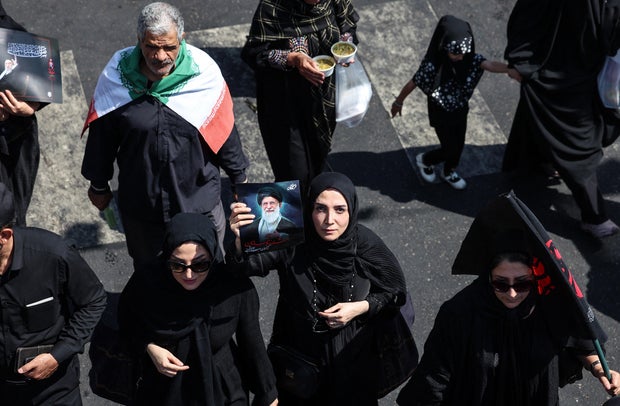
Hezbollah officials have previously called the negotiations "appeasement."
CBS/AFP
Seventh round of U.S.-mediated Lebanon-Israel talks to start in Rome shortly
Lebanon and Israel are set to begin the seventh round of U.S.-mediated direct negotiations in Rome on Tuesday, with the Lebanese delegation seeking additional Israeli withdrawals from southern Lebanon and a halt to Israeli military operations there.
Lebanese officials are hoping the second round of talks hosted in the Italian capital will produce results similar to those achieved during negotiations held on July 14-15, which led to the designation of the first "pilot zones" in southern Lebanon, areas that Lebanese troops would control in hopes of regaining authority in areas previously dominated by Hezbollah.
However, Lebanese officials have expressed concern that Israel may reject Beirut's key demands, particularly additional withdrawals from villages located within a so-called "Yellow Line" that includes more than 60 occupied villages or areas regularly raided by the Israeli army.
Lebanese officials are seeking rapid, phased Israeli pullbacks, a complete cessation of Israeli military activities — including demolitions, land clearing and the burning of homes — and measures to preserve the framework agreement and restore stability in the border region.
Beirut is also relying on Washington to pressure Israel into carrying out additional withdrawals from southern Lebanon, sources told Qatar-based outlet Al-Araby Al-Jadeed.
Aramco chief says Houthi attacks on Saudi Arabia had "no material impact"
The chief executive of Saudi Arabia's state oil firm said Tuesday that recent attacks by Yemen's Houthi rebels had no real effect on the oil giant's production.
Strikes by the Iran-backed group had "no material impact on our capabilities," Aramco president and CEO Amin H. Nasser said during a call with reporters, adding that they included Houthi attacks in July that targeted the company's operations on the Red Sea coast and elsewhere.
Tehran continues indirect diplomacy as Trump offers Iran "last chance" to sign ceasefire deal
Iran's top diplomat Seyed Abbas Araghchi held phone calls with Pakistan and Oman's foreign ministers late Monday, Iranian state media reported.
Araghchi spoke to the two men on the latest developments in the region and ongoing diplomatic efforts, according to the state media reports.
President Trump told reporters Monday that he was giving Iran a "last chance" to sign a ceasefire deal, and called Tehran's leadership "unbelievably duplicitous."
"Unknown projectile" struck cargo ship in Strait of Hormuz, U.K. maritime agency says
A cargo vessel was struck by an "unknown projectile" in the Strait of Hormuz off the coast of Oman, a British maritime agency said on Tuesday, without giving specifics on damage or injuries.
The vessel, which has not been named, reported being "hit by an unknown projectile" and authorities were investigating, the United Kingdom Maritime Trade Operations (UKMTO) said, adding the incident occurred 20 nautical miles (37 kilometers) northeast of Al Khasab, Oman.
Trump says oil companies should cut gas prices after making "too much money" from Iran war
President Trump on Monday urged U.S. oil companies to take action to ease gasoline prices, saying that the energy giants "made too much money" from high oil prices due to the Iran war.
Mr. Trump criticized Chevron and ExxonMobil for profiting from higher oil prices, which have surged as the war largely halted the flow of crude transiting the Strait of Hormuz.
"But they made too much money, too much money. Chevron, too much money. Exxon Mobil, too much. Too much money," Mr. Trump said Monday at the Oval Office during an executive order signing.
The president also predicted that oil prices would "drop through the floor" when the Iran conflict is over.
ExxonMobil declined to comment. Chevron didn't immediately respond to a request for comment.
U.S. military has redirected 44 vessels, CENTCOM says
The U.S. military said on X Monday that it has redirected 44 commercial vessels under its blockade against Iran.
U.S. forces have disabled two vessels and boarded another two, according to CENTCOM.
President Trump said earlier in a Truth Social post that nothing will get through to Iran "unless a Deal, or Total Surrender, is accomplished."
Trump says he wants to give Iran "every last chance before decapitation"
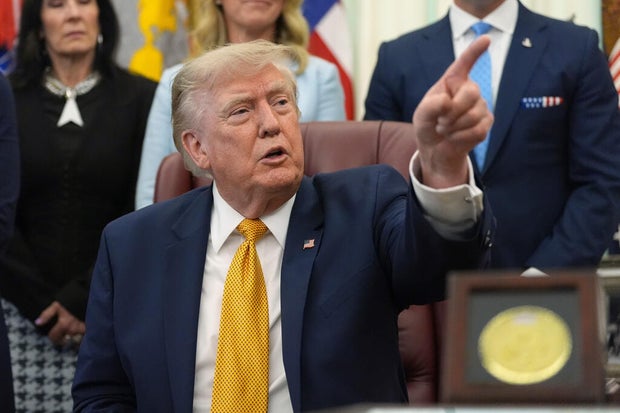
After he again backed down on further attacks against Iran to allow for negotiations, President Trump was asked what his message is to the American people.
"Well, you don't know, I don't know, I think we're going to maybe get something," the president told a reporter in the Oval Office. "But I want to give them every last chance before decapitation. Very tough to do what we have planned, still planned. We'll see what happens."
"I'm very proud of the fact that I will give people, I'll give people a chance," he added.
Trump says Iran talks "will go quickly, one way or the other"
The president told reporters that people will find out "today or tomorrow" about how talks with Iran are going.
"I mean they're going to go quickly, one way or the other. It's not very complex," Mr. Trump said. "We're talking about the strait, the opening of the strait, having it open, literally by tomorrow. Completely open. And that's phase one, and phase two is we then will talk about the nuclear capacity … the denuclearization of Iran."
Iran says it's not talking with the U.S. directly at the moment, although Mr. Trump insisted that talks begin today.
Pakistan invites Iranian foreign minister to Islamabad
Pakistan's Ministry of Foreign Affairs said Monday that Iran's foreign minister has been invited to visit Pakistan.
Pakistan's Deputy Prime Minister and Foreign Minister Mohammad Ishaq Dar spoke on the phone Monday with Iranian Foreign Minister Seyyed Abbas Araghchi "to discuss key regional and international developments."
"They exchanged views on regional and international developments, including the deteriorating situation in Occupied East Jerusalem," the Foreign Ministry said in a post on X. "DPM/FM invited Foreign Minister Araghchi to visit Pakistan at his earliest convenience."
Lebanon to send expanded delegation to Rome for new round of Israel talks, says Al-Araby al-Jadeed
An expanded Lebanese delegation will travel to Rome on Tuesday for the latest round of U.S.-mediated talks with Israel, according to Al-Araby Al-Jadeed, aimed at moving ahead with implementation of the framework agreement signed in Washington on June 26.
The delegation will include diplomats, military officers, legal experts, economists and border specialists to address a broad agenda covering security arrangements, border issues, reconstruction and the economy, according to the report.
The delegation will be headed by Ambassador Simon Karam and include Lebanon's ambassador to Washington, Nada Hamadeh Mouawad, a six-member military delegation, lawyer Antoine Safir, border demarcation expert Najib Massihi, who previously served on Lebanon's maritime border negotiation team with Israel, and Rawaa Harati, the Lebanese president's adviser for economic affairs. The delegation may be expanded further depending on developments, Lebanese official sources told the newspaper.
Beirut is expected to press for a complete halt to Israeli military operations in southern Lebanon and seek agreement on a second "pilot zone" that would pave the way for an Israeli withdrawal from additional occupied towns and the deployment of the Lebanese Army.
Lebanese officials are also expected to call for an end to Israeli demolitions, bulldozing operations and home destruction in the south, warning that continued military activity could undermine the framework agreement and risk renewed escalation.
"I am encouraged that talks in Rome remain ongoing, and I hope both governments reach a successful outcome," said U.S. Ambassador to Lebanon Michel Issa ahead of the talks.
Traffic in Strait of Hormuz and Bab el-Mandeb "remains constrained," says data firm Kpler
Shipping traffic in the Strait of Hormuz and Bab el-Mandeb, the two major Middle East trade chokepoints that have been affected by the Iran war, "remains constrained," data firm Kpler said Monday.
In a post on X, Kpler wrote that on Sunday "Hormuz recorded nine confirmed transits, including two sanctioned and two shadow fleet vessels."
Seven of these used a route established by Iran, the post added, through which shipping companies must coordinate with Tehran and possibly pay a toll.
In the nearby Bab el-Mandeb, the entrance to the Red Sea from the Gulf of Aden, where the Houthis have attacked Saudi vessels, there were "30 crossings, down from 41 on 31 July, with 20 vessels exiting the Red Sea and 10 entering," Kpler wrote. "Until U.S., Iranian and Omani signals converge into clear navigation arrangements, operators should treat both chokepoints as contested rather than normalised."
After repeated threats and pullbacks, Iran's leadership believes Trump doesn't want to expand war
President Trump said over the weekend that appeals from Saudi Arabia, the United Arab Emirates, Qatar and even Iran persuaded him to give diplomacy another chance after warning of a major attack on Iranian energy infrastructure.
They would have been the "biggest attacks since World War II," he said, adding instead that talks between the U.S. and Iran would resume Monday.
Besides the fact that Iranian leadership has already denied there are any plans for U.S.-Iran negotiations, they appear to be growing unconvinced by the president's carrot-and-stick diplomacy.
Back in April, the president warned Tehran to agree to a ceasefire or, as he put it, "a whole civilization will die," only to extend the deadline. He repeated the tactic in May and June.
Sources inside Iran say this has only reinforced a belief among the country's leadership that Mr. Trump is not looking for a wider war, but for leverage in negotiations.
They calculate that they can absorb the pressure and raise the cost to the U.S. through proxies – such as Yemen's Houthis – and threats to global shipping until Washington concludes there is no military way out of this conflict.
Fifty thousand U.S. troops are still deployed in the Middle East for a war that was expected to last no more than six weeks and is now in its sixth month. Eighteen American service members have been killed, and hundreds more wounded; global energy markets remain on edge, and Iran's leadership is firmly in power.
For now, the view from Tehran is that time is on their side.
No new negotiations planned despite Trump comments, U.S. officials tell CBS News
Despite President Trump's comments last night that negotiations with Iran are set to begin on Monday afternoon, U.S. officials have told CBS News that there are no "new" or novel negotiations planned – just the ongoing talks between Middle East envoy Steve Witkoff, Jared Kushner and the U.S. negotiating team with the Iranian team, through mediators.
Iran's foreign ministry spokesperson Esmaeil Baqaei said at a press conference Monday that Tehran had no plans to hold direct talks with Washington, after Mr. Trump's claim that a "deal is imminent."
"To avoid any misunderstanding, it is important to clarify what the current negotiations are about and who they are with. We are not negotiating with the United States at this time," Baghein said.
"Our negotiations are with Oman and are focused on reaching an understanding on a route that will ensure the safe passage of shipping through the Strait of Hormuz," he said.
Trump says Iran begged for talks, calls leadership "unbelievably duplicitous"
President Trump has responded to Tehran's dismissal of his claim that U.S.-Iran talks were set to restart Monday, calling the country's leadership "unbelievably duplicitous" and saying they begged for talks.
Mr. Trump said on Sunday that he had called off massive strikes on Iran because Gulf allies and Tehran had asked him to give diplomacy a chance, adding that U.S.-Iran talks would resume Monday afternoon and that a "deal is imminent."
Iran on Monday denied that any talks were planned and said it was only in negotiations with Oman at the moment, to discuss the future of the Strait of Hormuz.
In a post on his Truth Social platform Monday, Mr. Trump wrote: "Iranian Leadership is unbelievably duplicitous! They ask for a meeting, some would say 'beg,' talks begin, with more scheduled in the immediate future, and they say, openly and proudly, that they're not having any discussions, that nothing is being talked about, and they're only dealing with 'Oman.'"
"Nothing gets through to Iran, unless we want it to, and nothing will get through, unless a Deal, or Total Surrender, is accomplished," he added. "Whether Iran wants to admit it or not, we are, in fact, talking of a solution to a problem that they have caused, for decades. It is very simple, IRAN WILL NEVER HAVE A NUCLEAR WEAPON!"
Israel "will not retreat from its current stance" in Gaza, senior Israeli political source tells CBS News
Israel "will not retreat from its current stance" in Gaza, a senior Israeli political source told CBS News, after Hamas said Israeli escalation in the enclave was threatening negotiations.
Israel on Monday said it had conveyed its "comments and concerns" to the U.S. on the next phase of a Gaza peace plan as it kept up strikes on the Palestinian territory. Mr. Trump touted the plan last week, saying it includes the disarmament of Hamas, one of Iran's main proxy groups in the region.
A senior Hamas leader told Qatari state media Al Jazeera on Monday that the movement has contacted mediators over what it described as a recent Israeli escalation in Gaza, urging them to take action to halt further attacks.
Palestinian officials said at least 13 Gazans were killed in Israeli strikes over the weekend, including several children, according to CBS News' partner network The BBC.
"The movement demanded that the mediators intervene directly to compel the occupation to completely halt the ceasefire violations," the Hamas leader said, referring to Israel. "We confirmed to the mediators that the continuation of the attacks obstructs the implementation of the agreement and negotiations over the timetable."
But speaking later Monday to CBS News, a senior Israeli political source said Israel "will not retreat from its current stance in the Gaza Strip and will continue to thwart any threat to our citizens and soldiers."
Iraqi politician claims Baghdad is mediating between Iran and the U.S.
An Iraqi politician has claimed that Baghdad has been mediating between Iran and the U.S., according to Iranian state news agency IRNA.
Meysar al-Shammari, a leader in the National Wisdom Movement political party, said Iraqi Prime Minister Ali al-Zeidi carried messages from the U.S. to Tehran after a recent visit to the White House.
Al-Zeidi "is advancing diplomatic efforts to play a mediating role and bring the views of the Islamic Republic of Iran and the United States closer, with the aim of containing regional tensions and preventing the expansion of the scope of the conflict," al-Shammari said.
The Iraqi politician added that after the prime minister's recent visit to the U.S., al-Zeidi carried messages from the U.S. to Tehran, without going into specifics.
U.S. stocks boosted by drop in oil prices
Wall Street stocks bounced early Monday after Mr. Trump held off on new attacks on Iran, pressuring oil prices.
Mr. Trump, who had last week threatened severe attacks on Iran, said Saturday that the "perimeters" of a deal were present, although Iranian officials denied that there were ongoing talks with the U.S.
Oil prices fell more than 5%.
About 15 minutes into trading, the Dow Jones Industrial Average was up 1.1% at 53,072.36.
The broad-based S&P 500 advanced 0.6% to 7,535.94, while the tech-rich Nasdaq Composite Index jumped 0.8% to 25,566.98.
"Obviously the market likes hearing that there may be some progress in the Persian Gulf," said Steve Sosnick of Interactive Brokers. "We've heard this news before and it hasn't led to much, but the market always seems optimistic when they hear something of this type."
AFP
Tehran executes 2 men accused of spying for Israel, Iran's judiciary media reports
Iran has executed two men accused of providing sensitive military and security information to Israel's Mossad intelligence service, the judiciary's Mizan News Agency reported.
According to the report, Omid Behzad and Pouria Safvat were convicted of espionage and intelligence cooperation with Israel after allegedly sending coordinates, images, and information about sensitive locations to Mossad-linked channels and networks.
Mizan reported that Behzad had sent coordinates and information related to military, security, and law enforcement sites. Safvat was accused of providing images and location details of sensitive facilities to channels linked to Israel, including Iran International, a Saudi-funded opposition TV channel based in the U.K.
The judiciary's media outlet said the two men's death sentences were issued after investigations, court proceedings, approval by the Supreme Court, and completion of legal procedures. Their executions were carried out last Wednesday, according to the report.
The allegations and details of the case have not been independently verified.
Iranian State TV aired footage showing supposed confessions from the two men, as well as alleged message exchanges with their Israeli handlers.
Oil prices slide on hopes of deal to end Iran war
Oil prices tumbled Monday after Mr. Trump said he was preparing for new talks with Iran aimed at ending the war in the Middle East, which also helped lift stocks.
Crude futures slid more than 6%, even though Iran denied that any negotiations were taking place.
Despite falling on Monday, oil prices remain well above levels seen before the U.S. and Israel launched strikes against Iran in late February, sparking a war that has sharply curtailed Gulf exports of oil and other key products.
Mr. Trump said the latest U.S.-Iran negotiations would cover the Strait of Hormuz, which has become a main sticking point in the conflict, and "ultimately, the denuclearization of Iran."
His announcement came after he threatened to hit Iran "very hard" and was reportedly considering renewed attacks, including against energy infrastructure.
He pulled back from that threat on Saturday, saying the "perimeters" of a deal were there.
The decline in oil prices was aided by an agreement between Saudi Arabia, Russia and five other OPEC+ members to boost production by 188,000 barrels a day from September, analysts said.
CBS/AFP
Israel shares "comments and concerns" with the U.S. over Hamas disarmament deal
Israel said Monday it had conveyed its "comments and concerns" to the United States on the next phase of a Gaza peace plan as it kept up strikes on the Palestinian territory. President Trump touted the plan last week, saying it includes disarmament of Hamas, one of Iran's main proxy groups in the region.
It marks the latest sign of friction between Mr. Trump and Israeli Prime Minister Benjamin Netanyahu, who faces a tough reelection fight in October and has heavily promoted his relationship with the U.S. leader, whom he met again last week.
Netanyahu's office demanded more concrete disarmament by Hamas, which on Friday announced it would give up weapons under a Trump administration plan but to a nascent Palestinian governing committee.
"Israel has conveyed its comments and concerns on the proposed framework to our American counterparts. The version that has been made public does not reflect Israel's positions," Doron Spielman, spokesman for the prime minister's office, told CBS News.
He said that Israeli intelligence had found that Hamas had been rearming and recruiting forces since a ceasefire announced by the president in October.
CBS/AFP
Iran threatens to take "necessary measures" after Ukrainian attack on ship in Caspian Sea
Tehran threatened to take "necessary measures" after Ukraine attacked an Iranian commercial vessel in the Caspian Sea, the country's foreign ministry said Monday.
"Ukrainian officials … stressed that the incident was unintentional," Iran's foreign ministry spokesperson Esmail Baghaei said, referring to the July 25 strike that killed one soldier and wounded another. "However, the evidence and circumstances are quite clear. Among them are the explicit statements made by the President of Ukraine, which indicate that the attack was deliberate."
Ukraine's President Volodymyr Zelenskyy said last week that he didn't want to open a "new front" with the attack on the ship, but said Iran had "already attacked us," referring to Iran supplying Russia with attack drones.
"We have heard the explanations provided by the Ukrainian authorities, and we are waiting to see whether they will take practical steps that substantiate and confirm their claim that this crime was unintentional," Baghaei added.
"We will certainly take whatever measures are necessary, both to hold Ukraine accountable and to ensure that such a mistake and crime is not committed again by the Ukrainian side."
Iran's foreign minister holds second round of calls with Saudi, Pakistani leaders in 24 hours
Iran's foreign minister Abbas Araghchi has held a second round of phone calls with Saudi and Pakistani leaders in 24 hours, according to Iran's foreign ministry.
Araghchi spoke to his Saudi counterpart, Prince Faisal bin Farhan, and Pakistan's chief of staff, Gen. Asim Munir, the ministry said on Sunday.
"The parties reviewed and exchanged views on the latest diplomatic efforts and initiatives aimed at preserving and strengthening security and stability in the West Asia region," the ministry added, without giving specifics.
Iran says its only current talks are with Oman on the Strait of Hormuz
Iran said Monday that its only current negotiations are with Oman to discuss the future of the Strait of Hormuz.
Denying President Trump's claim that the U.S. and Iran would restart negotiations on Monday, Foreign Ministry Spokesperson Esmaeil Baqaei said: "Our negotiations are with Oman and are focused on reaching an understanding on a route that will ensure the safe passage of shipping through the Strait of Hormuz."
"Our goal is to determine, as soon as possible and in consultation with Oman, a route that will likely be temporary and will enable safe maritime navigation through the Strait," he added.
The two countries have had "constructive discussions over the past eight days regarding reaching an agreement on a new route," he said, which would have "both an inbound and outbound route, not two or three separate routes."
"This middle route is intended to be used temporarily until an agreement is reached on a permanent route," he said.
Iran has insisted that ships navigating through the waterway should use a route designated by them after requesting permission and paying service fees.
Tehran's stranglehold on the strategic waterway — through which roughly one-fifth of the world's oil and natural gas passed before the war — has put pressure on President Trump: Rising energy prices have hurt Americans at the pump and made the war unpopular, but walking away now, without any real gains from the conflict, would make the president look weak.
Baqaei said Sunday that the status quo in the strait "will in no way return to the status it was before February 28th," the day the war started.
Iran says no direct negotiations taking place with U.S.
Iran's foreign ministry spokesperson Esmaeil Baqaei said at a press conference Monday that Tehran had no plans to hold direct talks with Washington.
"To avoid any misunderstanding, it is important to clarify what the current negotiations are about and who they are with. We are not negotiating with the United States at this time," Baqaei said.
"Our negotiations are with Oman and are focused on reaching an understanding on a route that will ensure the safe passage of shipping through the Strait of Hormuz," he said.
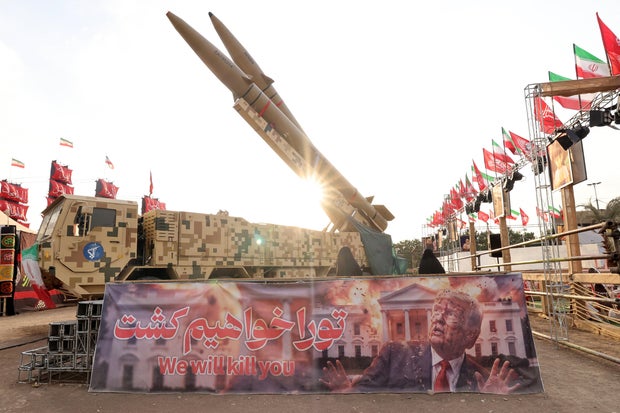
President Trump said Sunday that negotiations with Iran were set to begin Monday afternoon.
Speaking to reporters aboard Air Force One, Mr. Trump elaborated on the decision to hold off on attacks on Iran and again said it would have been the "biggest attacks since World War II."
"It would have been disastrous for them and they didn't want us to do it," he said. "The deal is imminent, having to do with the Hormuz Strait and also, ultimately, the denuclearization of Iran."
Iran says Strait of Hormuz will never have its pre-war status again
Iran's Foreign Ministry spokesperson Esmail Baghaei said on Sunday that the Strait of Hormuz "will in no way return to the status it was before February 28th," the day the war started.
On a call with Iranian state TV, he added that Iran is discussing shipping through the strait with Oman, on the other side of Hormuz, but that there's no current talk about reopening the crucial waterway.
President Trump has announced halts to strikes on Iran on several occasions since the United States and Israel attacked Iran on Feb. 28, only for things to unravel and fighting to resume again.
Iran's defense minister said on X that the country was "neither surprised nor passive" following Mr. Trump's announcement that he had called off new strikes on Iran and said the Islamic Republic remains alert in the face of concrete threats from the U.S.
While Iran's leaders appear united in a war strategy signaling strength and endurance, a struggle for control seems to be brewing within the theocracy's leadership between those who oppose all negotiations with the U.S. and others who count on military pressure to win at the negotiating table.
The Associated Press
Trump threatens major attack, then claims U.S.-Iran talks to resume
President Trump said Sunday that negotiations with Iran are set to begin Monday afternoon.
Speaking to reporters aboard Air Force One, Mr. Trump elaborated on his decision to hold off attacks on Iran and again said they would have been the "biggest attacks since World War II."
"It would have been disastrous for them and they didn't want us to do it," he said. "The deal is imminent, having to do with the Hormuz Strait and also, ultimately, the denuclearization of Iran."
The president confirmed he spoke with Saudi Arabia's crown prince who, according to Mr. Trump, told the president he'd prefer to make a deal with Iran.
The president said Saturday he canceled the attack on Iran because a rough framework of a deal had been reached.
"We have just been asked by Iran, and other Middle Eastern Countries, to hold off any attack in that the perimeters [sic] of a deal has been agreed to," Mr. Trump wrote on his Truth Social platform.
Mr. Trump said the deal "would include the Immediate, Complete, and Total OPENING OF THE HORMUZ STRAIT, and an end to Iran's nuclear threat."
Multiple sources Friday had told CBS News that the U.S. and Israel were preparing to conduct a powerful joint bombing campaign on energy infrastructure targets in Iran.
Trump administration touts its transparency, yet few details of the Iran war have been shared
In his first month on the job, Defense Secretary Pete Hegseth promised it "would be the most transparent administration ever," offering a sharp contrast with the previous wars in Iraq and Afghanistan that critics said had been shrouded in secrecy and misleading public statements.
Now, as the American-led war against Iran enters its sixth month, the administration is offering the public less information about the conflict and its direction, even as the costs continue to mount.
More than 50,000 American troops remain deployed in the Middle East. Some 18 U.S. service members are dead, and hundreds more are injured or wounded. Mr. Trump has launched several efforts at diplomacy with Iran, most recently this weekend. And Congress has been asked to approve another $67 billion to cover the costs of the campaign.
Yet Pentagon press briefings to reporters and the public have largely disappeared — the last one was in early May.